

What Is Freezing Point Depression?
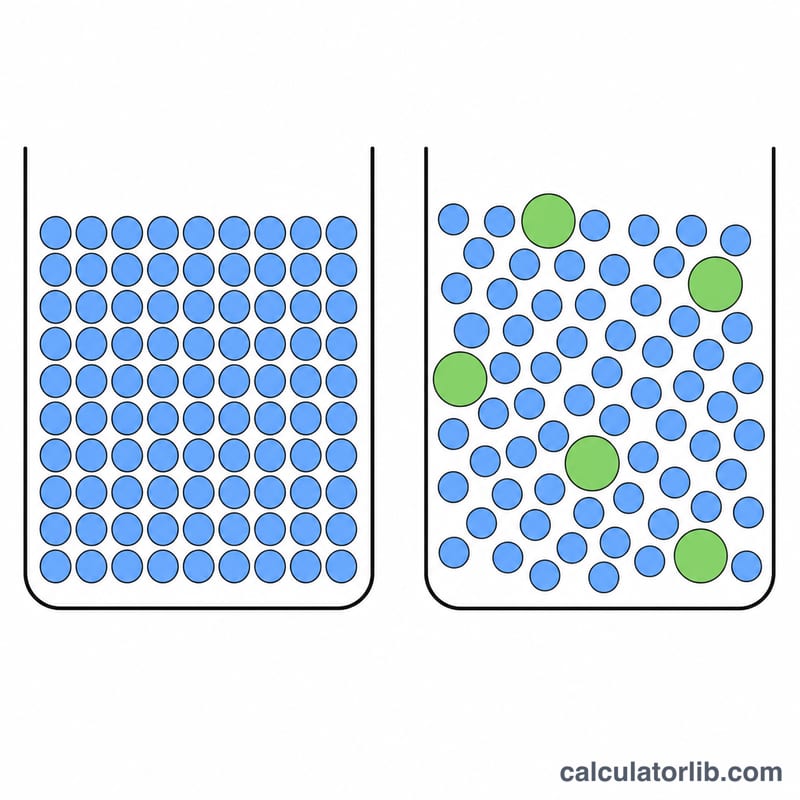
Freezing point depression is a colligative property: dissolving a solute in a solvent lowers the temperature at which that solvent freezes. The more dissolved particles present, the larger the drop. This calculator uses the standard relationship $$\Delta T_f = \text{i} \cdot \text{K}_f \cdot \text{m}$$ to find how many degrees the freezing point falls, and optionally the resulting freezing temperature.
How to Use This Calculator
Enter the three quantities: the van 't Hoff factor (\(i\)), the cryoscopic constant (\(K_f\)) of the solvent, and the molality (\(m\)) of the solution. Optionally enter the pure solvent's normal freezing point to get the new freezing point. Click calculate to see \(\Delta T_f\) in °C and the depressed freezing point.
The Formula Explained
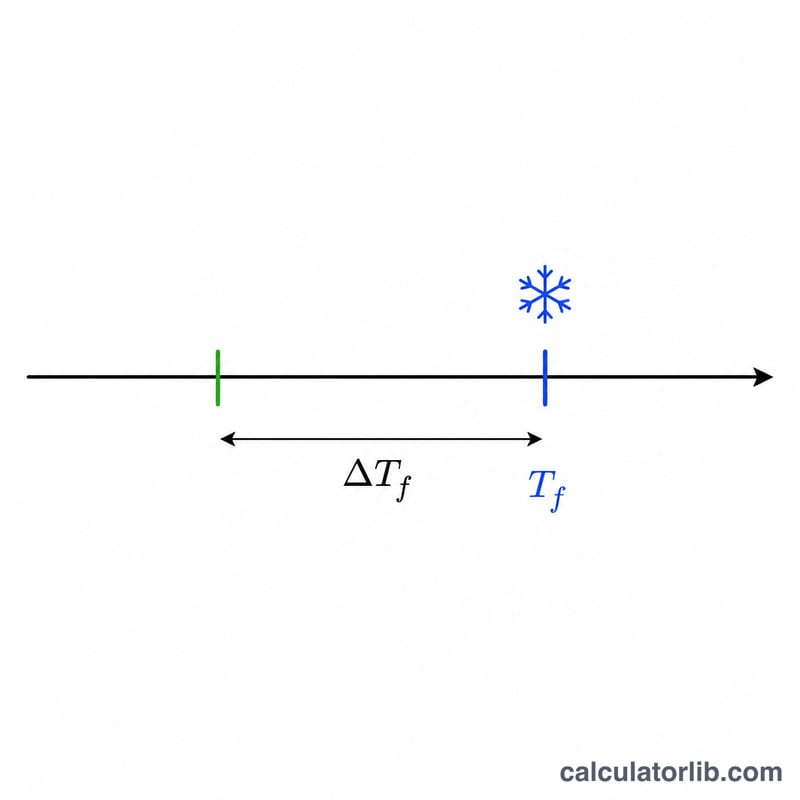
\(\Delta T_f\) is the change in freezing temperature. The van 't Hoff factor \(i\) is the number of particles a formula unit splits into: 1 for non-electrolytes like sugar, ≈2 for NaCl, ≈3 for CaCl₂. \(K_f\) is a property of the solvent (water = 1.86 °C·kg/mol). \(m\) is molality, moles of solute per kilogram of solvent. Multiplying them gives the temperature drop. The new freezing point is the pure solvent value minus \(\Delta T_f\):
$$T_f = \text{T}_{f,0} - \text{i} \cdot \text{K}_f \cdot \text{m}$$
Worked Example
Dissolve 1 mol of NaCl per kilogram of water. NaCl dissociates into Na⁺ and Cl⁻, so \(i \approx 2\). With \(K_f = 1.86\) and \(m = 1\): $$\Delta T_f = 2 \times 1.86 \times 1 = 3.72 \ ^\circ\text{C}.$$ Starting from water's freezing point of 0 °C, the solution freezes at \(0 - 3.72 = -3.72 \ ^\circ\text{C}\).
FAQ
What is the van 't Hoff factor? It is the effective number of dissolved particles per formula unit. Use 1 for molecular solutes and the number of dissociated ions for ionic compounds.
What is Kf for water? The cryoscopic constant of water is 1.86 °C·kg/mol. Benzene is 5.12 and camphor is about 40.
Why use molality instead of molarity? Molality is based on mass of solvent, which does not change with temperature, making it ideal for colligative property calculations.