
What this pH calculator does
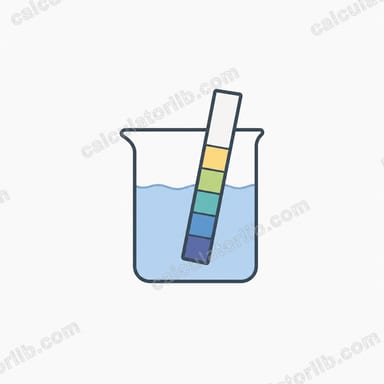
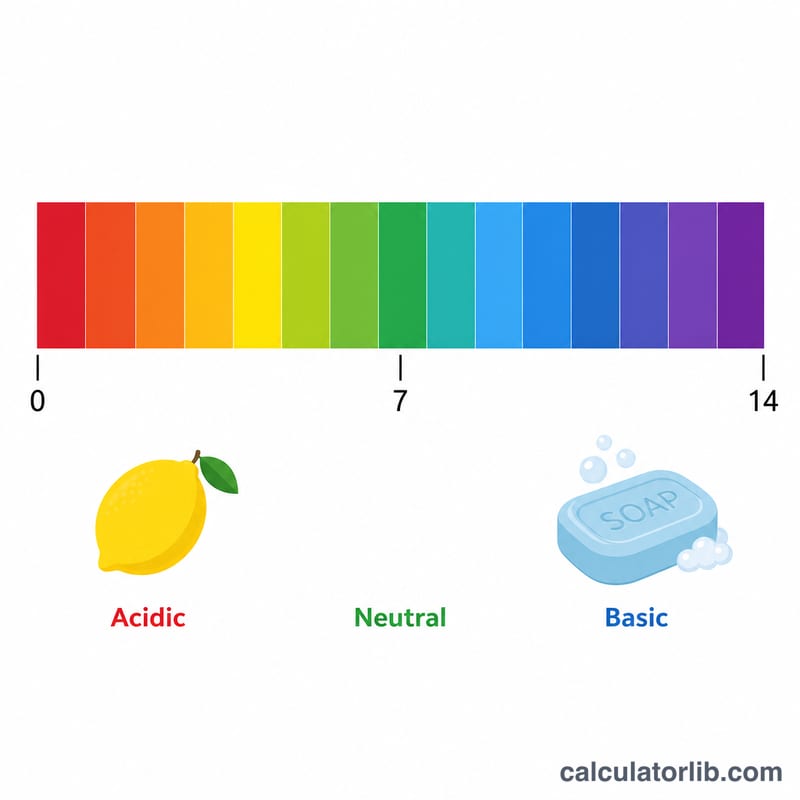
This tool estimates the pH and pOH of aqueous solutions of strong acids, weak acids, strong bases, and weak bases. pH measures how acidic or basic a solution is on a scale from 0 (very acidic) to 14 (very basic), with 7 being neutral at 25 °C. Enter the concentration and, for weak species, the acid (Ka) or base (Kb) dissociation constant.
How to use it
Pick the solution type, type the molar concentration C in mol/L, and for weak acids or bases enter the dissociation constant. The calculator returns pH, pOH, and a quick acidic/basic/neutral label. The relationship \(\text{pH} + \text{pOH} = 14\) is used throughout (valid at 25 °C).
The formula explained
A strong acid dissociates completely, so the hydrogen ion concentration equals the formal concentration: \([\text{H}^+] = C\) and $$\text{pH} = -\log_{10}\left(\text{C}\right)$$ A weak acid only partially ionizes; using the equilibrium expression and the simplifying assumption that ionization is small, \([\text{H}^+] \approx \sqrt{\text{K}_a \cdot \text{C}}\), giving $$\text{pH} = -\log_{10}\left(\sqrt{\text{K}_a \cdot \text{C}}\right)$$ Bases are handled symmetrically using \([\text{OH}^-]\) and pOH, then \(\text{pH} = 14 - \text{pOH}\).
Worked example
For a 0.01 mol/L solution of a strong acid like HCl: $$\text{pH} = -\log_{10}\left(0.01\right) = 2$$ For 0.1 mol/L acetic acid with \(\text{K}_a = 1.8 \times 10^{-5}\): $$[\text{H}^+] = \sqrt{1.8 \times 10^{-5} \times 0.1} = \sqrt{1.8 \times 10^{-6}} \approx 0.00134$$ so \(\text{pH} \approx 2.87\).
FAQ
Is the weak-acid formula exact? No. It assumes the amount ionized is negligible compared with C. For very dilute or fairly strong weak acids the approximation drifts, and the full quadratic should be used.
Does temperature matter? Yes. The neutral point of 7 and the \(\text{pH} + \text{pOH} = 14\) rule hold at 25 °C. At other temperatures the ion product of water changes.
What units should C be in? Molar concentration, mol/L (M).