
What this calculator does
This tool estimates the pH of a weak base solution using the base dissociation constant (Kb) and the initial molar concentration of the base. Weak bases such as ammonia (NH₃) only partially ionize in water, so their pH cannot be read directly from the concentration the way a strong base can. Instead, an equilibrium calculation is required.
How to use it
Enter the base dissociation constant Kb (for example 1.8×10⁻⁵ for ammonia) and the initial concentration C in moles per litre. The calculator returns the hydroxide ion concentration, the pOH, and finally the pH. Values above 7 indicate a basic (alkaline) solution.
The formula explained
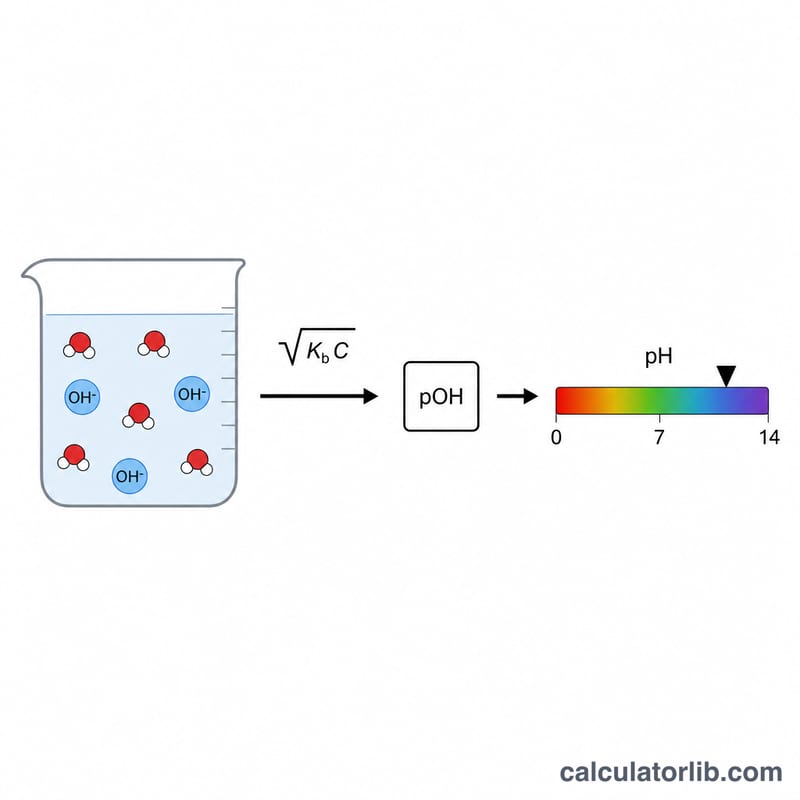
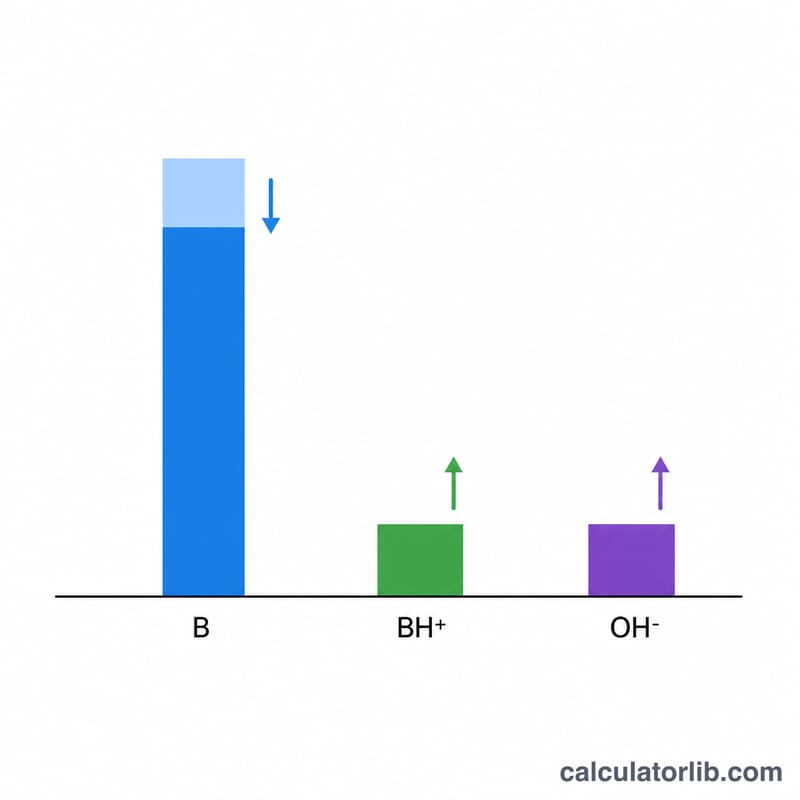
For a weak base B reacting with water (B + H₂O ⇌ BH⁺ + OH⁻), the equilibrium expression is \(\text{K}_b = \frac{[\text{BH}^+][\text{OH}^-]}{[\text{B}]}\). Assuming the amount that ionizes is small compared with C, the equation simplifies to \(\text{K}_b \approx \frac{x^2}{\text{C}}\), where \(x = [\text{OH}^-]\). Solving gives the standalone result
$$[\text{OH}^-] = \sqrt{\text{K}_b \cdot \text{C}}$$We then compute \(\text{pOH} = -\log_{10}[\text{OH}^-]\) and \(\text{pH} = 14 - \text{pOH}\) (valid at 25 °C, where the water constant \(\text{pK}_w = 14\)).
Worked example
For 0.1 M ammonia with \(\text{K}_b = 1.8\times10^{-5}\):
$$[\text{OH}^-] = \sqrt{1.8\times10^{-5} \times 0.1} = \sqrt{1.8\times10^{-6}} \approx 1.342\times10^{-3}\ \text{mol/L}$$Then \(\text{pOH} = -\log(1.342\times10^{-3}) \approx 2.872\), so \(\text{pH} = 14 - 2.872 \approx 11.13\) — a moderately basic solution.
FAQ
Is this approximation always valid? The \(\sqrt{\text{K}_b \cdot \text{C}}\) shortcut assumes ionization is less than about 5% of C. For very dilute or very weak bases, a full quadratic solution is more accurate.
Why pH = 14 − pOH? At 25 °C, \(\text{pH} + \text{pOH} = \text{pK}_w = 14\). At other temperatures \(\text{pK}_w\) changes slightly.
What units does concentration use? Moles per litre (molarity, M). Kb is dimensionless as entered here.