
What This Calculator Does
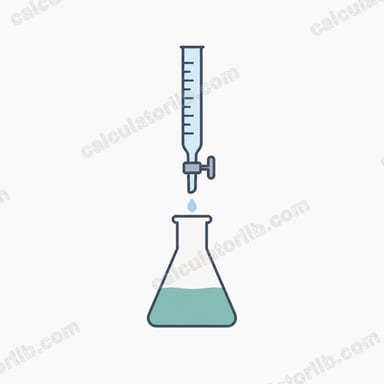
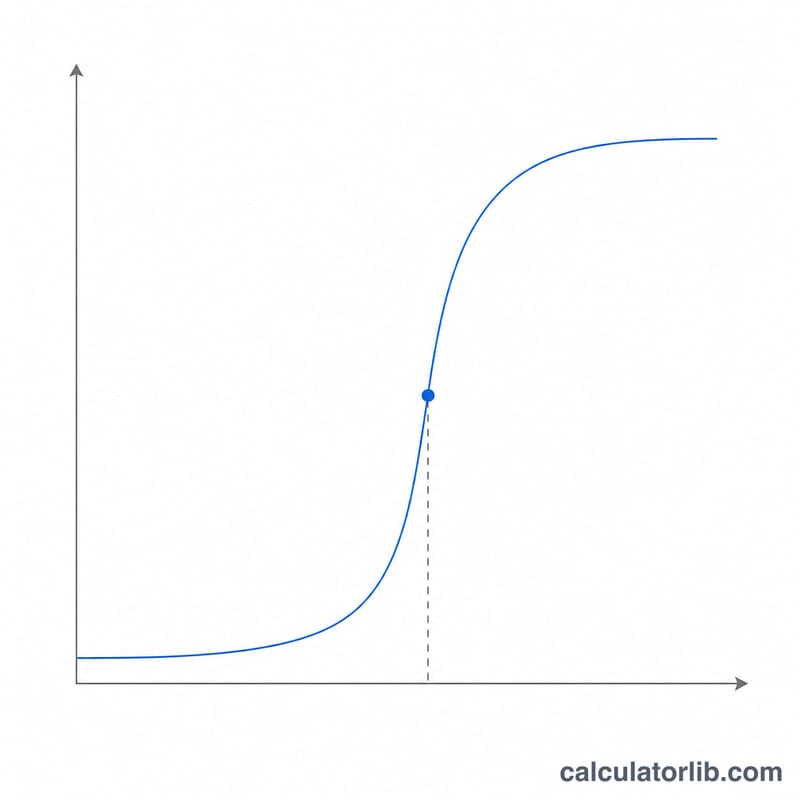
The Acid-Base Titration Volume Calculator finds the volume of titrant required to reach the equivalence point of a titration. The equivalence point is the moment when the moles of titratable hydrogen ions (H+) supplied by the acid exactly equal the moles of hydroxide ions (OH-) supplied by the base. Knowing this volume lets you predict where the indicator color change or the steep section of a pH curve should occur.
How to Use It
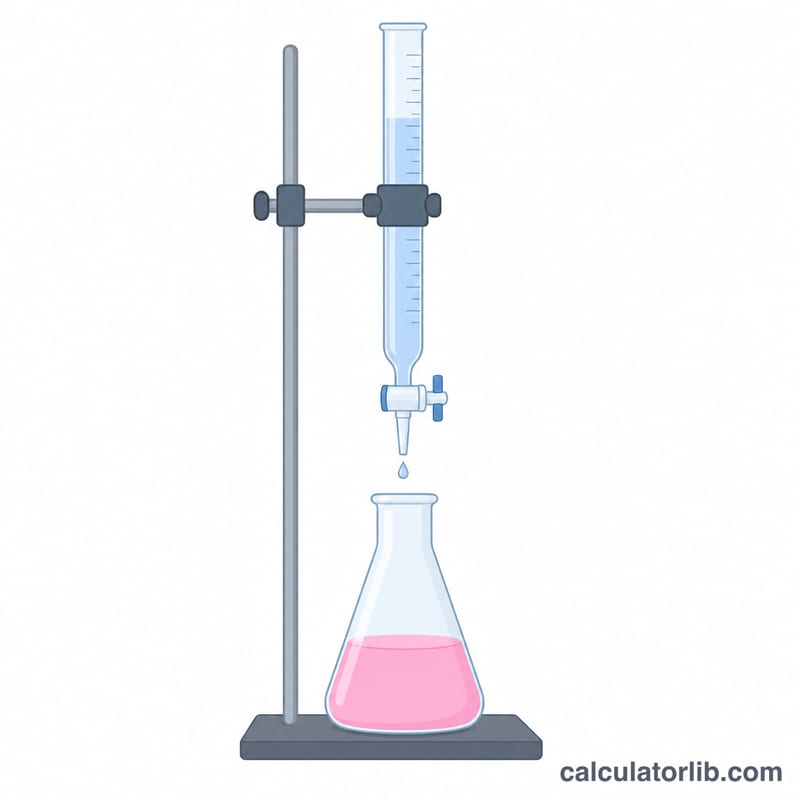
Enter the volume (\(V_a\)) and concentration (\(C_a\)) of the analyte you placed in the flask, along with its number of reactive protons or hydroxides per molecule (\(n_a\)). Then enter the titrant concentration (\(C_b\)) and its reactive proton/hydroxide count (\(n_b\)). The calculator returns the titrant volume \(V_b\) in milliliters, plus the moles of analyte and titrant involved. For a monoprotic acid neutralized by a monobasic base, set \(n_a = n_b = 1\). For diprotic acids such as H2SO4 use \(n_a = 2\).
The Formula Explained
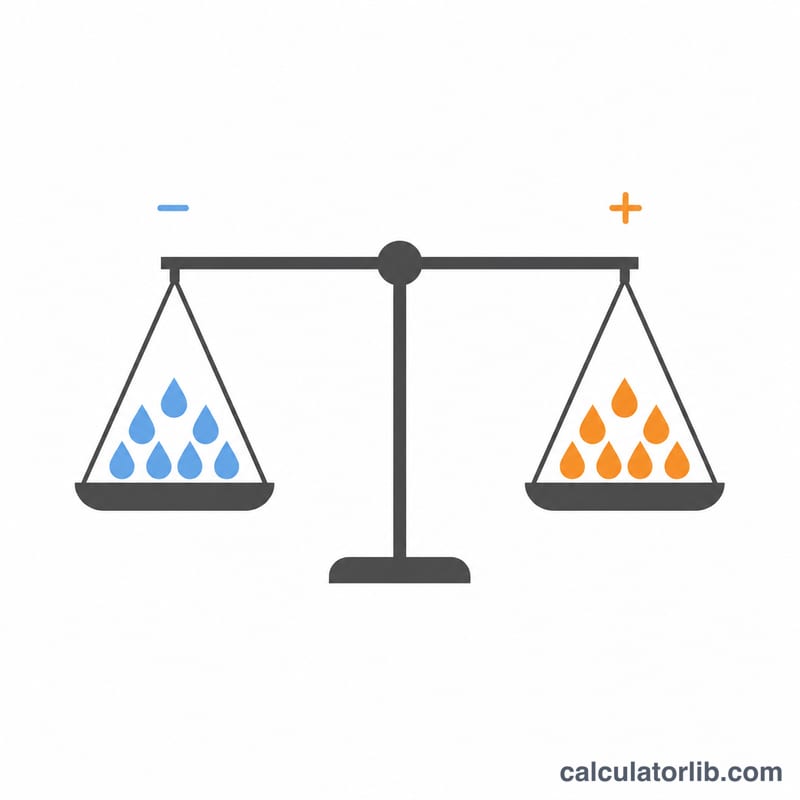
The balance condition is $$V_a \cdot C_a \cdot n_a = V_b \cdot C_b \cdot n_b$$ Each side equals the equivalents of reactive species: concentration times volume gives moles, and multiplying by the n-factor gives equivalents. Rearranging for the unknown titrant volume gives $$V_b = \dfrac{V_a \cdot C_a \cdot n_a}{C_b \cdot n_b}$$ The volume unit of \(V_a\) simply carries through to \(V_b\), so entering \(V_a\) in mL returns \(V_b\) in mL.
Worked Example
You titrate 25 mL of 0.1 mol/L HCl (\(n_a = 1\)) with 0.1 mol/L NaOH (\(n_b = 1\)). $$V_b = \frac{25 \times 0.1 \times 1}{0.1 \times 1} = 25 \text{ mL}$$ If instead you titrate 25 mL of 0.1 mol/L H2SO4 (\(n_a = 2\)) with the same NaOH, $$V_b = \frac{25 \times 0.1 \times 2}{0.1 \times 1} = 50 \text{ mL}$$ because each acid molecule donates two protons.
Common Acids and Bases with Their n-Factors
The n-factor (\(n_a\) for the acid, \(n_b\) for the base) is the number of reactive protons (\(\text{H}^+\)) an acid can donate, or the number of hydroxide ions (\(\text{OH}^-\)) or equivalent base units released, per formula unit in a complete neutralization. It directly scales the equivalence-point relationship \(V_a C_a n_a = V_b C_b n_b\).
| Reagent | Formula | Type | n-factor |
|---|---|---|---|
| Hydrochloric acid | HCl | Monoprotic acid | 1 |
| Nitric acid | HNO₃ | Monoprotic acid | 1 |
| Acetic acid | CH₃COOH | Monoprotic acid | 1 |
| Sulfuric acid | H₂SO₄ | Diprotic acid | 2 |
| Phosphoric acid | H₃PO₄ | Triprotic acid | 3 (full neutralization) |
| Oxalic acid | H₂C₂O₄ | Diprotic acid | 2 |
| Sodium hydroxide | NaOH | Monobasic base | 1 |
| Potassium hydroxide | KOH | Monobasic base | 1 |
| Calcium hydroxide | Ca(OH)₂ | Dibasic base | 2 |
| Sodium carbonate | Na₂CO₃ | Dibasic (diacidic) base | 2 (to H₂CO₃ endpoint) |
Note: polyprotic species such as H₃PO₄ and Na₂CO₃ have more than one equivalence point. The n-factor you use should match the specific equivalence point being titrated to (e.g. n = 1 for the first endpoint of H₃PO₄, n = 2 for the second).
Titrant Volume Across Different Scenarios
The required titrant volume follows \(V_b = \dfrac{V_a \cdot C_a \cdot n_a}{C_b \cdot n_b}\). The table below shows how analyte volume, concentration, n-factor, and titrant strength change the volume needed to reach the equivalence point.
| Analyte (acid) | Vₐ (mL) | Cₐ (M) | nₐ | Titrant (base) | C_b (M) | n_b | V_b (mL) |
|---|---|---|---|---|---|---|---|
| HCl (monoprotic) | 25.0 | 0.100 | 1 | NaOH | 0.100 | 1 | 25.0 |
| HCl (dilute analyte) | 25.0 | 0.050 | 1 | NaOH | 0.100 | 1 | 12.5 |
| H₂SO₄ (diprotic) | 25.0 | 0.100 | 2 | NaOH | 0.100 | 1 | 50.0 |
| H₃PO₄ (triprotic, full) | 20.0 | 0.100 | 3 | NaOH | 0.100 | 1 | 60.0 |
| HCl + concentrated titrant | 25.0 | 0.100 | 1 | NaOH | 0.500 | 1 | 5.0 |
| HCl titrated with Ca(OH)₂ | 30.0 | 0.100 | 1 | Ca(OH)₂ | 0.100 | 2 | 15.0 |
Key patterns: doubling the analyte n-factor (monoprotic → diprotic) doubles the titrant volume, while doubling the titrant concentration or n-factor halves it.
Definitions & Glossary
- Analyte
- The substance of unknown (or to-be-confirmed) concentration that is being measured — in an acid–base titration, the acid or base placed in the flask.
- Titrant
- The reagent of accurately known concentration delivered from a burette to react with the analyte.
- Equivalence point
- The point at which the moles of titrant added are stoichiometrically equal to the moles of analyte, i.e. \(V_a C_a n_a = V_b C_b n_b\). It is a theoretical/chemical point defined by the reaction stoichiometry.
- Endpoint
- The observed point where an indicator changes color (or an instrument signals completion). A well-chosen indicator makes the endpoint coincide closely with the equivalence point; any small difference is the titration (indicator) error.
- n-factor (nₐ / n_b)
- The number of reactive H⁺ ions an acid donates (nₐ) or OH⁻ ions / equivalents a base accepts or releases (n_b) per formula unit in the reaction. HCl and NaOH have n = 1; H₂SO₄ and Ca(OH)₂ have n = 2.
- Equivalents
- A measure of reactive capacity equal to moles × n-factor. At the equivalence point the equivalents of acid equal the equivalents of base.
- Molarity (M)
- Concentration expressed as moles of solute per litre of solution (mol/L). The Cₐ and C_b values in the titration formula are molarities.
FAQ
What is na and nb? They are the number of acidic protons (for an acid) or hydroxide ions (for a base) per formula unit that participate in the neutralization.
Does this assume a strong acid/base? The stoichiometric volume is the same for weak and strong reactants; only the shape of the pH curve and the indicator choice differ. This calculator gives the equivalence-point volume in all cases.
Can I use liters instead of mL? Yes. The result volume comes out in whatever volume unit you used for \(V_a\).