
What This Calculator Does
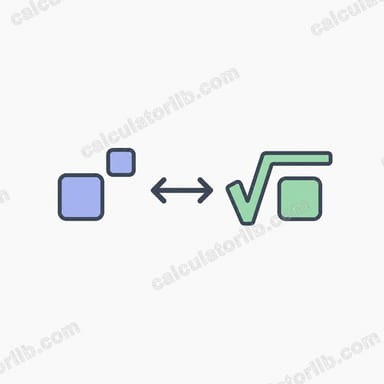
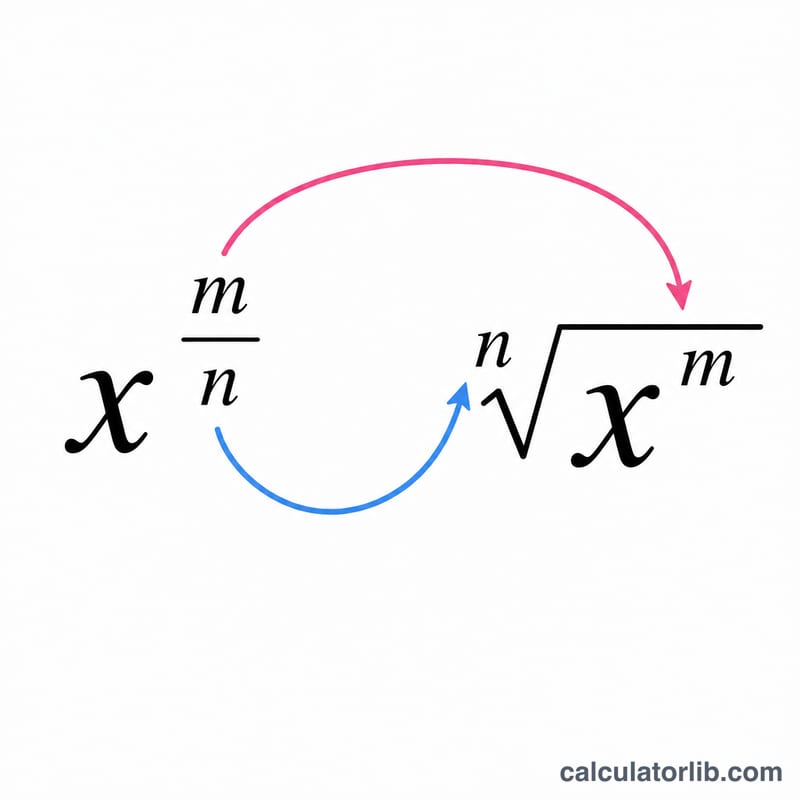
This tool converts between exponential form and radical form and evaluates the result. A rational (fractional) exponent and a radical (root) are two ways of writing the same quantity. Given a base x, a numerator m, and a denominator n, the expression \(x^{m/n}\) is identical to the nth root of x raised to the power m.
How to Use It
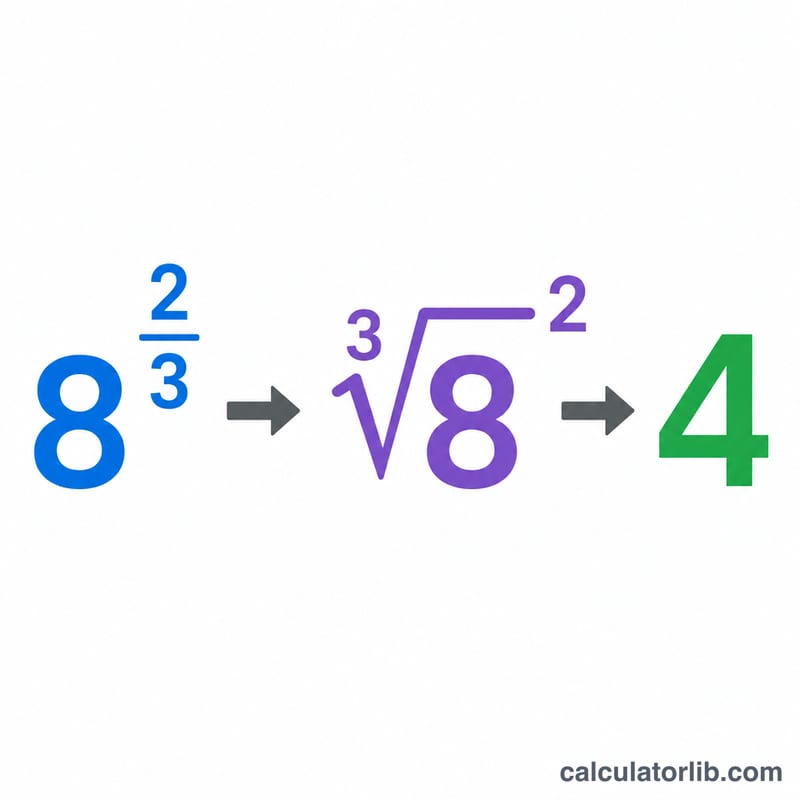
Enter the base x, the exponent numerator m, and the denominator n (which becomes the root index). The calculator shows both the exponential form and the equivalent radical form, then evaluates the numeric value. For example, the input base 8, numerator 2, denominator 3 produces the radical form "cube root of 8 squared" and the value 4.
The Formula Explained
The conversion rule is $$x^{\frac{m}{n}} = \sqrt[n]{x^{m}}$$ The denominator of the fractional exponent tells you which root to take, and the numerator tells you the power. You can apply them in either order: take the root first, \(\sqrt[n]{x}\), then raise to m, or raise to m first, then take the nth root. Both give the same real result when the base is positive.
Worked Example
Convert \(16^{3/4}\). Here \(x = 16\), \(m = 3\), \(n = 4\). In radical form this is the 4th root of 16 cubed, or \((\sqrt[4]{16})^{3}\). Since \(\sqrt[4]{16} = 2\), we get $$2^{3} = 8.$$ So \(16^{3/4} = 8\).
FAQ
What does the denominator mean? The denominator n is the index of the root — \(n = 2\) is a square root, \(n = 3\) is a cube root, and so on.
Can the base be negative? Negative bases only give real results for odd root indices; even roots of negatives are not real numbers.
Is \(x^{m/n}\) the same as \((x^{m})^{1/n}\)? Yes. For positive bases the order of taking the root and the power does not change the answer.