
What Is Exponential Growth?
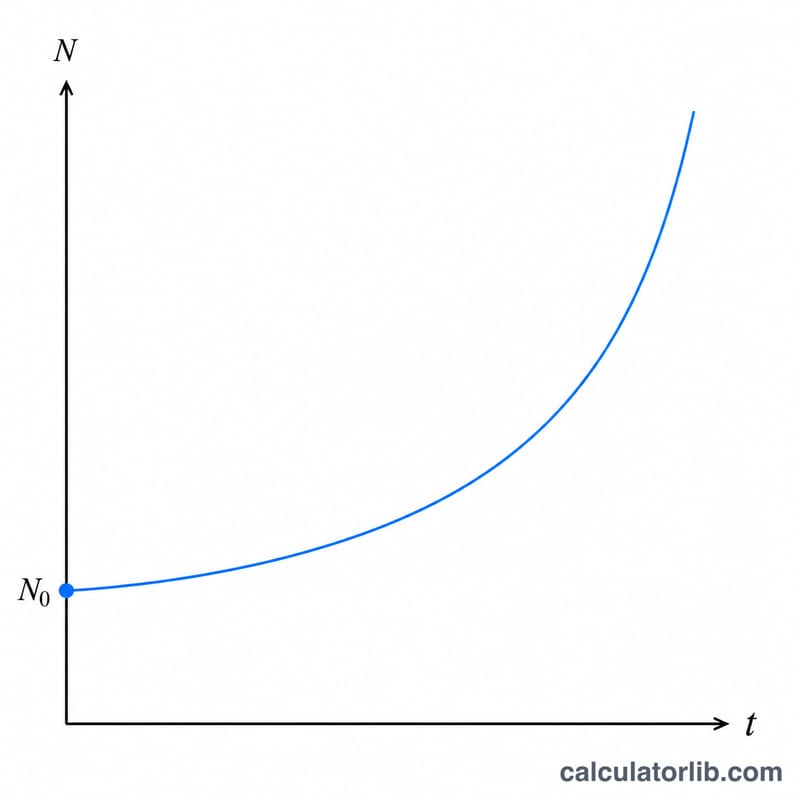
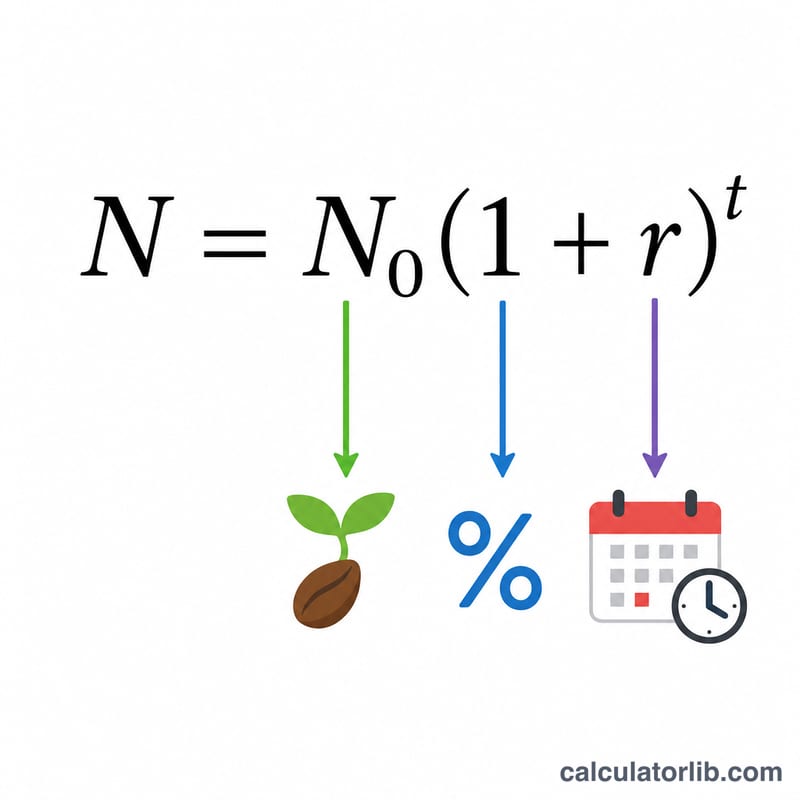
Exponential growth describes any quantity that increases by a constant percentage each period rather than a constant amount. Money in a compound-interest account, a growing population, and viral spread all follow this pattern. This calculator applies the universal formula \(N(t) = N_0\cdot(1 + r)^t\) to any starting value, growth rate, and number of periods.
How to Use It
Enter three numbers: the initial value (\(N_0\)), the growth rate as a percentage per period (\(r\)), and the number of periods (\(t\)). A period can be a year, month, day, or any unit you choose — just keep your rate and periods on the same time scale. The tool returns the final value and the total amount gained.
The Formula Explained
In $$N(t) = N_0\cdot(1 + r)^t,$$ the factor \((1 + r)\) is how much the quantity multiplies each period. Raising it to the power \(t\) compounds that growth over every period, so gains build on previous gains. The rate \(r\) is entered as a percent and converted internally to a decimal (5% → 0.05).
Worked Example
Suppose you invest $1,000 at 5% per year for 10 years. Then $$N(10) = 1000 \cdot (1.05)^{10} = 1000 \cdot 1.628895 \approx \$1{,}628.89.$$ The total growth is about $628.89 — noticeably more than the $500 you would earn with simple (non-compounded) growth.
FAQ
What if the rate is negative? A negative rate models exponential decay; the final value will be smaller than the initial value.
Can periods be a fraction? Yes. Fractional periods (e.g. 2.5) are valid and use the same power formula.
Is this the same as compound interest? Yes — when compounding once per period, compound interest is a direct application of this exponential growth formula.