
What is the vertex of a parabola?
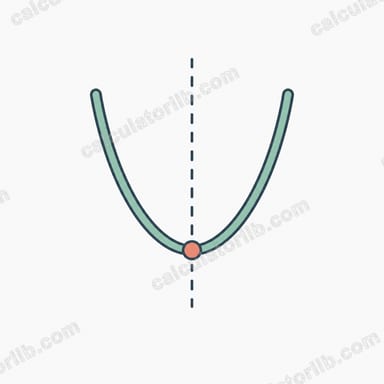
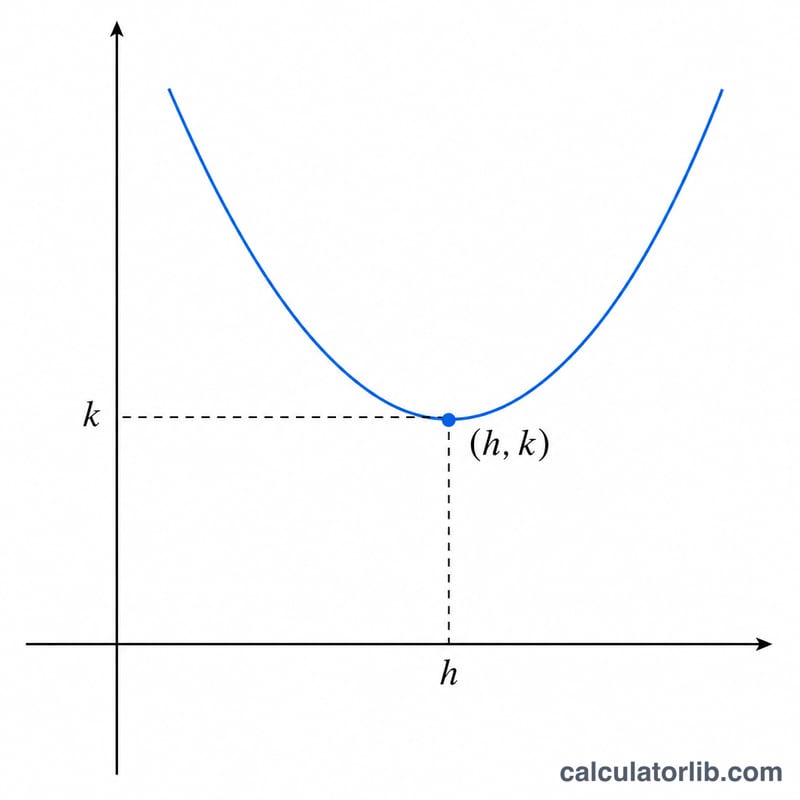
Every quadratic function written in standard form y = ax² + bx + c graphs as a parabola. The vertex is the turning point of that parabola — the lowest point if the parabola opens upward (a > 0) or the highest point if it opens downward (a < 0). This calculator finds the vertex coordinates (h, k) from the coefficients a, b, and c.
How to use this calculator
Enter the three coefficients of your quadratic: a (the x² coefficient), b (the x coefficient), and c (the constant term). The calculator returns the vertex point (h, k) and rewrites the equation in vertex form, \(y = a(x - h)^2 + k\). Note that a cannot be zero, or the equation would be linear rather than a parabola.
The formula explained
The x-coordinate of the vertex sits on the axis of symmetry, halfway between the roots: \(h = -\frac{b}{2a}\). Substituting that back into the original equation gives the y-coordinate, which simplifies to \(k = c - \frac{b^2}{4a}\). Together (h, k) locate the vertex exactly.
$$\left(h,\,k\right) = \left(-\frac{b}{2a},\; c - \frac{b^{2}}{4a}\right)$$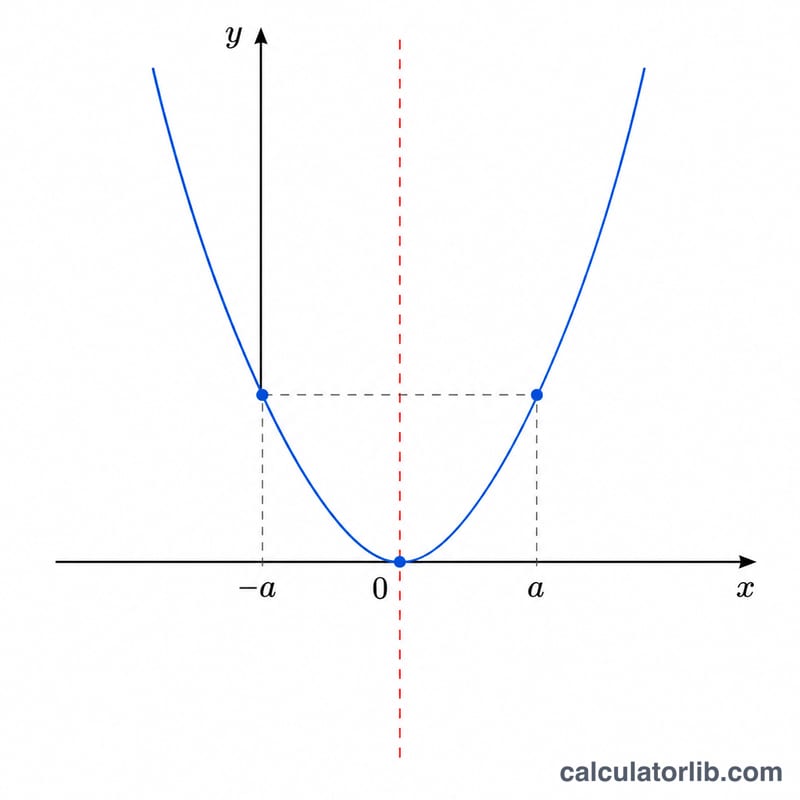
Worked example
Take \(y = x^2 - 4x + 3\), so a = 1, b = −4, c = 3. Then $$h = -\frac{-4}{2\cdot 1} = \frac{4}{2} = 2.$$ And $$k = 3 - \frac{(-4)^2}{4\cdot 1} = 3 - \frac{16}{4} = 3 - 4 = -1.$$ The vertex is (2, −1), and the vertex form is \(y = (x - 2)^2 - 1\).
FAQ
Is the vertex a maximum or minimum? If a is positive the vertex is a minimum; if a is negative it is a maximum.
What is the axis of symmetry? It is the vertical line \(x = h\), the same as the vertex x-coordinate.
Why must a be non-zero? If a = 0 the term ax² disappears and the graph becomes a straight line, which has no vertex.