
What is the Area of a Rectangle?
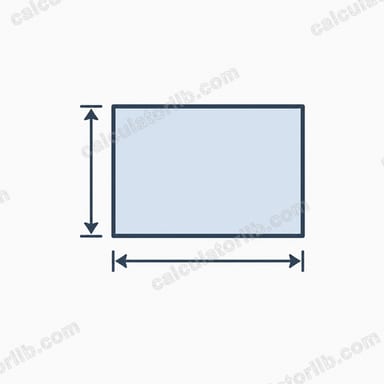
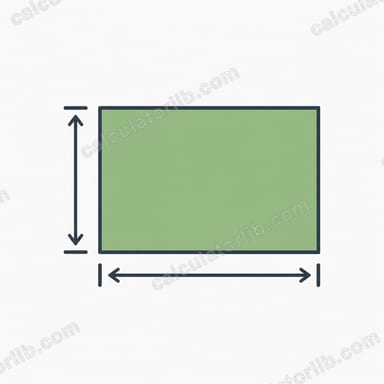
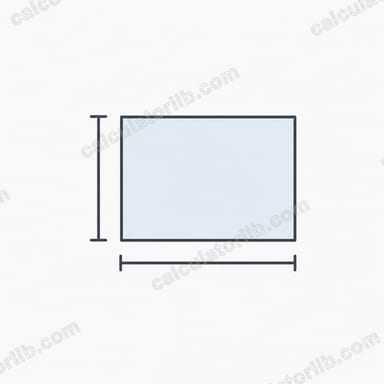
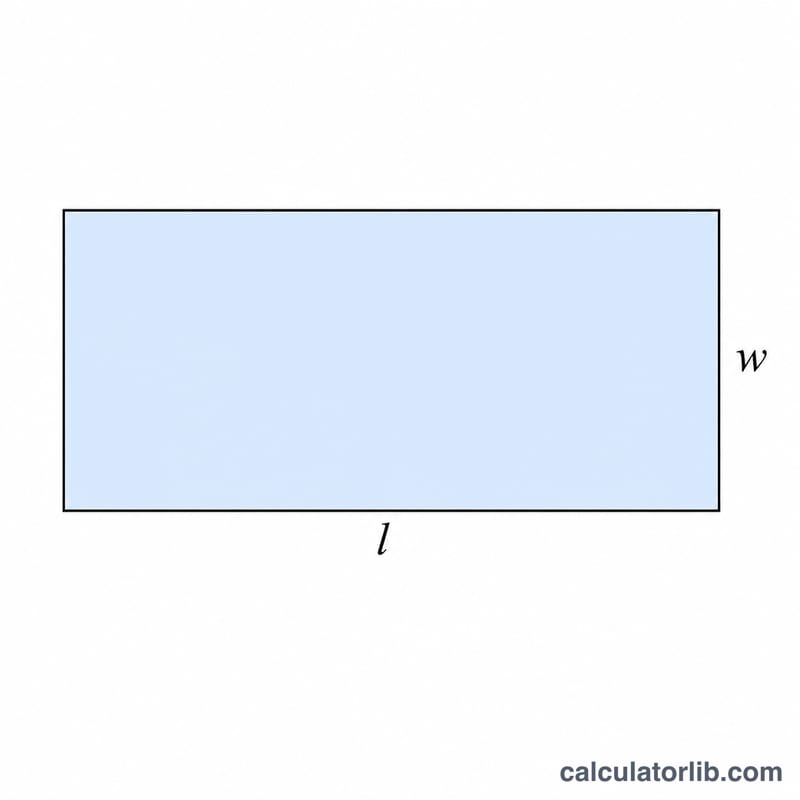
The area of a rectangle is the amount of space enclosed by its four sides. A rectangle has two pairs of equal, parallel sides — a length and a width — that meet at right angles. The area is found by multiplying the length by the width, giving a result in square units (such as cm², m², or ft²).
How to Use This Calculator
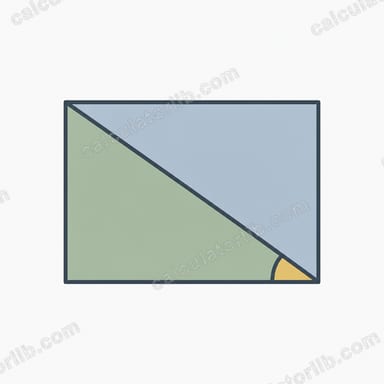
Enter the length and the width of your rectangle in the same unit of measurement, then read off the result. The calculator returns the area along with two bonus figures: the perimeter (the total distance around the rectangle) and the diagonal (the straight-line distance between opposite corners). Because the tool is unit-agnostic, your answer is in whatever unit you provided — inches in, square inches out.
The Formula Explained
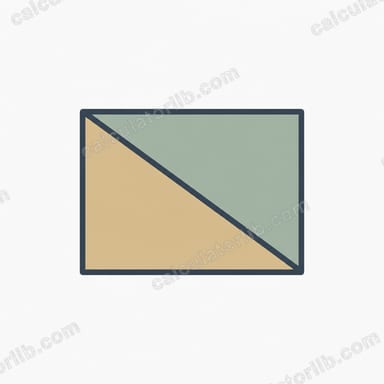
The core formula is \(A = l \times w\), where l is the length and w is the width. The perimeter uses \(P = 2(l + w)\), and the diagonal comes from the Pythagorean theorem: \(d = \sqrt{l^{2} + w^{2}}\), since the diagonal forms the hypotenuse of a right triangle with the two sides.
Worked Example
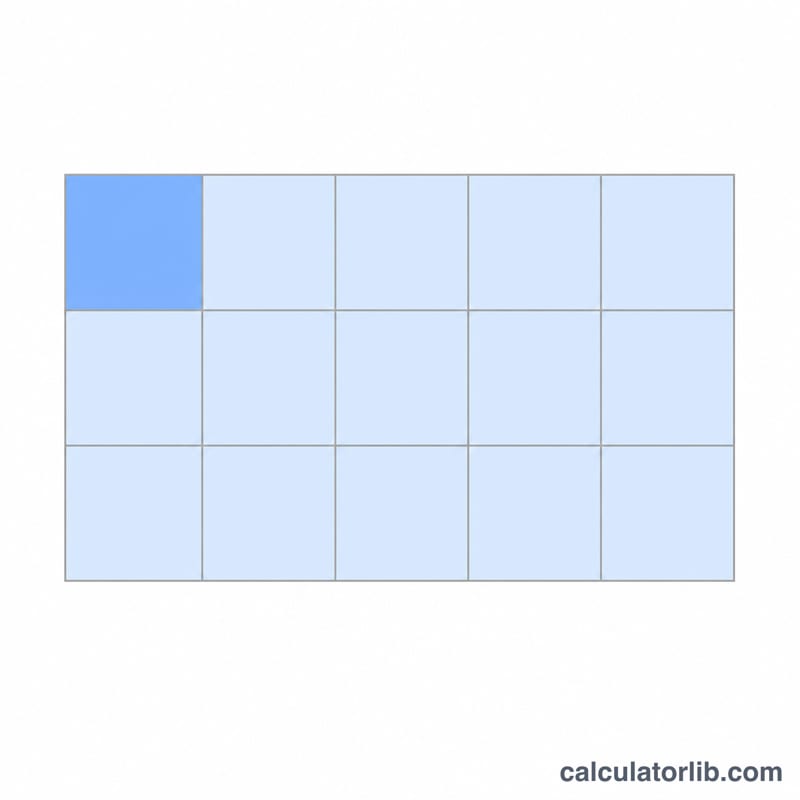
Suppose a room is 10 metres long and 5 metres wide. The area is $$10 \times 5 = 50 \text{ m}^{2}.$$ The perimeter is $$2 \times (10 + 5) = 30 \text{ m}.$$ The diagonal is $$d = \sqrt{10^{2} + 5^{2}} = \sqrt{125} \approx 11.18 \text{ m}.$$ So you would need 50 square metres of flooring to cover the room.
Area Unit Conversion Table
Area is always expressed in square units. Because area scales with the square of a length, the conversion factor between two area units is the square of the corresponding length factor. For example, since 1 ft = 12 in, it follows that \(1\,\text{ft}^2 = 12^2 = 144\,\text{in}^2\). The table below lists the most frequently used conversions for everyday and construction work.
| From | To | Multiply by |
|---|---|---|
| 1 square meter (m²) | square feet (ft²) | 10.7639 |
| 1 square foot (ft²) | square inches (in²) | 144 |
| 1 square inch (in²) | square feet (ft²) | 0.0069444 (= 1/144) |
| 1 square yard (yd²) | square feet (ft²) | 9 |
| 1 acre | square feet (ft²) | 43,560 |
| 1 hectare (ha) | square meters (m²) | 10,000 |
| 1 square centimeter (cm²) | square meters (m²) | 0.0001 (= 1/10,000) |
| 1 square meter (m²) | square centimeters (cm²) | 10,000 |
To convert a computed area, multiply by the factor shown. For instance, a room measured as \(15\,\text{m}^2\) equals \(15 \times 10.7639 = 161.46\,\text{ft}^2\), and an acre of land equals \(43{,}560\,\text{ft}^2\), which is roughly \(4{,}047\,\text{m}^2\).
FAQ
What units does the result use? The area is in square units of whatever you entered. If you used feet, the area is in square feet.
Does the order of length and width matter? No. Multiplication is commutative, so \(10 \times 5\) and \(5 \times 10\) give the same area.
How do I find a square's area? A square is a rectangle with equal sides, so enter the same value for length and width.