
What is the pH of a Strong Acid Calculator?
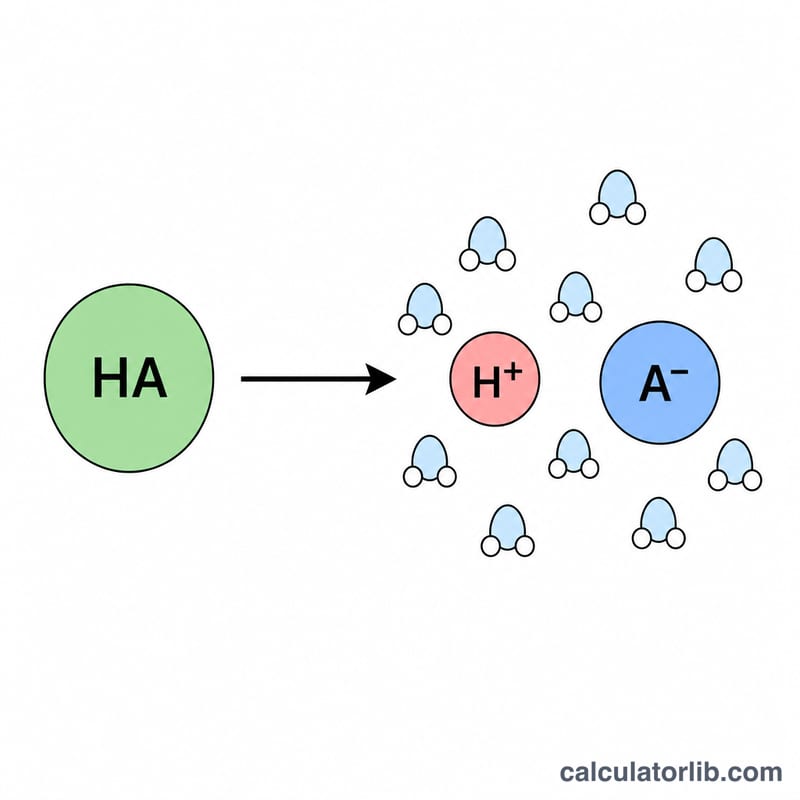
This tool computes the pH of a strong acid solution that dissociates completely in water. Strong acids such as HCl, HNO₃, and H₂SO₄ release all of their acidic protons, so the hydrogen-ion concentration equals the acid concentration multiplied by the number of acidic protons per molecule.
How to use it
Enter the molar concentration of the acid in mol/L and the number of acidic protons (\(n_H\)): 1 for monoprotic acids like HCl, 2 for diprotic acids like H₂SO₄. The calculator returns the pH, the hydrogen-ion concentration [H⁺], and the pOH.
The formula explained
For a strong acid, \([\text{H}^+] = C \times n_H\) because dissociation is complete. The pH is the negative base-10 logarithm of that concentration: $$\text{pH} = -\log_{10}\left(C \times n_H\right)$$ The pOH follows from the water autoionization relation \(\text{pH} + \text{pOH} = 14\) at 25 °C.
Worked example
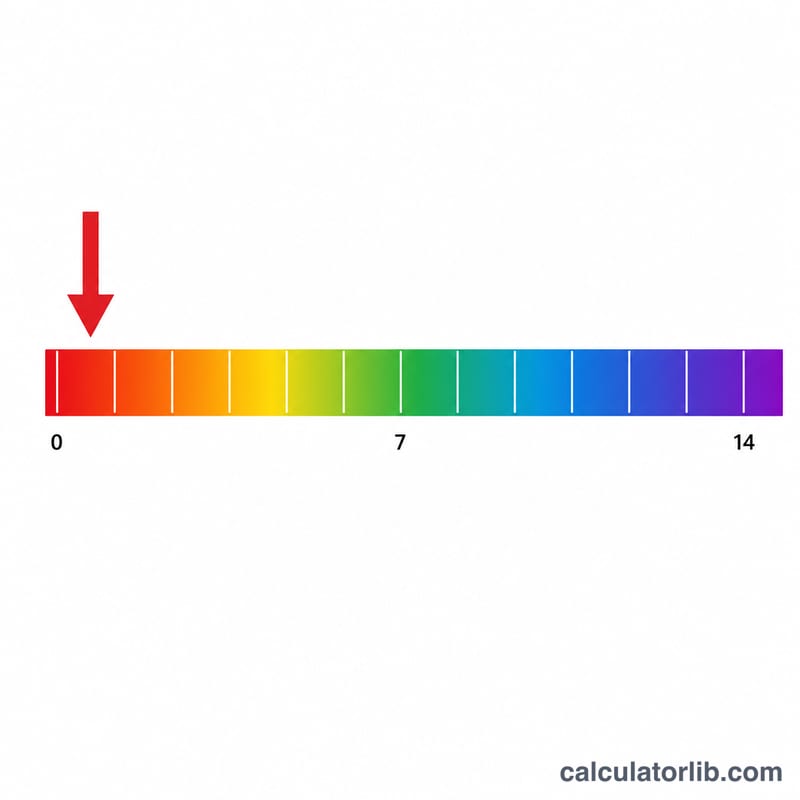
For 0.01 mol/L HCl (\(n_H = 1\)): \([\text{H}^+] = 0.01\ \text{mol/L}\), $$\text{pH} = -\log_{10}(0.01) = 2$$ and \(\text{pOH} = 14 - 2 = 12\). For 0.01 mol/L H₂SO₄ treated as fully diprotic (\(n_H = 2\)): \([\text{H}^+] = 0.02\ \text{mol/L}\), $$\text{pH} = -\log_{10}(0.02) \approx 1.70$$
FAQ
Does this work for weak acids? No. Weak acids only partially dissociate and require their acid dissociation constant (Ka). This calculator assumes full dissociation.
Is the polyprotic approximation exact? Treating every proton as fully released is an idealization; the second dissociation of H₂SO₄ is not truly complete, so real pH may be slightly higher.
Why can pH be negative? Very concentrated acids (\(C \times n_H > 1\)) give a negative pH, which is mathematically valid though activity effects matter at high concentration.