
What this calculator does
This tool estimates the pH of a dilute solution of a weak monoprotic acid from two inputs: the acid dissociation constant (Ka) and the initial (analytical) concentration of the acid, C, in moles per litre. It uses the standard weak-acid approximation that gives a quick, classroom-accurate answer without solving a full quadratic equation.
How to use it
Enter the Ka of your acid (for example, acetic acid has Ka ≈ \(1.8 \times 10^{-5}\)) and the initial concentration in mol/L. The calculator returns the hydrogen ion concentration [H⁺], the pH, and the corresponding pOH (\(\text{pOH} = 14 - \text{pH}\) at 25 °C). Use scientific notation freely — most browsers accept values like 1.8e-5.
The formula explained
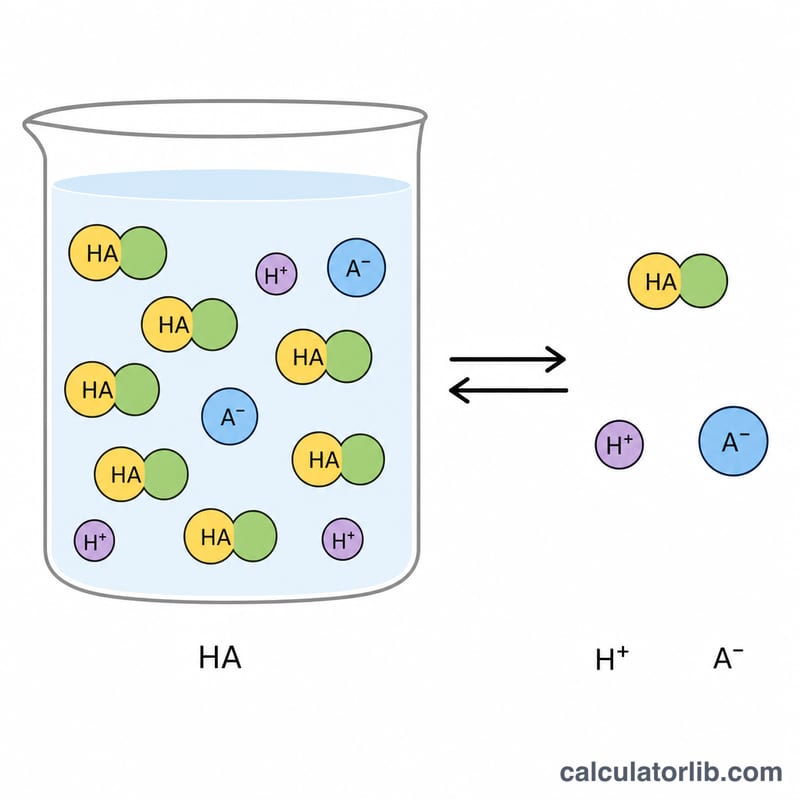
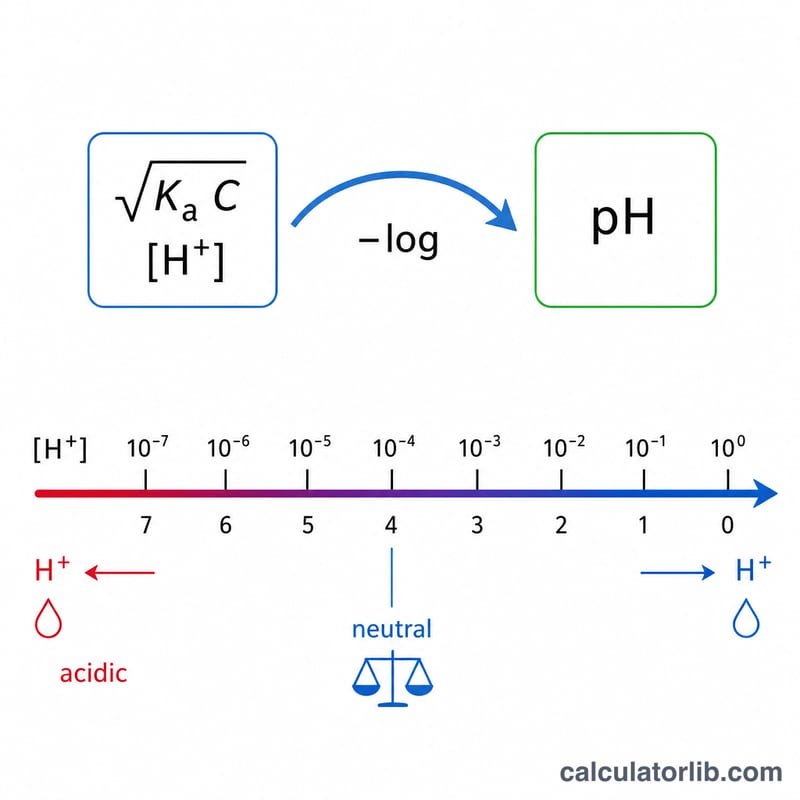
For a weak acid HA dissociating as HA ⇌ H⁺ + A⁻, the equilibrium expression is \(\text{Ka} = \frac{[\text{H}^+][\text{A}^-]}{[\text{HA}]}\). When dissociation is small (\(x \ll C\)), \([\text{H}^+] = [\text{A}^-] = x\) and \([\text{HA}] \approx C\), so \(\text{Ka} \approx \frac{x^2}{C}\). Solving for x gives \([\text{H}^+] = \sqrt{\text{Ka} \cdot C}\), and $$\text{pH} = -\log_{10}\sqrt{\text{Ka} \cdot C}$$ The approximation is reliable when the acid is weak and not extremely dilute (roughly \(C/\text{Ka} > 100\)).
Worked example
Take 0.1 mol/L acetic acid with Ka = \(1.8 \times 10^{-5}\). Then $$[\text{H}^+] = \sqrt{1.8 \times 10^{-5} \times 0.1} = \sqrt{1.8 \times 10^{-6}} \approx 1.342 \times 10^{-3} \text{ mol/L}$$ The pH = \(-\log_{10}(1.342 \times 10^{-3}) \approx 2.87\), a typical value for dilute acetic acid.
FAQ
When does this approximation fail? For very dilute or relatively strong acids where x is no longer negligible compared with C, you should solve the full quadratic instead.
Does temperature matter? The \(\text{pOH} = 14 - \text{pH}\) relationship assumes 25 °C, where the water ion product \(\text{Kw} = 1.0 \times 10^{-14}\).
Can I use pKa instead? Convert first with \(\text{Ka} = 10^{-\text{pKa}}\), then enter that Ka value here.