
What is the Milliliters to Grams Calculator?
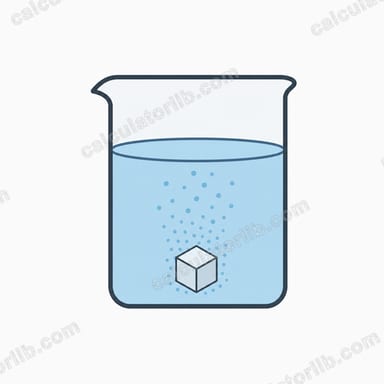
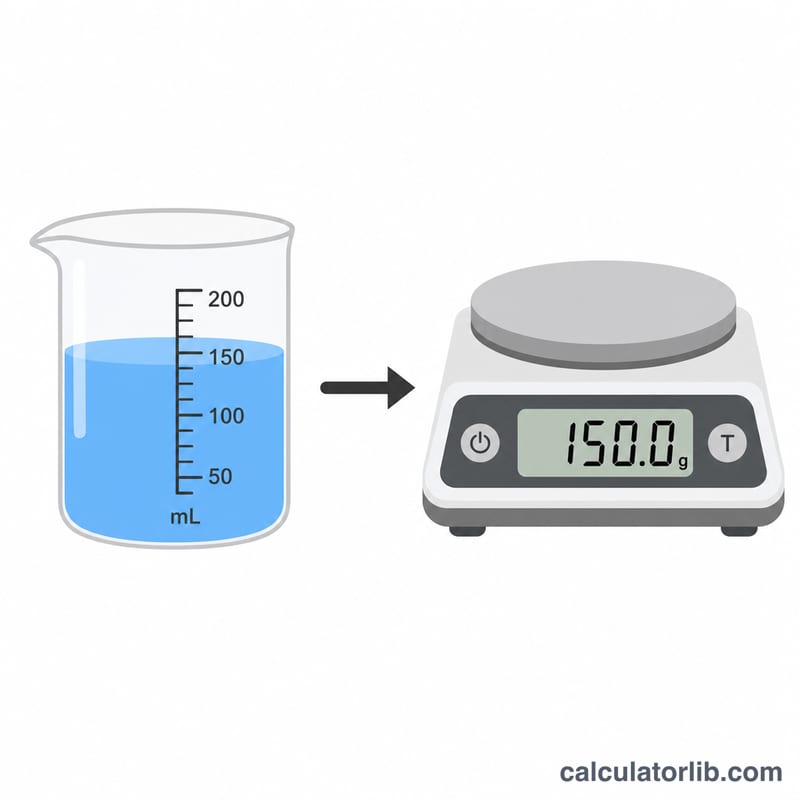
Milliliters (mL) measure volume, while grams (g) measure mass. You cannot convert between them directly because the same volume of two different substances weighs differently. The bridge between volume and mass is density — how much mass is packed into each milliliter. This calculator converts a volume in milliliters to a mass in grams (and kilograms) once you supply the substance's density in grams per milliliter.
How to use it
Enter the volume in milliliters and the density of your substance in grams per milliliter (g/mL). The calculator multiplies the two to return the mass. Pure water at 4 °C has a density of exactly 1 g/mL, so for water, milliliters and grams are numerically equal. Other common densities: milk ≈ 1.03 g/mL, vegetable oil ≈ 0.92 g/mL, honey ≈ 1.42 g/mL, ethanol ≈ 0.789 g/mL.
The formula explained
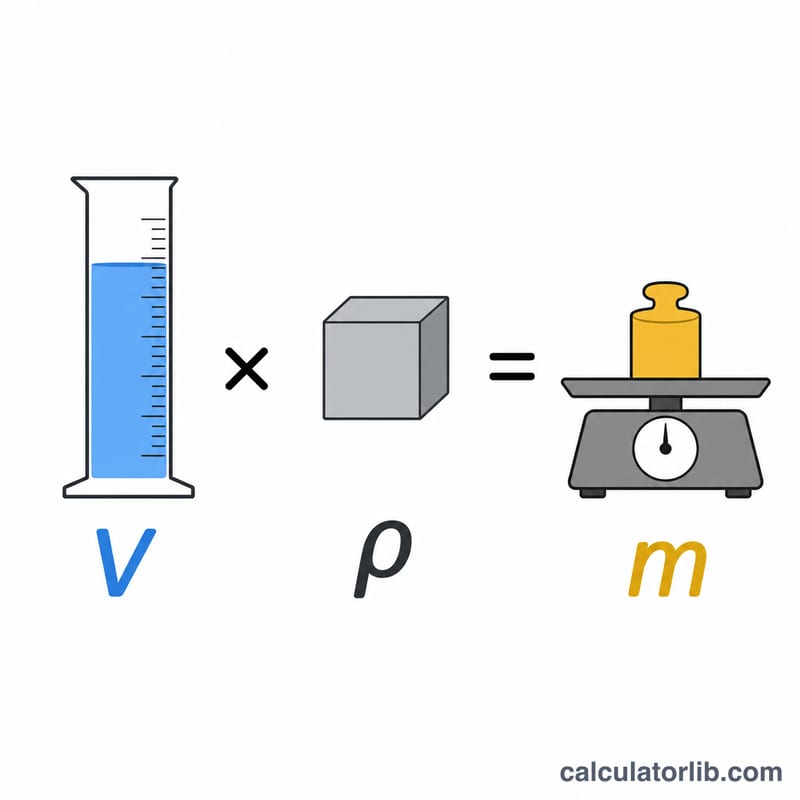
The relationship is $$m = V \times \rho$$ where m is mass in grams, V is volume in milliliters, and \(\rho\) (rho) is density in grams per milliliter. Because 1 mL = 1 cm³, the units cancel cleanly: \((\text{mL}) \times (\text{g/mL}) = \text{g}\). To go the other direction, divide mass by density: \(V = m \div \rho\).
Worked example
Suppose you have 250 mL of milk with a density of 1.03 g/mL. Multiply: $$250 \times 1.03 = 257.5 \text{ grams}$$ or 0.2575 kg. If it were 250 mL of water (density 1.0), the mass would simply be 250 grams.
FAQ
Is 1 mL always 1 gram? Only for pure water near 4 °C. For anything else you must use that substance's density.
Where do I find density? Product labels, chemistry references, or material data sheets list density, usually in g/mL or g/cm³ (they are equivalent).
Does temperature matter? Yes — density changes slightly with temperature, so use a value measured at your working temperature for best accuracy.