
What is the Moles to Grams Calculator?
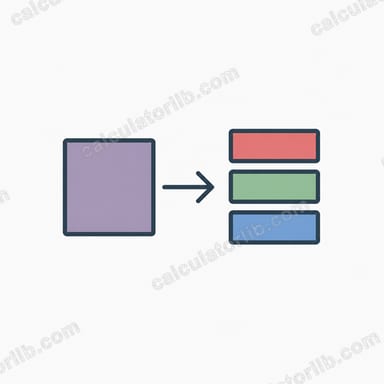
This calculator converts an amount of substance measured in moles (mol) into a mass in grams (g). It is one of the most common conversions in chemistry, used in stoichiometry, solution preparation, and lab work. All you need is the number of moles and the molar mass of the compound.
How to use it
Enter the amount in moles (n) and the molar mass (MW) of your substance in grams per mole. The molar mass can be read from the periodic table by summing the atomic masses of every atom in the chemical formula. Click calculate to get the mass in grams.
The formula explained
The relationship is direct and linear:
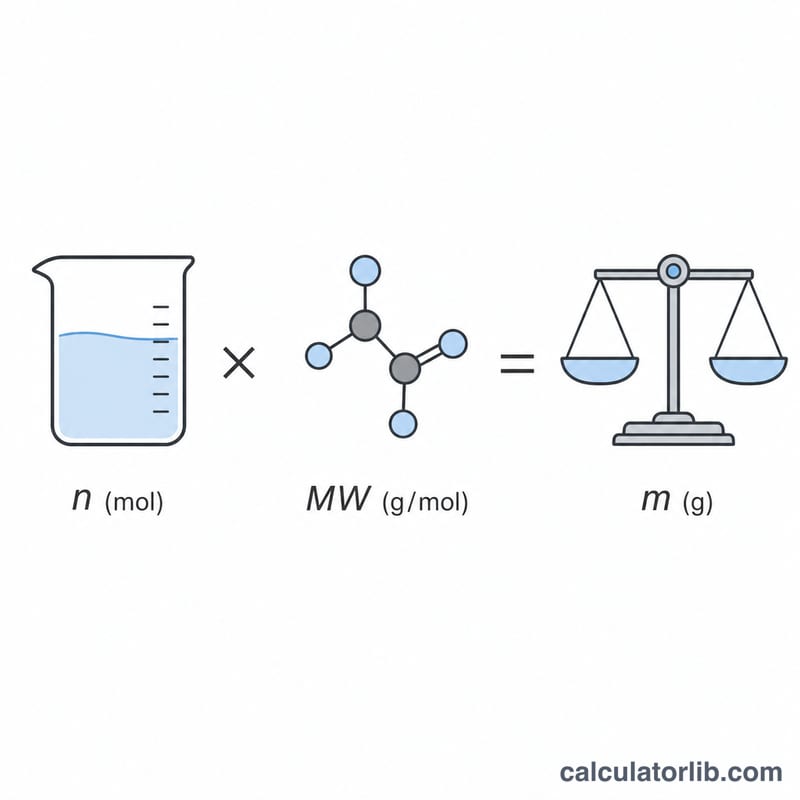
$$\text{Mass (g)} = \text{Amount (mol)} \times \text{Molar Mass (g/mol)}$$
Because the molar mass tells you how many grams one mole of a substance weighs, multiplying by the number of moles scales that up (or down) to the mass you actually have. The units cancel cleanly: \(\text{mol} \times (\text{g/mol}) = \text{g}\).
Worked example
Suppose you have 2 moles of water (H₂O). The molar mass of water is about 18.015 g/mol (\(2 \times 1.008\) for hydrogen + 15.999 for oxygen). Then:
$$\text{mass} = 2\ \text{mol} \times 18.015\ \text{g/mol} = 36.03\ \text{g}$$
So two moles of water weigh roughly 36 grams.
FAQ
Where do I find the molar mass? Add up the atomic masses (from the periodic table) of all atoms in the chemical formula. For example, \(\text{CO}_2 = 12.011 + 2 \times 15.999 = 44.009\ \text{g/mol}\).
Can I go from grams back to moles? Yes — divide mass by molar mass: \(n = m \div MW\).
Does this work for any substance? Yes, as long as you use the correct molar mass for that exact compound or element.