
What This Calculator Does
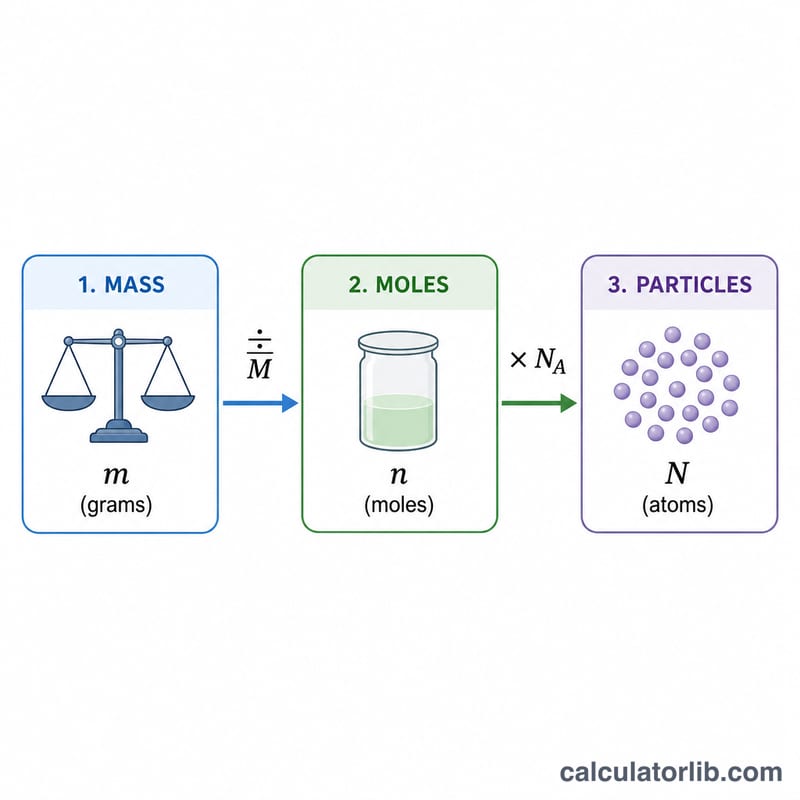
This tool converts a substance's mass into the number of moles and then into the number of particles (atoms or molecules). It bridges the three most common quantities in chemistry: grams, moles, and individual particles — using the molar mass and Avogadro's number.
How to Use It
Enter the mass of your sample in grams and its molar mass in grams per mole (g/mol). The molar mass comes from the periodic table — for a compound, add up the atomic masses of all atoms in the formula. The calculator returns the number of moles and the total particle count.
The Formula Explained
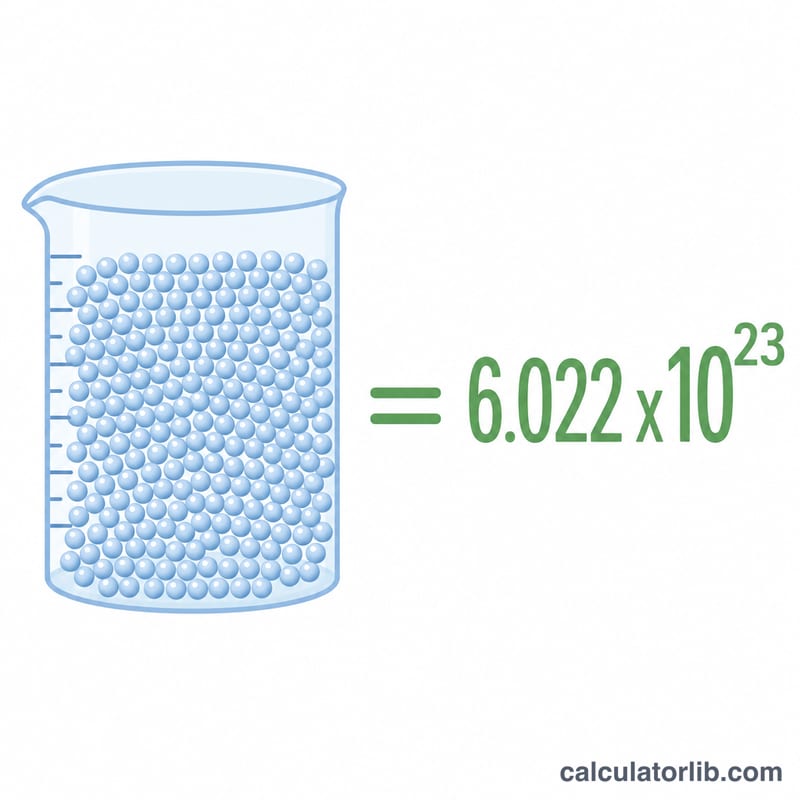
The relationship is $$N = \frac{m}{M} \times N_A$$ where \(m\) is mass in grams, \(M\) is molar mass in g/mol, and \(N_A\) is Avogadro's number (\(6.02214076 \times 10^{23}\) particles per mole). First, dividing mass by molar mass gives the number of moles (\(n = m / M\)). Multiplying moles by Avogadro's number converts to individual particles.
Worked Example
Take 18 g of water (H₂O), which has a molar mass of about 18.015 g/mol. Moles = \(18 / 18.015 \approx 0.99917\) mol. Particles = \(0.99917 \times 6.02214076 \times 10^{23} \approx 6.017 \times 10^{23}\) molecules of water.
FAQ
Are the particles atoms or molecules? It depends on the substance. For an element like iron (Fe), they are atoms; for a compound like water, they are molecules.
Where do I find molar mass? Sum the atomic masses (from the periodic table) of every atom in the chemical formula. For NaCl: \(22.99 + 35.45 = 58.44\) g/mol.
What is Avogadro's number? It is the fixed number of particles in one mole, defined as exactly \(6.02214076 \times 10^{23}\).