
What Is the Limiting Reactant?
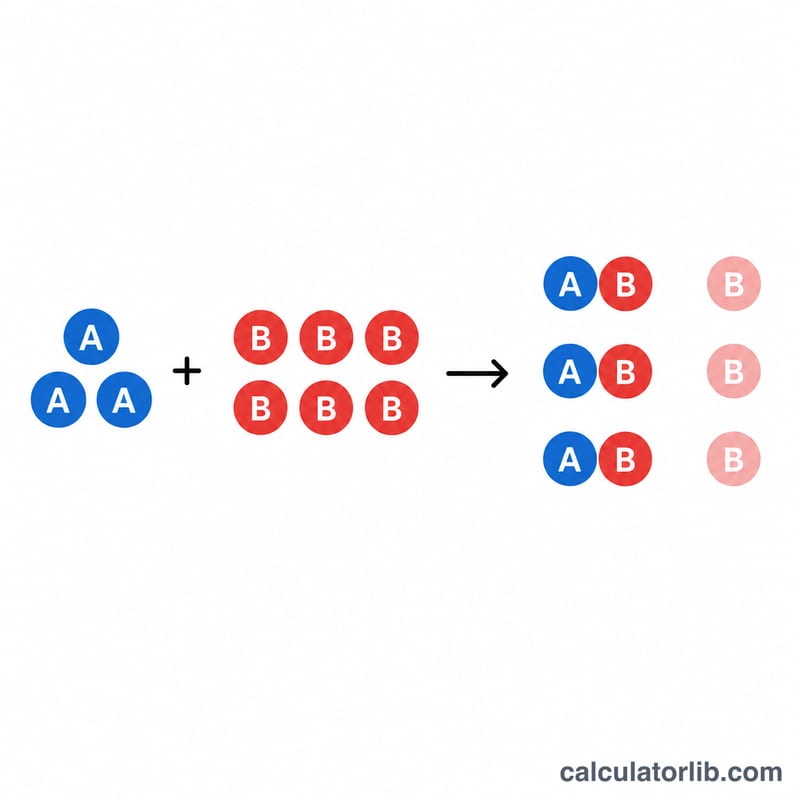
In a chemical reaction, the limiting reactant (or limiting reagent) is the substance that is completely consumed first, halting the reaction and capping how much product can form. The other reactants are present in excess — some of them is left over once the reaction stops. Identifying the limiting reactant is the key step in any stoichiometry yield calculation.
How to Use This Calculator
Enter the number of moles you have of each reactant along with its coefficient from the balanced chemical equation. The calculator divides each reactant's moles by its coefficient and compares the results. Whichever gives the smaller value is the limiting reactant, and the tool also reports how much of the excess reactant remains.
The Formula Explained
For a reaction a·A + b·B → products, compute \( n_A/a \) and \( n_B/b \). The reactant with the smallest mole-to-coefficient ratio is limiting because, relative to the recipe, you have proportionally less of it. The excess remaining is the leftover moles after subtracting what the limiting reactant consumes:
The limiting reactant is identified by:
$$ \text{Limiting Reactant} = \min\left( \frac{\text{Moles A}}{\text{Coeff. A}},\ \frac{\text{Moles B}}{\text{Coeff. B}} \right) $$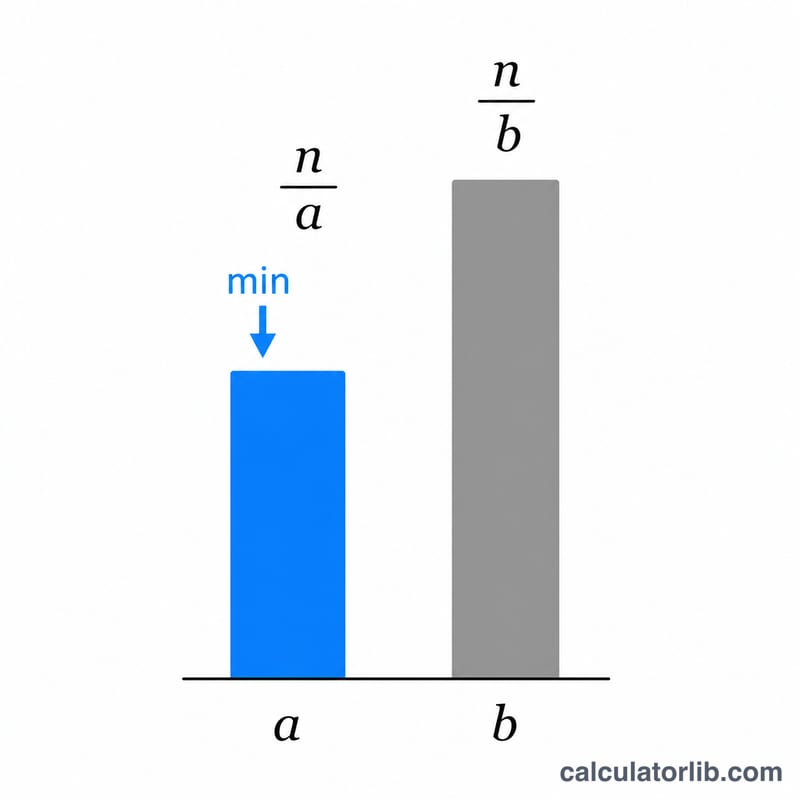
Worked Example
Consider 2 mol N2 and 3 mol H2 reacting as N₂ + 3 H₂ → 2 NH₃. For N2: \( 2 \div 1 = 2 \). For H2: \( 3 \div 3 = 1 \). Since \( 1 < 2 \), H2 is the limiting reactant. The N2 consumed:
leaving \( 2 - 1 = 1 \) mol of N2 in excess.
FAQ
Do I need a balanced equation? Yes — the coefficients must come from a properly balanced equation, otherwise the ratios are meaningless.
What if both ratios are equal? Then neither reactant is in excess; they are present in exact stoichiometric proportion and both are fully consumed.
Can I use grams instead of moles? Convert grams to moles first by dividing by the molar mass, then enter the moles here.