
What Is the Limiting Reagent?
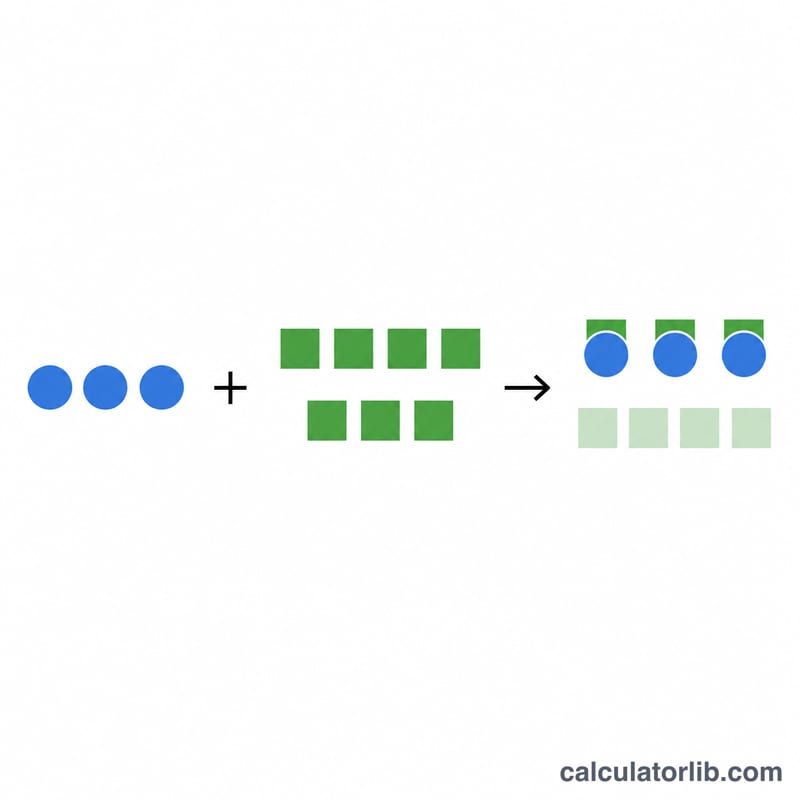
In a chemical reaction, the limiting reagent (or limiting reactant) is the substance that is completely consumed first, stopping the reaction and capping how much product can form. Every other reactant is present in excess. Identifying it is the essential first step in any stoichiometry or yield calculation.
How to Use This Calculator
Enter the number of moles available for each of two reactants, along with the stoichiometric coefficient that appears in front of that species in the balanced chemical equation. The calculator divides moles by coefficient for each reactant and compares the two ratios. The reactant with the smaller ratio is the limiting reagent.
The Formula Explained
For each reactant the ratio is \(r = \text{moles} / \text{coefficient}\). This ratio represents how many "reaction units" that reactant can supply. The reactant offering the fewest reaction units cannot be replaced once exhausted, so it limits the reaction. Mathematically the limiting reagent corresponds to the minimum of all the ratios.
$$\text{Limiting Reactant} = \min\left( \frac{\text{Moles A}}{\text{Coeff A}},\ \frac{\text{Moles B}}{\text{Coeff B}} \right)$$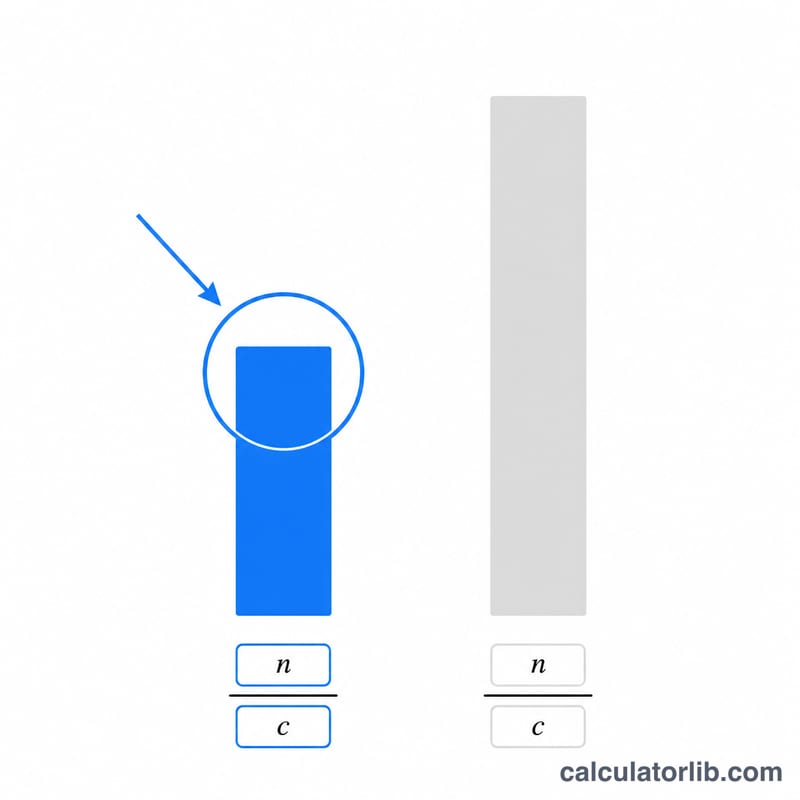
Worked Example
Consider \(\text{N}_2 + 3\text{H}_2 \to 2\text{NH}_3\). Suppose you have 4 mol N2 (coefficient 1) and 10 mol H2 (coefficient 3). For nitrogen the ratio is \(4 / 1 = 4\). For hydrogen it is \(10 / 3 = 3.33\). Hydrogen has the smaller ratio (\(3.33 < 4\)), so hydrogen is the limiting reagent and nitrogen is in excess.
FAQ
Why divide by the coefficient instead of comparing moles directly? Because reactants are consumed in the ratio set by the balanced equation, not one-to-one. Dividing by the coefficient normalizes each reactant to the same basis.
What if both ratios are equal? The reactants are in perfect stoichiometric proportion and both are consumed completely; neither is in excess. This tool reports Reactant A in that tie case.
Can I use grams instead of moles? No. Convert mass to moles first by dividing grams by molar mass, then enter the moles here.