
What this calculator does
In Dungeons & Dragons 5th edition (and many d20 games), you often roll a twenty-sided die and need the result to meet or beat a target number, such as an Armor Class or a Difficulty Class. Advantage lets you roll two d20 and keep the higher; Disadvantage makes you roll two and keep the lower. This tool computes the exact probability of success under each condition so you can see how much that advantage really helps.
How to use it
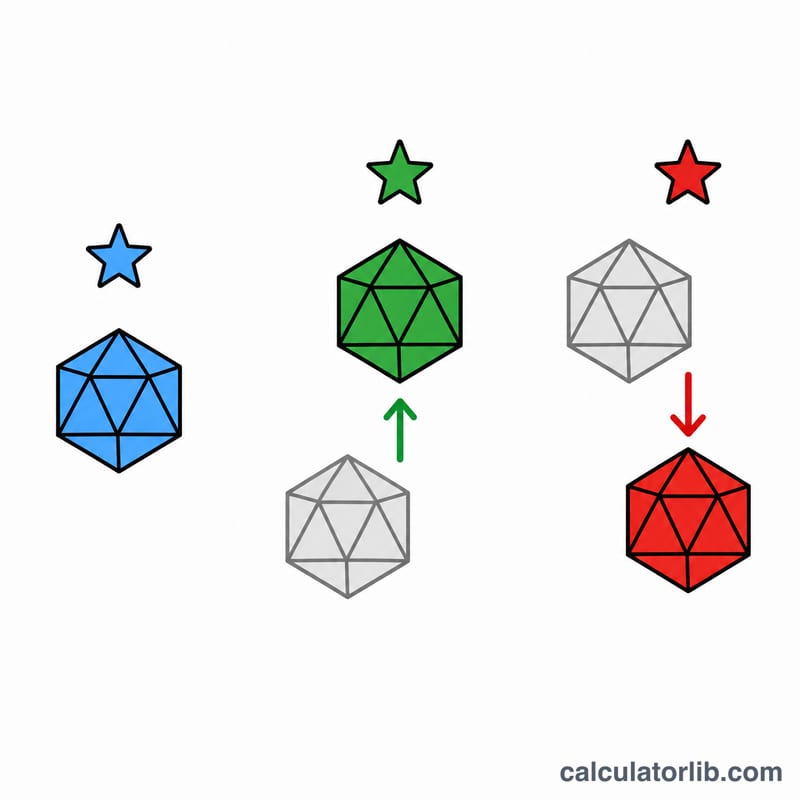
Enter the target number you need to roll (1 to 20) — this is the lowest single-die result that still counts as a success. Pick a mode: Advantage, Disadvantage, or Normal. The calculator shows your chosen probability as a percentage along with all three modes side by side for comparison.
The formula explained
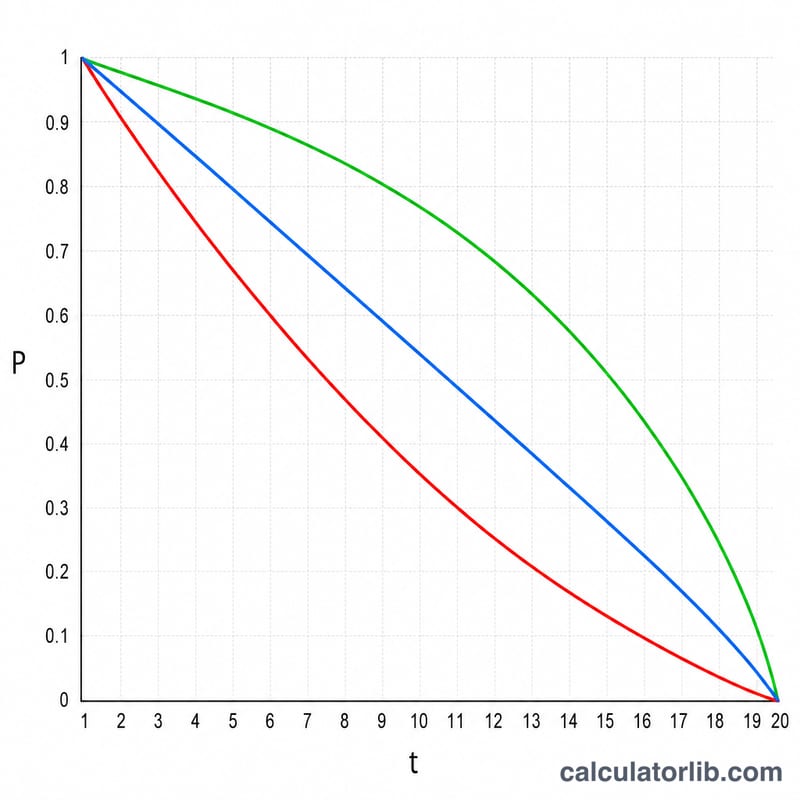
A single fair d20 rolls at or above target \(t\) with probability \((21 - t) / 20\). With Advantage you fail only when both dice fall below \(t\), so the success chance is
$$P_{adv} = 1 - \left(\frac{t-1}{20}\right)^2$$With Disadvantage you succeed only when both dice land at or above \(t\), giving
$$P_{dis} = \left(\frac{21-t}{20}\right)^2$$These assume an ideal, fair d20.
Worked example
Suppose you need an 11 or higher (\(t = 11\)). Normal success is
$$\frac{21 - 11}{20} = 50\%$$With Advantage:
$$1 - \left(\frac{10}{20}\right)^2 = 1 - 0.25 = 75\%$$With Disadvantage:
$$\left(\frac{10}{20}\right)^2 = 0.25 = 25\%$$So Advantage raises a coin-flip to a comfortable 75% chance.
Hit Probability by Target Number
In Dungeons & Dragons 5e you succeed on a d20 check when your roll meets or beats a target number \(t\) (after modifiers, this is the natural roll you need). For a single d20 the chance of rolling \(t\) or higher is
$$P_{\text{normal}} = \frac{21 - t}{20} \times 100\%.$$With Advantage you roll two d20s and keep the higher; the chance that at least one meets the target is \(1 - p^2\) where \(p\) is the chance a single die fails. With Disadvantage you keep the lower, so both dice must succeed, giving \(q^2\) where \(q\) is the single-die success chance. The final column shows the Advantage swing — how many percentage points Advantage adds over a normal roll, which peaks near the middle of the range.
| Target (t) | Normal | Advantage | Disadvantage | Advantage swing |
|---|---|---|---|---|
| 1 | 100.00% | 100.00% | 100.00% | 0.00% |
| 2 | 95.00% | 99.75% | 90.25% | 4.75% |
| 3 | 90.00% | 99.00% | 81.00% | 9.00% |
| 4 | 85.00% | 97.75% | 72.25% | 12.75% |
| 5 | 80.00% | 96.00% | 64.00% | 16.00% |
| 6 | 75.00% | 93.75% | 56.25% | 18.75% |
| 7 | 70.00% | 91.00% | 49.00% | 21.00% |
| 8 | 65.00% | 87.75% | 42.25% | 22.75% |
| 9 | 60.00% | 84.00% | 36.00% | 24.00% |
| 10 | 55.00% | 79.75% | 30.25% | 24.75% |
| 11 | 50.00% | 75.00% | 25.00% | 25.00% |
| 12 | 45.00% | 69.75% | 20.25% | 24.75% |
| 13 | 40.00% | 64.00% | 16.00% | 24.00% |
| 14 | 35.00% | 57.75% | 12.25% | 22.75% |
| 15 | 30.00% | 51.00% | 9.00% | 21.00% |
| 16 | 25.00% | 43.75% | 6.25% | 18.75% |
| 17 | 20.00% | 36.00% | 4.00% | 16.00% |
| 18 | 15.00% | 27.75% | 2.25% | 12.75% |
| 19 | 10.00% | 19.00% | 1.00% | 9.00% |
| 20 | 5.00% | 9.75% | 0.25% | 4.75% |
The swing column makes a well-known D&D fact concrete: Advantage is roughly equivalent to a +5 bonus when you need around an 11 on the die, but its benefit shrinks toward both extremes. When you need a 1 (auto-success) or are betting on a natural 20, rolling a second die barely changes the outcome.
Key Terms
- Advantage
- A condition (from a favorable situation, spell, or class feature) where you roll two d20s and keep the higher result. Select the mode = Advantage option to see how this raises your success chance against the chosen target — most dramatically when you need a middle-of-the-road roll.
- Disadvantage
- A condition (from an unfavorable situation, condition, or hazard) where you roll two d20s and keep the lower result. If you have both Advantage and Disadvantage from any number of sources, they cancel and you roll a single normal d20.
- Target Number (t)
- The lowest result on the d20 (after adding your modifier) that counts as a success. It is the target field in this calculator and must be from 1 to 20. A higher \(t\) means a harder roll, so the success probability \(\tfrac{21-t}{20}\) falls by 5 percentage points for each step up.
- Armor Class (AC)
- The defense value an attack roll must equal or exceed to hit a creature. In practice you convert AC into a target number with \(t = \text{AC} - \text{attack bonus}\), then enter that \(t\) here to find your chance to hit.
- Difficulty Class (DC)
- The number an ability check or saving throw must meet or beat to succeed. Like AC, it becomes a target number via \(t = \text{DC} - \text{relevant modifier}\) before you look up the probability.
- d20
- The twenty-sided die that drives nearly every check, attack, and save in 5e. Each face from 1 to 20 is equally likely (5% each), which is why every one-step change in the target shifts the odds by exactly 5%.
- Modifier
- The total bonus or penalty added to your raw d20 roll (ability modifier, proficiency, magic items, situational effects). Rather than entering it directly, you fold it into the target number: a +7 attack bonus against AC 15 gives \(t = 15 - 7 = 8\), an 8 or higher needed on the die.
FAQ
Does this include modifiers? No. Subtract your bonus from the DC first, then enter the resulting target you need on the raw die.
How big is the Advantage bonus? It peaks near the middle (around +5 effective at \(t = 11\)) and shrinks toward the extremes.
Do natural 1s and 20s matter? This computes raw probability; auto-success or auto-fail rules for attack rolls are not modeled here.