
What Is the Valve Kv Flow Coefficient?
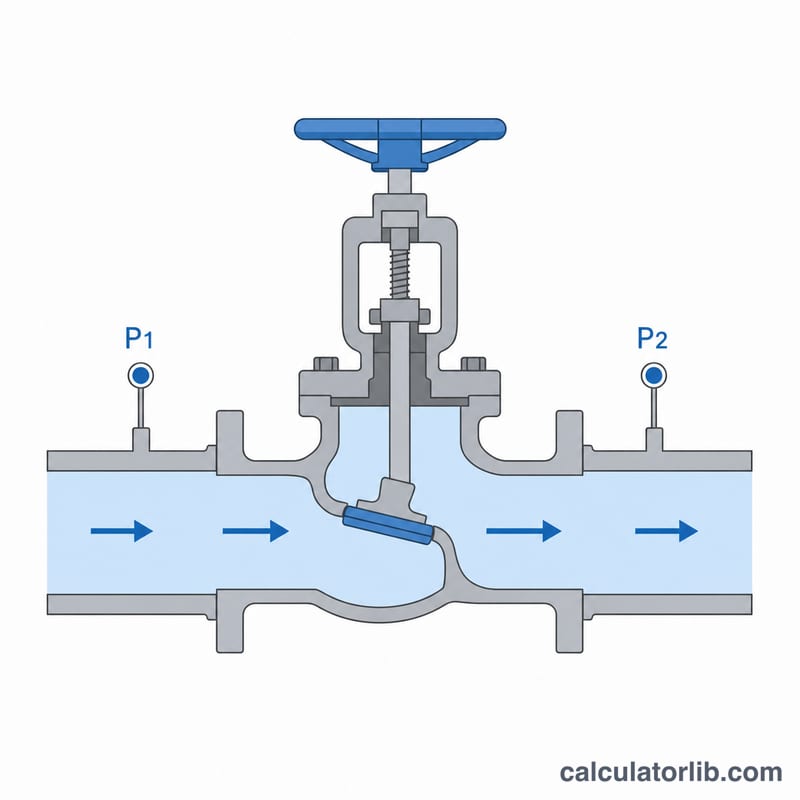
The flow coefficient Kv is a metric measure of a control valve capacity. It is defined as the volume of water (in m³/h) at 5–40 °C that flows through the fully open valve with a pressure drop of 1 bar across it. A higher Kv means the valve passes more flow for the same pressure loss. Kv is the standard sizing parameter used across Europe and most of the world; the imperial equivalent is Cv.
How to Use This Calculator
Enter the required volumetric flow rate Q in cubic metres per hour, the specific gravity SG of the fluid relative to water (water = 1), and the available pressure drop ΔP across the valve in bar. The calculator returns the required Kv and the equivalent Cv. Select a commercially available valve whose rated Kv comfortably exceeds this value.
The Formula Explained
The governing equation for incompressible (liquid) flow is:
$$K_v = \text{Q} \cdot \sqrt{\dfrac{\text{SG}}{\Delta P}}$$
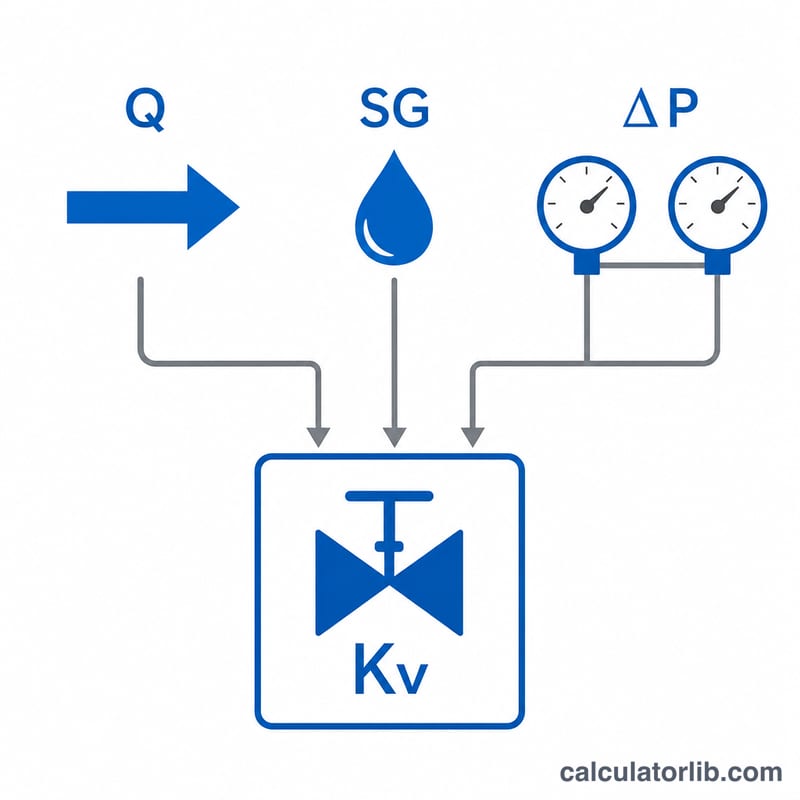
Q is the flow in m³/h, SG is the relative density (dimensionless), and ΔP is the differential pressure in bar. When ΔP equals 1 bar and the fluid is water (SG = 1), Kv numerically equals the flow rate, which matches the definition.
Worked Example
Suppose water (SG = 1) must flow at Q = 20 m³/h with a pressure drop of ΔP = 4 bar. Then $$K_v = 20 \times \sqrt{\frac{1}{4}} = 20 \times 0.5 = \textbf{10 m³/h}.$$ The equivalent Cv = 10 / 0.865 ≈ 11.56. You would choose a valve rated at, say, Kv 16 to leave headroom.
FAQ
What is the difference between Kv and Cv? Kv is metric (m³/h, bar) while Cv is imperial (US gpm, psi). They are related by \(C_v \approx K_v / 0.865\), or \(K_v \approx 0.865 \times C_v\).
Does this work for gases or steam? No. This formula applies to incompressible liquid flow. Compressible gas and steam sizing require different equations that account for density changes and choked flow.
Should I oversize the valve? Choose a valve whose rated Kv is larger than the calculated value, but avoid extreme oversizing, which causes poor control near the closed position.