
What is the Orifice Flow Calculator?
This tool estimates the volumetric flow rate of a liquid escaping through a sharp-edged orifice under a static head. It applies the classic orifice equation, derived from Torricelli's law and corrected by a discharge coefficient that accounts for real-world contraction and friction losses. It is widely used in hydraulics, tank-drainage design, fluid mechanics coursework, and process engineering.
How to use it
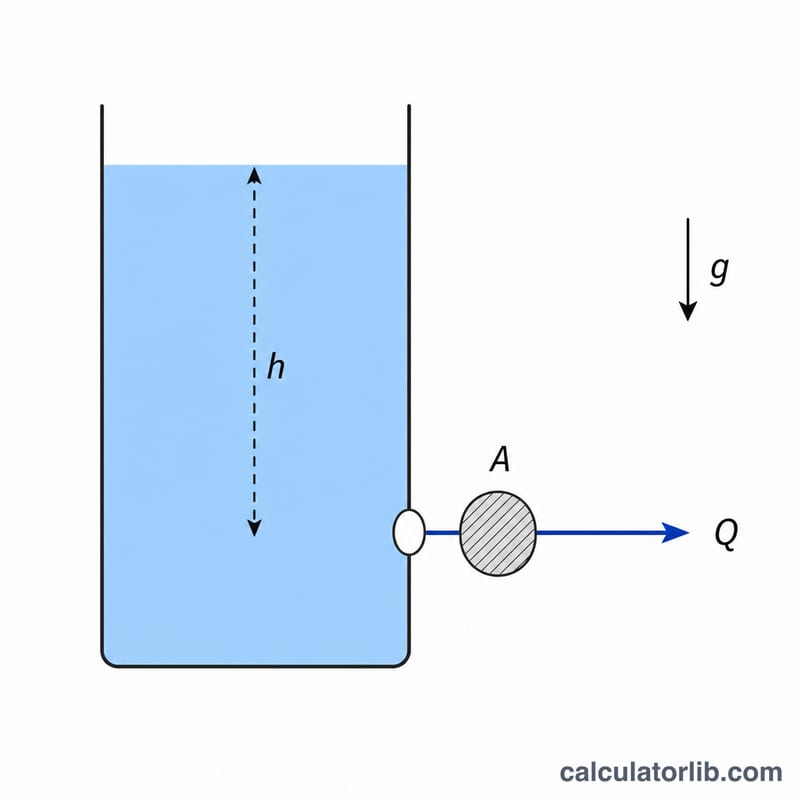
Enter the discharge coefficient (Cd), the cross-sectional area of the orifice (A) in square metres, the head of liquid above the orifice centre (h) in metres, and the acceleration due to gravity (g, default 9.81 m/s²). The calculator returns the flow rate Q in cubic metres per second, plus the theoretical efflux velocity.
The formula explained
The equation is $$Q = \text{C}_d \cdot \text{A} \cdot \sqrt{2 \cdot \text{g} \cdot \text{h}}$$. The term \(\sqrt{2gh}\) is the theoretical velocity from Torricelli's law — the speed a fluid particle would reach falling from height \(h\). Multiplying by area \(A\) gives the ideal flow, and the discharge coefficient \(C_d\) (typically 0.60–0.65 for a sharp-edged orifice) reduces it to the actual flow, capturing the vena contracta and viscous effects.
Worked example
With \(C_d = 0.62\), \(A = 0.01\ \text{m}^2\), \(h = 2\ \text{m}\) and \(g = 9.81\ \text{m/s}^2\): velocity $$= \sqrt{2 \times 9.81 \times 2} = \sqrt{39.24} \approx 6.2642\ \text{m/s}.$$ Then $$Q = 0.62 \times 0.01 \times 6.2642 \approx 0.03884\ \text{m}^3/\text{s},$$ or about 38.8 litres per second.
FAQ
What value should I use for Cd? For a sharp-edged circular orifice, \(C_d \approx 0.61\text{–}0.62\). Rounded or bell-mouthed entries can approach 0.95–0.98.
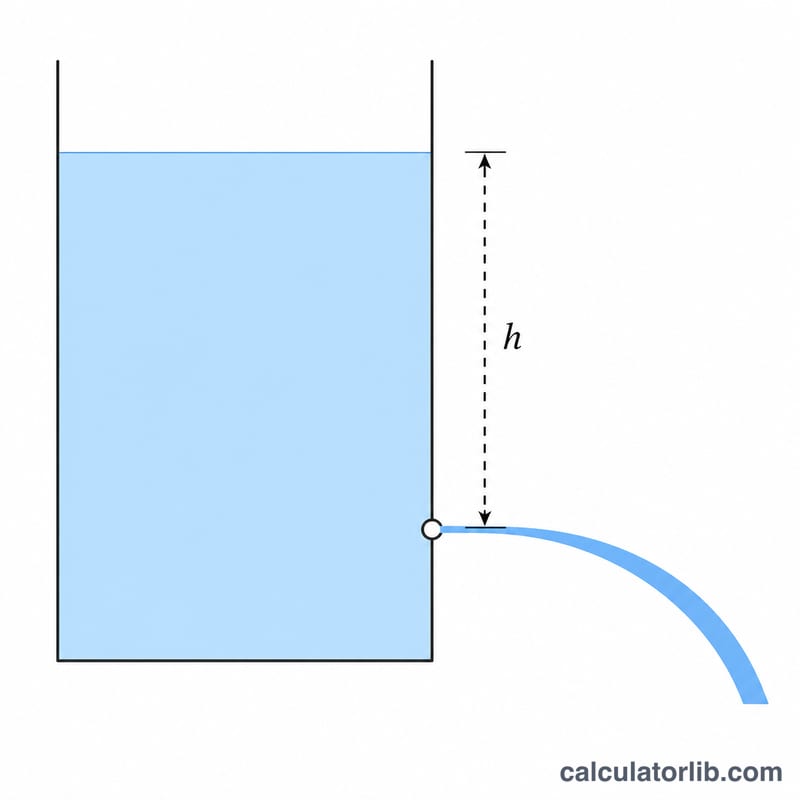
What is the head h? It is the vertical distance from the free surface of the liquid down to the centre of the orifice.
Does this account for the falling level? No — it gives the instantaneous flow at the given head. As a tank drains, \(h\) decreases and so does \(Q\).