
What Is the Pipe Velocity Calculator?
This tool computes the average velocity of a fluid flowing through a circular pipe. Velocity is one of the most important parameters in piping design — it affects pressure loss, erosion, noise, and pump sizing. Engineers typically aim for liquid velocities of about 1–3 m/s in pressure lines to balance friction losses against pipe cost.
How to Use It
Enter the volumetric flow rate and select its unit (m³/s, m³/h, L/s or L/min). Then enter the pipe's inside diameter in millimetres. The calculator converts everything to SI units, computes the cross-sectional area, and returns the average flow velocity in metres per second along with the area and the flow rate in m³/s.
The Formula Explained
Average velocity is volumetric flow rate Q divided by the flow area A:
\(v = Q / A\). For a round pipe the area is \(A = \pi d^{2}/4\), so the velocity becomes \(v = \dfrac{4Q}{\pi d^{2}}\). Q must be in m³/s and d in metres for v to come out in m/s.
$$v = \frac{Q}{\frac{\pi}{4}\,d^{2}}$$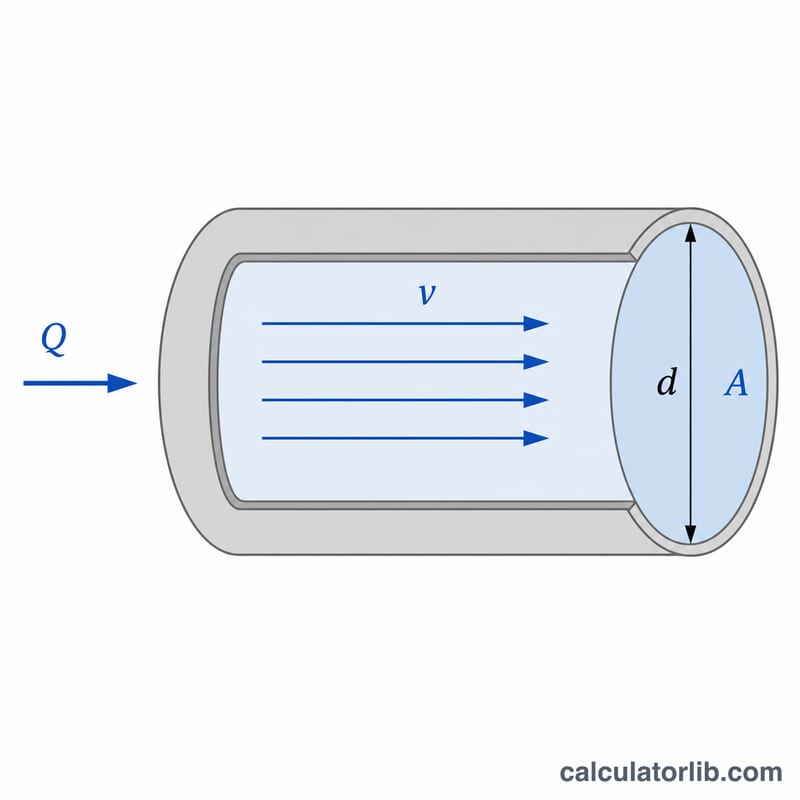
Worked Example
Suppose \(Q = 0.05\) m³/s through a pipe of inside diameter \(d = 100\) mm \(= 0.1\) m. The area is
$$A = \frac{\pi (0.1)^{2}}{4} = 0.007854 \text{ m}^2.$$The velocity is
$$v = \frac{0.05}{0.007854} \approx 6.37 \text{ m/s}$$— quite high for a liquid line, suggesting a larger pipe may be appropriate.
FAQ
Should I use inside or outside diameter? Always use the inside (bore) diameter, since that is the area the fluid actually flows through.
What velocity is recommended? Common rules of thumb are 1–3 m/s for water in pressure pipes and lower for suction lines to avoid cavitation.
Does this work for gases? Yes, the same formula applies, but for compressible gases the volumetric flow must be at the actual operating pressure and temperature.