
What Is the Pipe Flow Velocity Calculator?
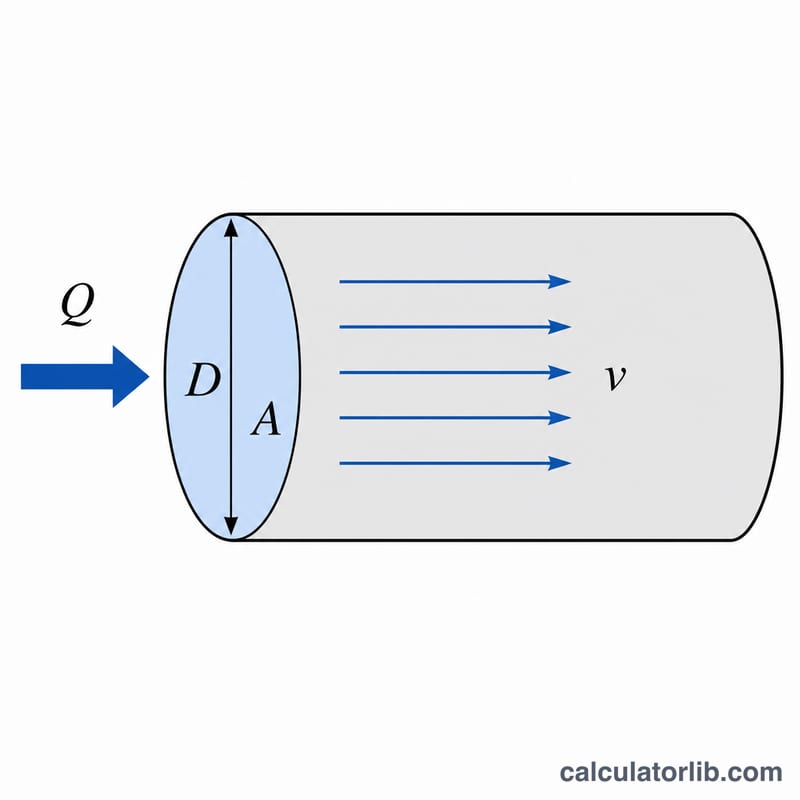
This calculator determines the average velocity of a fluid moving through a circular pipe. Given the volumetric flow rate (Q) and the pipe's inner diameter (D), it computes how fast the fluid travels using the continuity relationship between flow rate, velocity, and cross-sectional area. It works for any consistent fluid in SI units and is widely used in plumbing, HVAC, irrigation, and process engineering.
How to Use It
Enter the volumetric flow rate in cubic meters per second (m³/s) and the inner diameter of the pipe in meters (m). The tool calculates the pipe's cross-sectional area and divides the flow rate by that area to give the velocity in meters per second (m/s). To convert flow from liters per second to m³/s, divide by 1000; to convert diameter from millimeters to meters, divide by 1000.
The Formula Explained
The governing equation is the continuity principle: \(v = \frac{Q}{A}\), where the area of a round pipe is \(A = \frac{\pi}{4} D^2\). Combining them gives $$v = \frac{Q}{\frac{\pi}{4} D^2}$$ Velocity is inversely proportional to the square of the diameter — halving the diameter quadruples the velocity for the same flow rate.
Worked Example
Suppose \(Q = 0.05\) m³/s and \(D = 0.1\) m. The area is $$A = \frac{\pi}{4} \times 0.1^2 = 0.0078539816 \text{ m}^2$$ $$v = \frac{0.05}{0.0078539816} \approx 6.366 \text{ m/s}$$ So the fluid moves at about 6.37 meters per second.

FAQ
Does this account for friction or turbulence? No. It gives the average (bulk) velocity assuming uniform flow; actual local velocities vary across the pipe profile.
What units should I use? Use SI units: flow in m³/s and diameter in meters to get velocity in m/s. Convert other units beforehand.
Why does velocity rise so fast for small pipes? Because area scales with diameter squared, a small diameter creates a much smaller area, forcing the same flow to move faster.