
What this calculator does
The Shaft Torque from Power Calculator converts a rotating machine's power and speed into the mechanical torque carried by its shaft. Engineers use it to size motors, couplings, gearboxes and shafts, and to verify that a drivetrain can deliver the load it is designed for. Enter the power in kilowatts or horsepower together with the rotational speed in revolutions per minute (RPM), and the tool returns torque in both newton-metres (N·m) and pound-feet (lb-ft).
How to use it
Choose your power unit, type the power value, and enter the shaft speed in RPM. Click calculate to read the torque. If your motor nameplate lists rated power and rated speed, use those for continuous (rated) torque. Use the lower running speed if you want torque at a specific operating point.
The formula explained
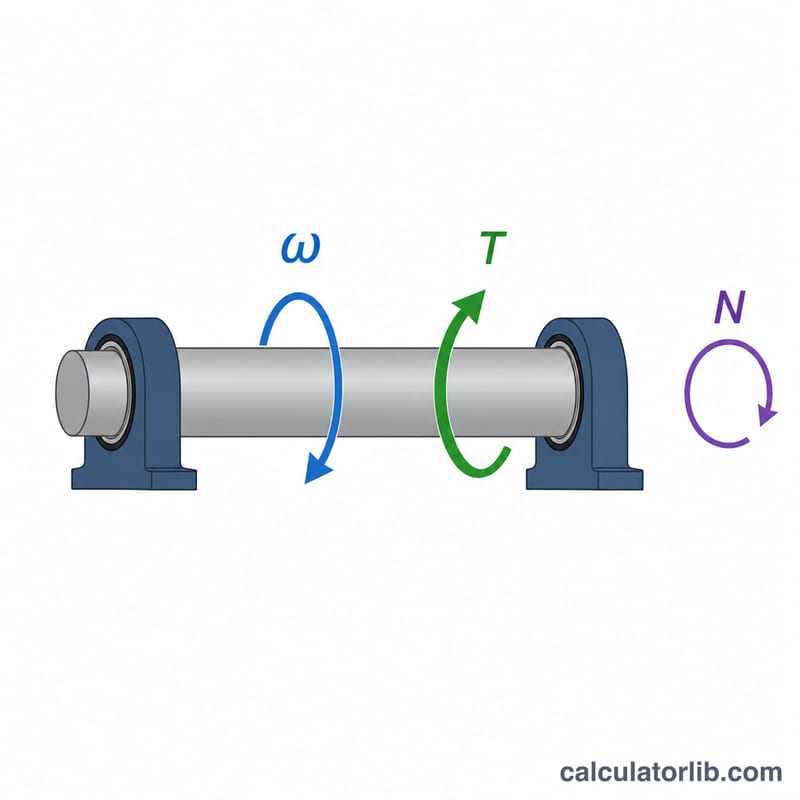
Power equals torque times angular velocity: \(P = T \times \omega\). With \(\omega\) in radians per second and speed \(N\) in RPM, \(\omega = 2\pi N / 60\). Solving for torque and substituting consistent units gives the handy shortcuts:
$$T_{N\cdot m} = \frac{9550 \times P_{kW}}{N}$$ and $$T_{lb\text{-}ft} = \frac{5252 \times P_{HP}}{N}$$. The constants 9550 (\(\approx 60000/2\pi\)) and 5252 (\(\approx 33000/2\pi\)) bake in the unit conversions so you don't have to. To convert between the two, \(1\ \text{lb-ft} \approx 1.3558\ \text{N}\cdot\text{m}\).
Worked example
A 15 kW motor runs at 1500 RPM. $$T = \frac{9550 \times 15}{1500} = \frac{143250}{1500} = 95.5\ \text{N}\cdot\text{m}$$ which is about 70.4 lb-ft. This is the steady torque available at the shaft at that speed.
FAQ
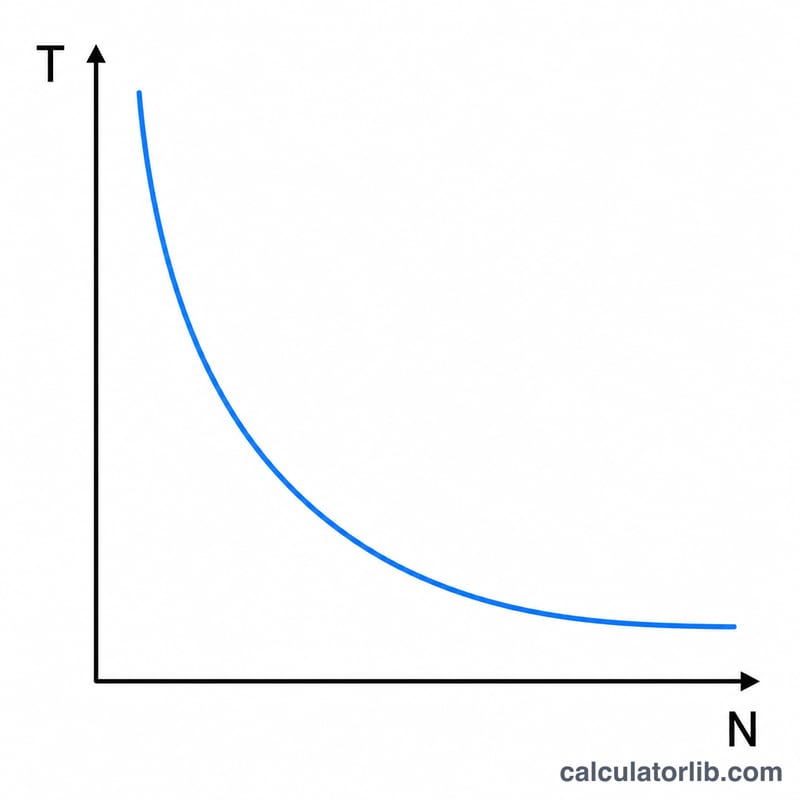
Does higher RPM mean less torque for the same power? Yes. For a fixed power, torque is inversely proportional to speed — doubling the RPM halves the torque.
Is this rated or peak torque? It is the torque corresponding to the power and speed you enter. Use rated values for continuous torque and peak values for short-duration limits.
Does it account for efficiency? No. It assumes the entered power is delivered to the shaft. Multiply input electrical power by efficiency first if you need output shaft torque.