
What This Calculator Does
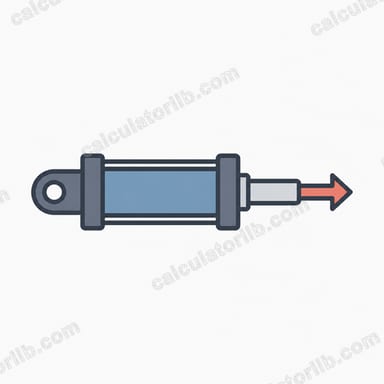
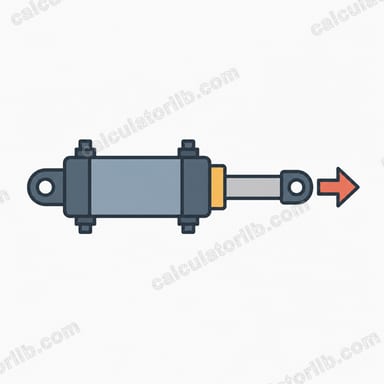
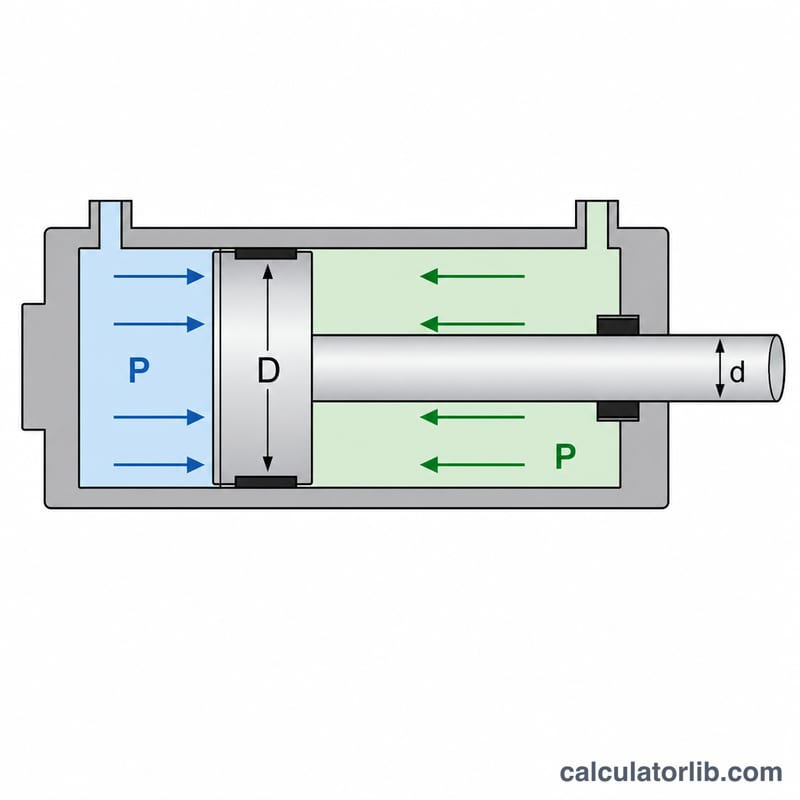
A hydraulic cylinder converts fluid pressure into linear force. This calculator finds the push (extend) and pull (retract) force a cylinder produces from the supply pressure and the cylinder geometry. Because the piston rod occupies part of the area on the retract side, the pull force is always smaller than the push force for the same pressure.
How To Use It
Choose your unit system: bar & mm (metric, result in newtons) or psi & inches (imperial, result in pounds-force). Enter the working pressure, the bore (piston) diameter, and the rod diameter. The bore diameter drives the push force; the rod diameter is subtracted from the bore area to give the annulus that drives the pull force. Leave the rod at 0 if you only need push force.
The Formula Explained
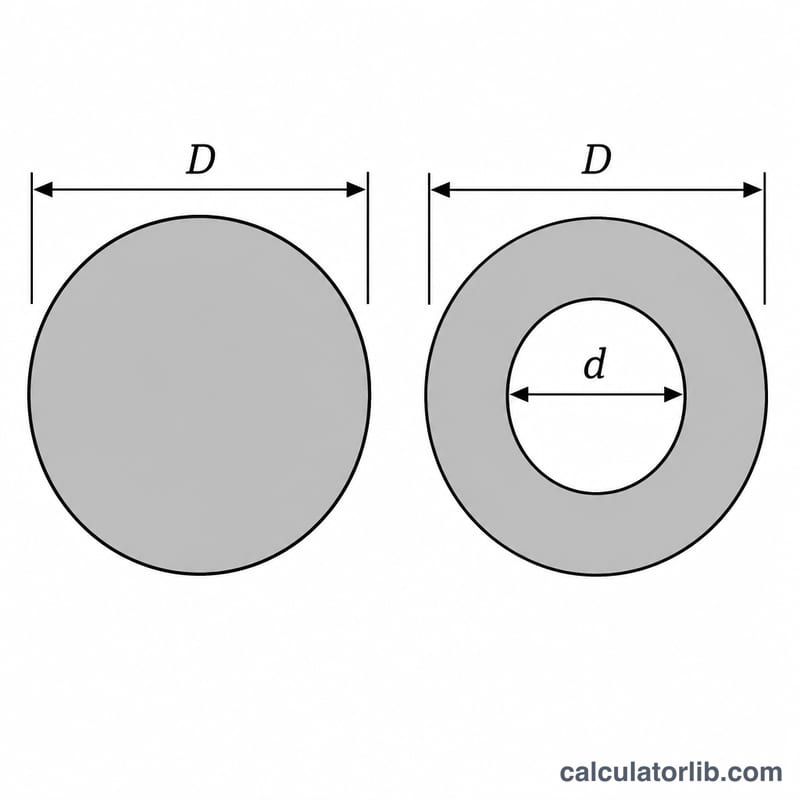
Force equals pressure times area: $$F = P \times A$$ The piston is a circle, so its area is \(A = \frac{\pi}{4} \times D^2\). For the retract stroke the effective area is the bore area minus the rod cross-section: $$A = \frac{\pi}{4} \times \left(D^2 - d^2\right)$$ In metric, pressure in bar is converted to N/mm² (\(1\ \text{bar} = 0.1\ \text{N/mm}^2\)) so that area in mm² yields force in newtons. In imperial, psi \(\times\) in² gives force directly in pounds-force.
Worked Example
A cylinder runs at 100 bar with a 50 mm bore and 25 mm rod. Push area = $$\frac{\pi}{4}(50^2) = 1963.5\ \text{mm}^2$$ At 10 N/mm² (100 bar), push force = \(19{,}635\ \text{N} \approx 19.6\ \text{kN}\). Annulus area = $$\frac{\pi}{4}(50^2 - 25^2) = 1472.6\ \text{mm}^2$$ so pull force \(\approx 14{,}726\ \text{N}\).
FAQ
Why is pull force lower than push force? The rod reduces the area pressure acts on during retraction, so less force is generated at the same pressure.
Does this account for friction or efficiency? No — it gives the theoretical force. Real cylinders deliver slightly less due to seal friction (typically 90–95% efficiency).
How do I convert newtons to kgf? Divide newtons by 9.80665 (e.g. \(19{,}635\ \text{N} \approx 2{,}002\ \text{kgf}\)).