
What Is the Force Calculator?
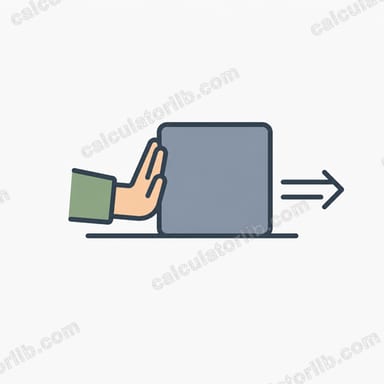
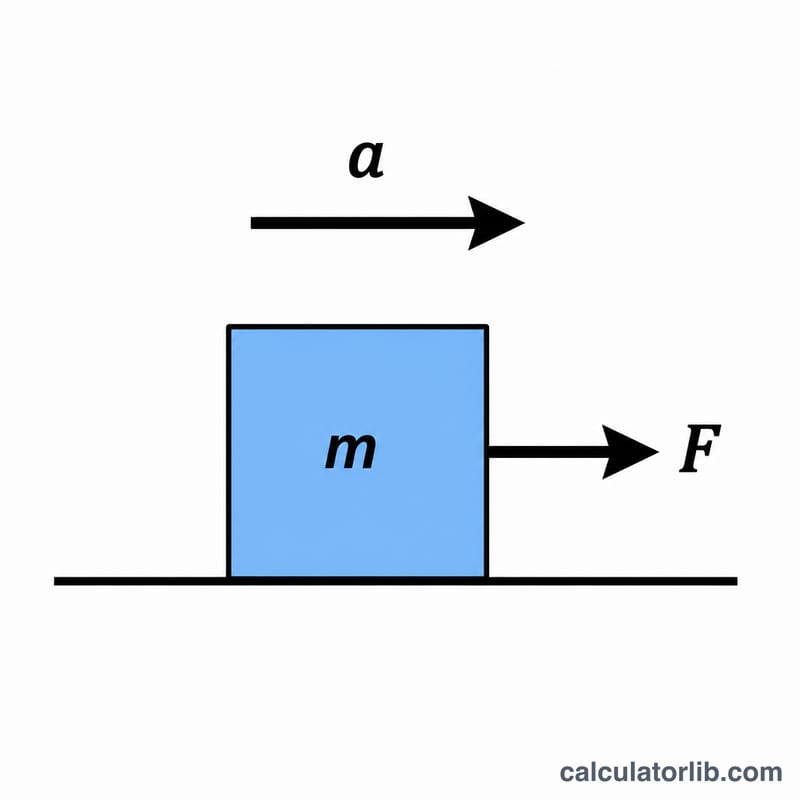
This Force Calculator applies Newton's second law of motion, \(F = m \cdot a\), to find the net force acting on an object. Force is the push or pull that changes an object's motion, and it depends on how much matter the object contains (its mass) and how quickly its velocity is changing (its acceleration). The result is expressed in newtons (N), where one newton is the force needed to accelerate a one-kilogram mass at one metre per second squared.
How to Use It
Enter the object's mass in kilograms and its acceleration in metres per second squared, then read off the force in newtons. To find the weight of an object at rest on Earth, use the gravitational acceleration of about 9.81 m/s² as the acceleration value.
The Formula Explained
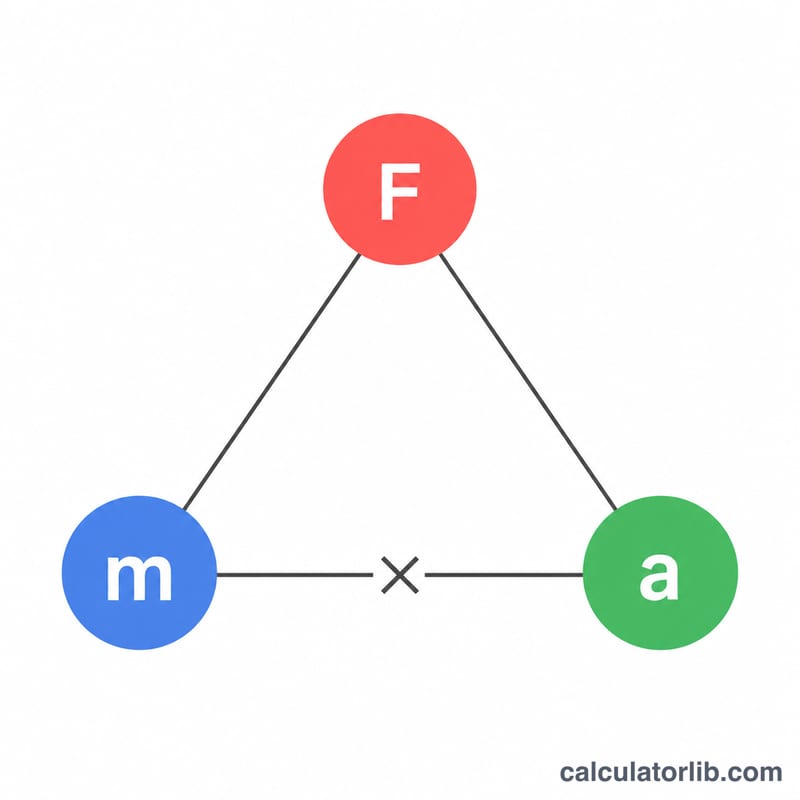
Newton's second law states that the net force on a body equals the product of its mass and acceleration: $$F = m \times a$$ Mass (\(m\)) is measured in kilograms, acceleration (\(a\)) in m/s², and the resulting force (\(F\)) in newtons. The law is linear, so doubling either the mass or the acceleration doubles the force.
Worked Example
Suppose a 10 kg crate is pushed so that it accelerates at 3 m/s². The force required is $$F = 10 \times 3 = 30 \text{ N}.$$ If instead you want the weight of that same crate at rest, multiply its mass by gravity: $$F = 10 \times 9.81 = 98.1 \text{ N}.$$
FAQ
What unit is force measured in? The SI unit of force is the newton (N), equal to \(\text{kg}\cdot\text{m/s}^2\).
How do I find weight instead of force? Weight is just force due to gravity — set acceleration to 9.81 m/s² (Earth's surface gravity).
Can acceleration be negative? Yes. A negative acceleration (deceleration) yields a negative force, indicating it acts in the opposite direction of motion.