
What is the Buoyant Force Calculator?
This tool calculates the upward buoyant force exerted by a fluid on a fully or partially submerged object. It is based on Archimedes' principle, which states that the buoyant force equals the weight of the fluid displaced by the object. The calculator works for any fluid (water, oil, air, seawater) on any planet — simply adjust the density and gravity values.
How to use it
Enter three values: the fluid density in kg/m³ (fresh water ≈ 1000, seawater ≈ 1025, air ≈ 1.225), the displaced volume in cubic meters (the volume of fluid pushed aside, equal to the submerged volume of the object), and the gravitational acceleration (9.81 m/s² on Earth). The calculator returns the buoyant force in newtons and the equivalent mass of displaced fluid.
The formula explained
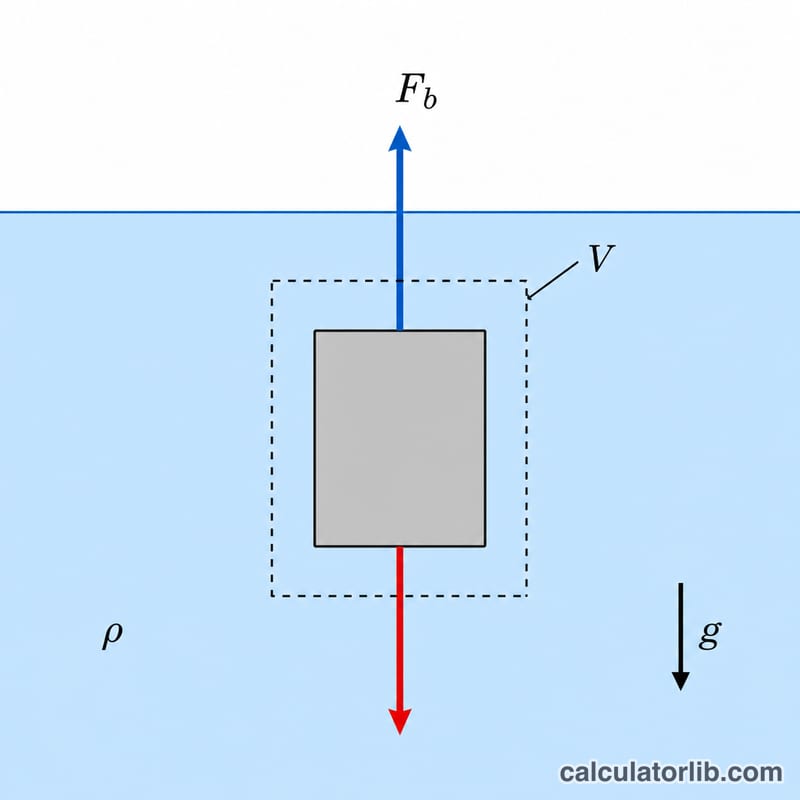
The governing equation is Fb = ρ · g · V, where ρ (rho) is the fluid density, g is gravity, and V is the displaced volume. The product ρ · V gives the mass of displaced fluid, and multiplying by g converts that mass into a weight (force). Because the buoyant force depends only on the displaced fluid — not the object's own material — a steel ship floats while a steel ball sinks, depending on how much volume each displaces.
Worked example
A sealed box of volume 0.05 m³ is fully submerged in fresh water (ρ = 1000 kg/m³) on Earth (g = 9.81 m/s²). The buoyant force is Fb = 1000 × 9.81 × 0.05 = 490.5 N. This equals the weight of 50 kg of water displaced — so if the box weighs less than 490.5 N it floats, and if it weighs more it sinks.
Gravity & Reference Constants
The gravitational acceleration gravity sets how strongly the displaced fluid is pulled, and therefore the buoyant force. Standard Earth gravity is the usual default; other bodies are listed for off-world or comparative problems.
| Body | Gravity (m/s²) |
|---|---|
| Earth (standard, g₀) | 9.80665 |
| Moon | 1.62 |
| Mars | 3.71 |
| Jupiter (cloud-top) | 24.79 |
Variables & Units (SI)
| Symbol | Quantity | SI unit |
|---|---|---|
| \(\rho\) | Fluid density (rho) | kg/m³ |
| \(V\) | Displaced volume (volume) | m³ |
| \(g\) | Gravitational acceleration (gravity) | m/s² |
| \(F_b\) | Buoyant force | N (newtons) |
Keep all three inputs in SI units so the result comes out in newtons: \(F_b = \rho \, g \, V\). Convert litres to cubic metres by dividing by 1000, and grams per cm³ to kg/m³ by multiplying by 1000.
FAQ
Does the object's weight matter for buoyant force? No. Buoyant force depends only on displaced fluid volume, density, and gravity. The object's weight determines whether it floats, but not the buoyant force itself.
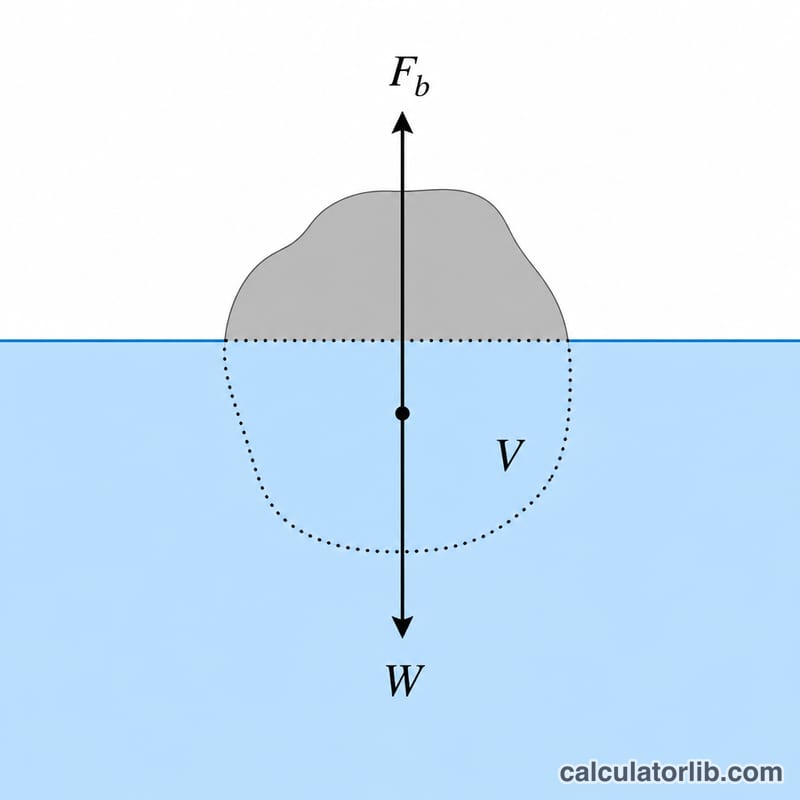
What volume should I enter? Enter the submerged volume — the volume of fluid actually displaced. For a fully submerged object this is its total volume; for a floating object it is only the part below the surface.
Can I use it for air or gases? Yes. Use the density of the surrounding gas (air ≈ 1.225 kg/m³) to estimate lift on balloons and airships.