
What Is the Lift Force Calculator?
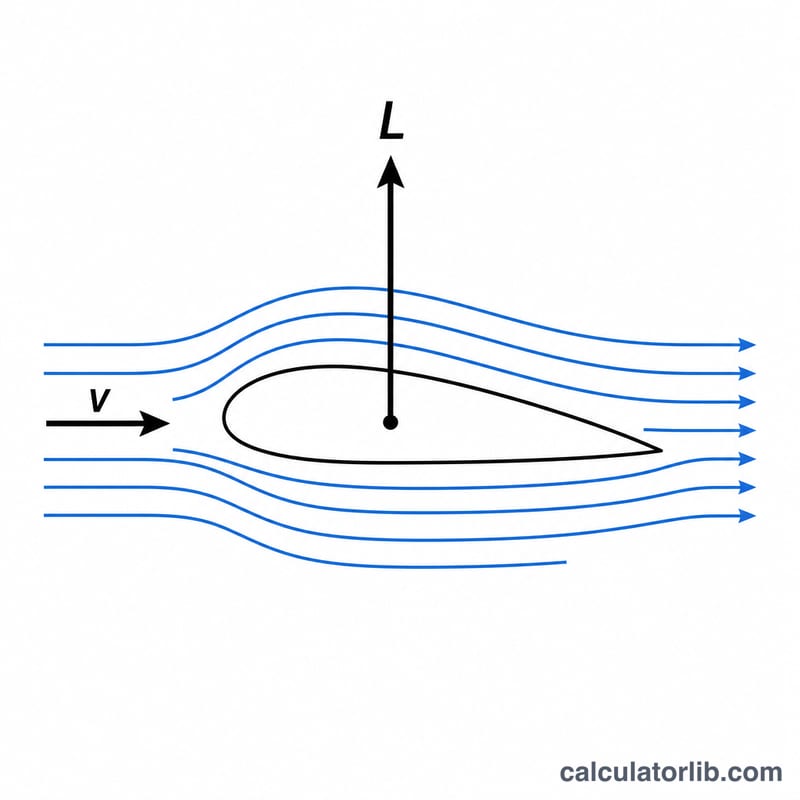
This calculator finds the aerodynamic lift force generated by a wing or airfoil using the standard lift equation, $$L = \frac{1}{2} \cdot \rho \cdot v^{2} \cdot C_L \cdot A$$ Lift is the upward force that allows aircraft to fly, produced as air flows over and under a wing. The tool is universal physics and uses SI units, returning the result in newtons (N).
How to Use It
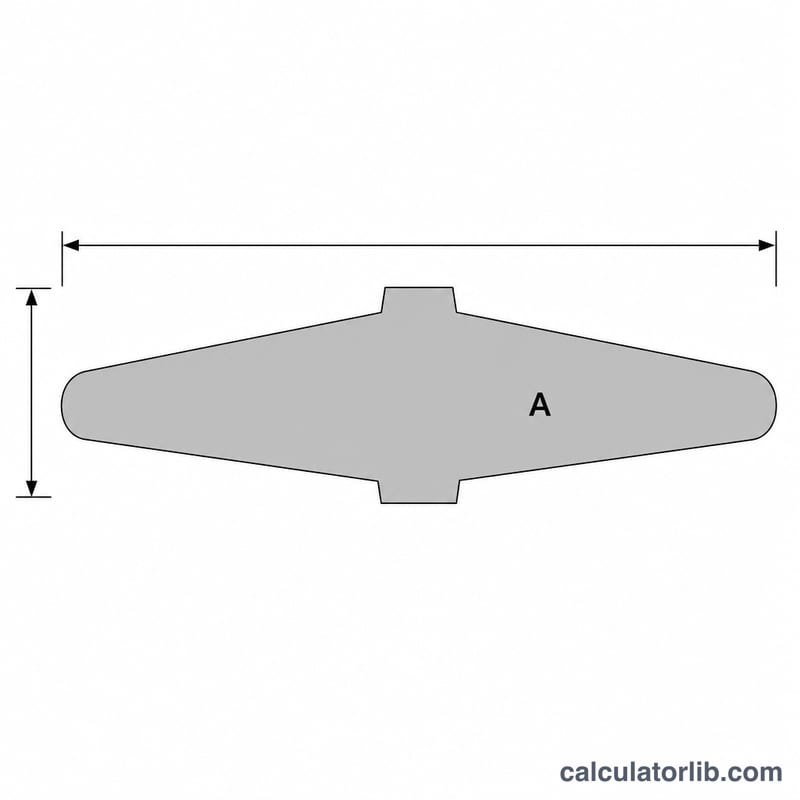
Enter four values: the air density \(\rho\) in kg/m³ (about 1.225 at sea level), the airspeed \(v\) in m/s, the dimensionless lift coefficient \(C_L\) (which depends on the airfoil shape and angle of attack), and the wing planform area \(A\) in m². The calculator multiplies them together with the \(\frac{1}{2}\) factor and the velocity squared to give the lift force, and also reports the dynamic pressure \(\frac{1}{2}\rho v^{2}\).
The Formula Explained
The term \(\frac{1}{2}\rho v^{2}\) is the dynamic pressure — the kinetic energy per unit volume of the moving air. Multiplying it by the wing area \(A\) converts pressure into a force, and the lift coefficient \(C_L\) scales that force according to how effectively the airfoil deflects the airflow. Note that lift grows with the square of velocity: doubling the speed quadruples the lift.
Worked Example
For \(\rho = 1.225\) kg/m³, \(v = 50\) m/s, \(C_L = 1.0\), and \(A = 20\) m²: $$L = 0.5 \times 1.225 \times 50^{2} \times 1.0 \times 20 = 0.5 \times 1.225 \times 2500 \times 20 = 30{,}625 \text{ N}$$ The dynamic pressure is \(0.5 \times 1.225 \times 2500 = 1{,}531.25\) Pa.
FAQ
What is a typical lift coefficient? Cruise \(C_L\) for airliners is roughly 0.4–0.6, while near stall with flaps it can reach 1.5–2.5.
What air density should I use? Use 1.225 kg/m³ at sea level in standard conditions; density drops with altitude and temperature.
Does this work for any wing? Yes — the lift equation applies to any airfoil as long as you supply the correct \(C_L\) and reference area.