
What Is EIRP?
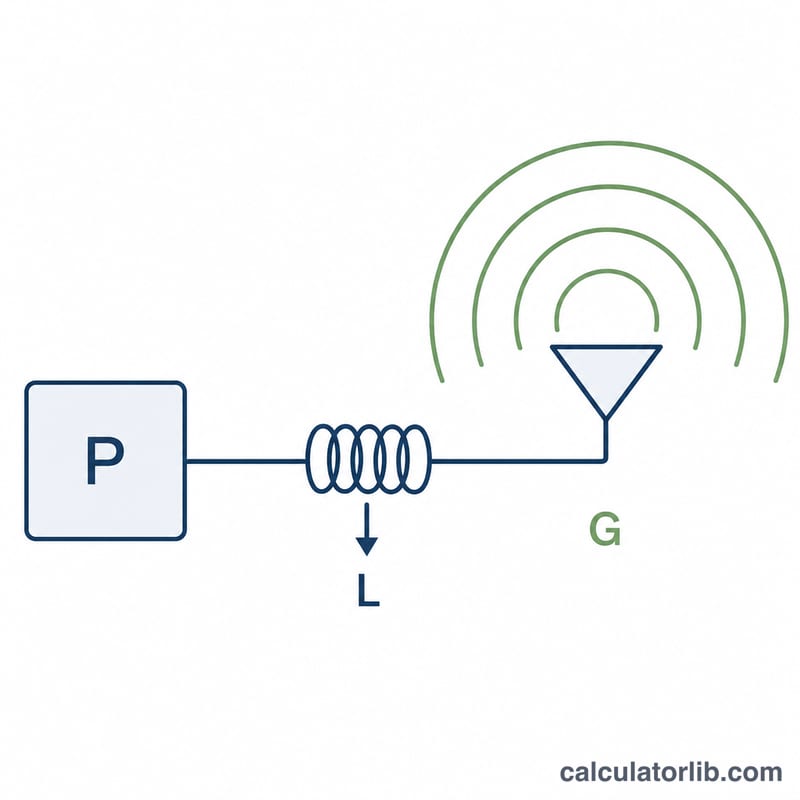
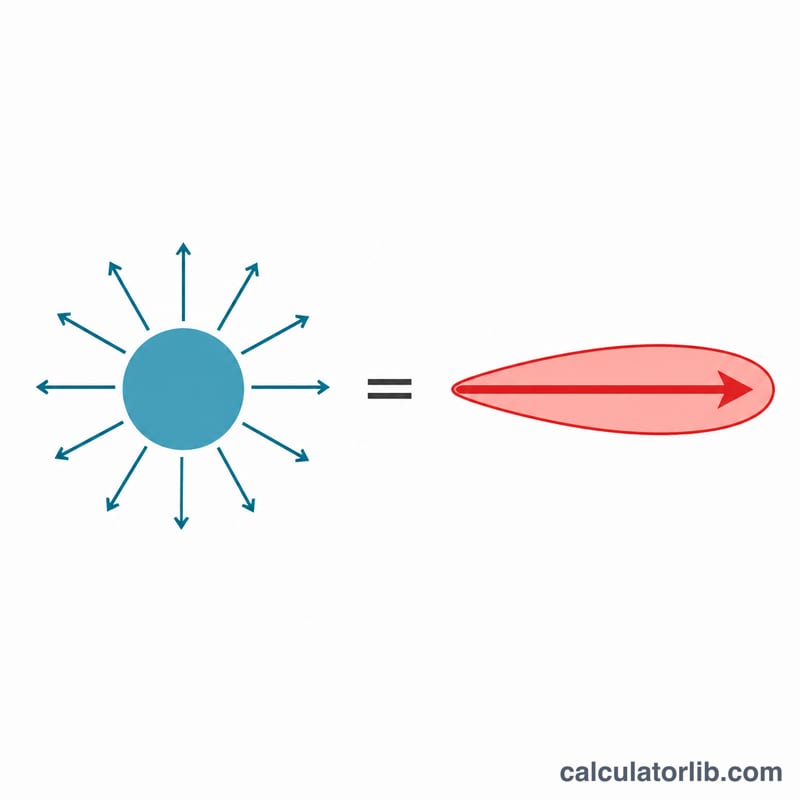
Effective Isotropic Radiated Power (EIRP) is the total power that a theoretical isotropic antenna would need to radiate to produce the peak power density observed in the direction of maximum antenna gain. It is the standard figure used in RF link budgets, regulatory compliance checks, and Wi-Fi, cellular, and satellite system design. EIRP combines three things: how much power the transmitter delivers, how much the antenna focuses (gain), and how much is lost in the feed line.
How to Use This Calculator
Enter the transmitter output power in dBm, the antenna gain in dBi, and the total cable plus connector loss in dB. The calculator returns EIRP in dBm, dBW, and watts. Because all inputs are in logarithmic units, you simply add and subtract them — no multiplication is needed.
The Formula Explained
$$\text{EIRP (dBm)} = \text{Tx Power (dBm)} + \text{Antenna Gain (dBi)} - \text{Cable Loss (dB)}$$ Transmitter power and antenna gain raise the radiated power, while cable loss reduces it. To convert to watts, use \(P_{W} = 10^{(\text{EIRP}_{\text{dBm}} - 30)/10}\), since \(0\ \text{dBm} = 1\ \text{mW}\) and \(30\ \text{dBm} = 1\ \text{W}\).
Worked Example
Suppose a transmitter outputs 30 dBm, the antenna has 12 dBi gain, and the cable loss is 2 dB. Then $$\text{EIRP} = 30 + 12 - 2 = 40\ \text{dBm}.$$ In dBW that is \(40 - 30 = 10\ \text{dBW}\), and in watts it is \(10^{(40-30)/10} = 10^{1} = 10\ \text{W}\).
FAQ
What is the difference between dBi and dBd? dBi references an isotropic radiator; dBd references a dipole. To convert, \(\text{dBi} = \text{dBd} + 2.15\).
Should I include connector loss? Yes — add all feed-line losses (cable, connectors, splitters) into the cable loss field for an accurate result.
Why does regulatory EIRP matter? Many bands (e.g. Wi-Fi) cap legal EIRP. Knowing your EIRP ensures your installation stays within authorized limits.