
What Is Power Dissipation?
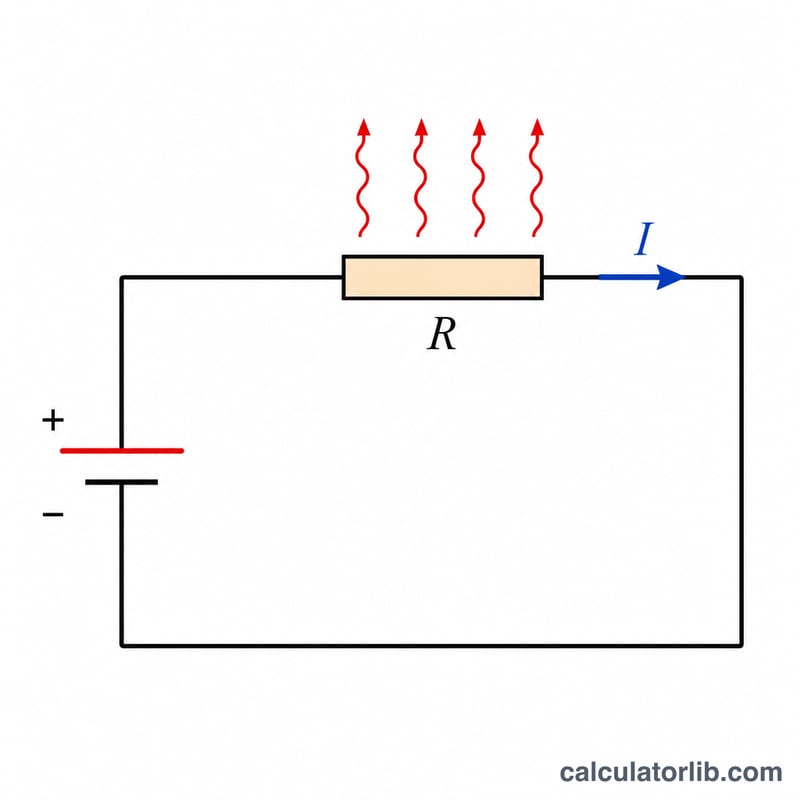
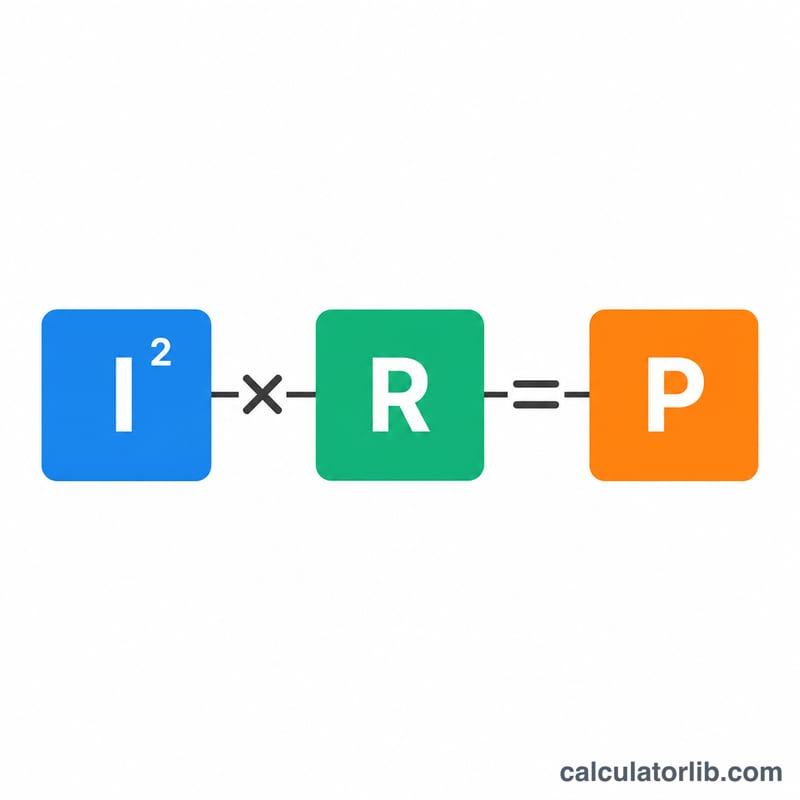
Power dissipation is the rate at which electrical energy is converted into heat as current flows through a resistive component. When current passes through a resistor, the resistor opposes that flow and the lost energy appears as heat. This calculator uses the classic relationship \(P = I^2 \times R\) to find the power dissipated, where P is power in watts, I is current in amperes, and R is resistance in ohms. It applies universally to any resistive circuit element.
How to Use This Calculator
Enter the current flowing through the component in amperes (A) and its resistance in ohms (Ω). The calculator squares the current, multiplies it by the resistance, and returns the dissipated power in watts (W). Use this to size resistors, predict heat output, choose heat sinks, or verify that a component stays within its power rating.
The Formula Explained
The equation \(P = I^2 R\) comes from combining Ohm's law (\(V = IR\)) with the general power formula (\(P = VI\)). Substituting \(V = IR\) into \(P = VI\) gives $$P = (IR) \cdot I = I^2 R.$$ Because current is squared, doubling the current quadruples the power dissipated — a key reason high-current connections must be sized carefully.
Worked Example
Suppose a current of 2 A flows through a 10 Ω resistor. Then $$P = (2)^2 \times 10 = 4 \times 10 = 40 \text{ watts}.$$ That resistor would need a power rating comfortably above 40 W to avoid overheating.
FAQ
Can I use \(P = I^2 R\) for AC circuits? Yes, for resistive (real-power) dissipation use the RMS current value as I.
What if I only know voltage and resistance? Use the equivalent form \(P = V^2/R\) instead, since both derive from Ohm's law.
Why is the current squared? Power depends on both the current and the voltage drop (which itself is proportional to current), so it scales with the square of the current.