
What Is the Universe Expansion Calculator?
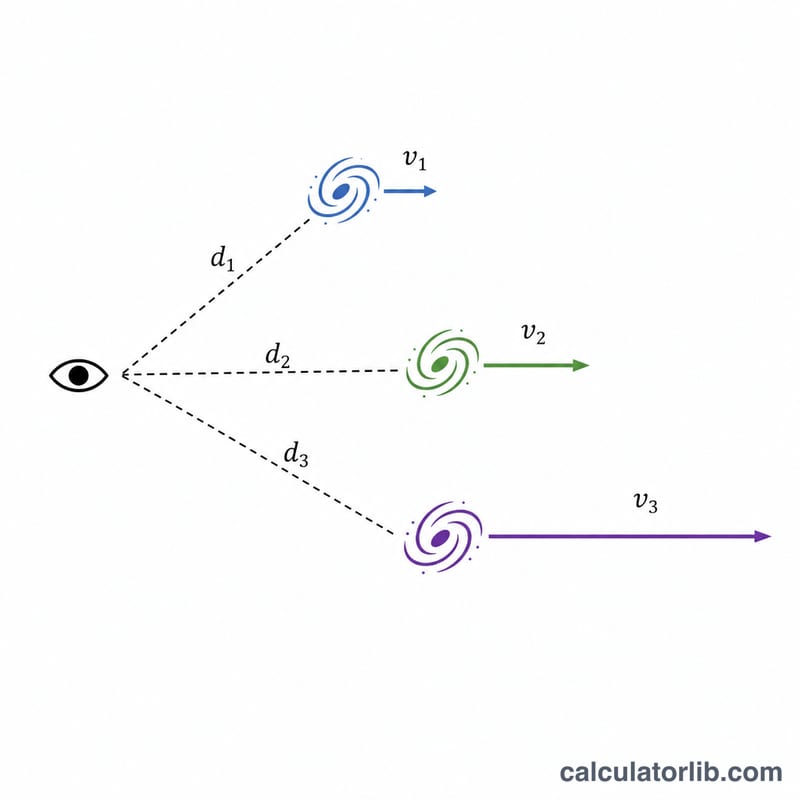
This tool applies Hubble's Law, one of the cornerstones of modern cosmology, which states that distant galaxies recede from us at a velocity proportional to their distance. The further away a galaxy is, the faster it appears to move away — direct evidence that the universe is expanding. The relationship is written as \(v = \text{H}_0 \times d\), where \(v\) is the recession velocity, \(\text{H}_0\) is the Hubble constant, and \(d\) is the distance.
How to Use It
Enter the distance to a galaxy in megaparsecs (Mpc) — 1 Mpc is about 3.26 million light-years. Then enter the Hubble constant \(\text{H}_0\) in km/s per Mpc. Modern measurements place \(\text{H}_0\) between roughly 67 and 74 km/s/Mpc; we default to 70. The calculator returns the recession velocity in km/s and also shows it as a fraction of the speed of light.
The Formula Explained
Hubble's Law multiplies the Hubble constant by distance: $$v = \text{H}_0 \times d$$ Because \(\text{H}_0\) has units of km/s/Mpc and distance is in Mpc, the Mpc units cancel, leaving velocity in km/s. To express how relativistic the motion is, we divide by the speed of light \(c \approx 299{,}792.458\) km/s.
$$\frac{v}{c} = \frac{\text{H}_0 \times \text{Distance}}{299792.458}$$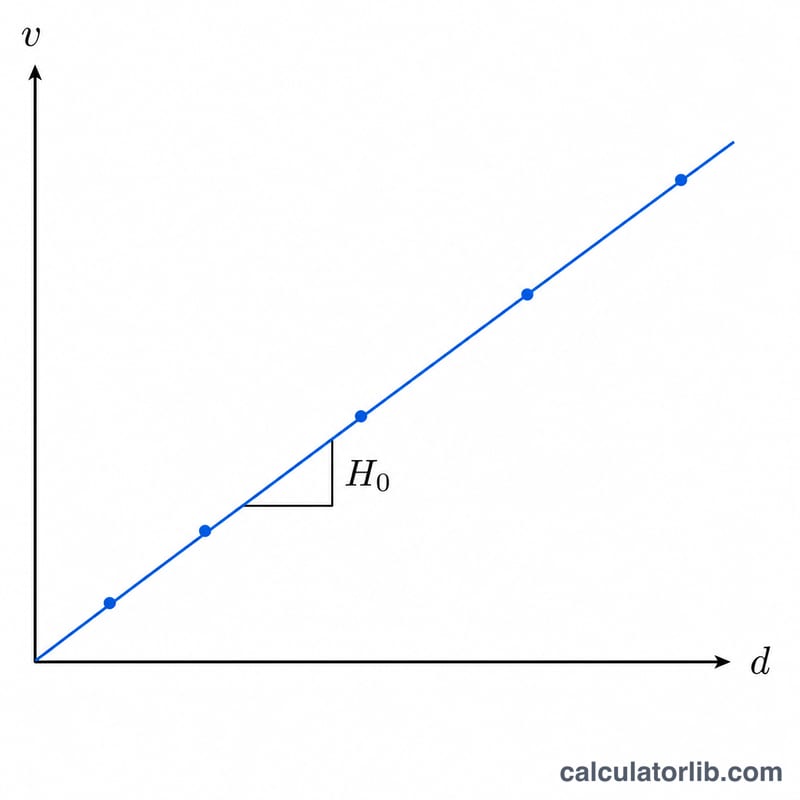
Worked Example
Suppose a galaxy lies 100 Mpc away and \(\text{H}_0 = 70\) km/s/Mpc. Then $$v = 70 \times 100 = 7{,}000 \text{ km/s}$$ As a fraction of light speed that is \(7{,}000 \div 299{,}792.458 \approx 0.0234\,c\), or about 2.3% of the speed of light.
FAQ
What is the Hubble constant? It is the current expansion rate of the universe, measured as how fast space stretches per unit distance — around 70 km/s for every megaparsec.
Does Hubble's Law work for very close objects? No. Nearby galaxies have local "peculiar" motions that overwhelm the smooth Hubble flow, so the law is reliable mainly for distant galaxies.
Can the velocity exceed the speed of light? For very large distances the computed recession velocity can exceed \(c\). This is allowed because it is the expansion of space itself, not motion through space, and does not violate relativity.