
What is the Prandtl-Meyer Expansion Function?
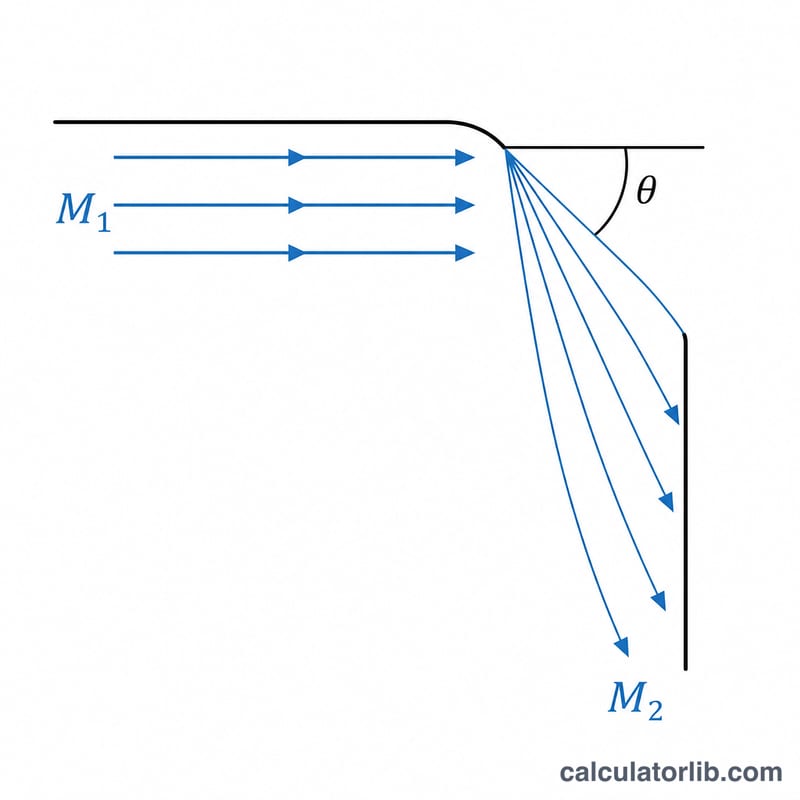
The Prandtl-Meyer function \(\nu(M)\) describes how much a supersonic flow turns as it expands isentropically (without losses) around a convex corner. As the flow accelerates from Mach 1 to a higher Mach number \(M\), it bends through an expansion fan. The function gives the cumulative turning angle for that acceleration. It is a cornerstone of compressible gas dynamics, used in nozzle design, supersonic airfoils, and method-of-characteristics solutions.
How to Use This Calculator
Enter the Mach number \(M\) (must be 1 or greater, since the function is only defined for supersonic flow) and the specific heat ratio \(\gamma\) of the gas. For air, \(\gamma \approx 1.4\). Click calculate to get \(\nu(M)\) in degrees, the same value in radians, and the Mach angle \(\mu\). To find the flow turn between two Mach numbers, compute \(\nu\) at each and subtract.
The Formula Explained
The equation is
$$\nu(M) = \sqrt{\frac{\gamma+1}{\gamma-1}}\;\arctan\!\sqrt{\frac{M^{2}-1}{\frac{\gamma+1}{\gamma-1}}} \;-\; \arctan\!\sqrt{M^{2}-1}$$The first arctan term scales the rotation by the gas property factor, and the second subtracts the geometric Mach-wave contribution. The result is in radians; this tool multiplies by \(180/\pi\) for degrees. At \(M=1\), \(\nu=0\); the function rises monotonically and approaches a maximum of about \(130.45^\circ\) for \(\gamma=1.4\) as \(M\to\infty\).
Worked Example
For \(M = 2.0\) and \(\gamma = 1.4\): \(M^{2}-1 = 3\), ratio \(= \frac{2.4}{0.4} = 6\). First term:
$$\sqrt{6} \cdot \arctan\!\sqrt{\tfrac{3}{6}} = 2.4495 \cdot \arctan(0.7071) = 2.4495 \cdot 0.61548 = 1.50762\ \text{rad}$$Second term:
$$\arctan\!\sqrt{3} = \arctan(1.7321) = 1.04720\ \text{rad}$$So
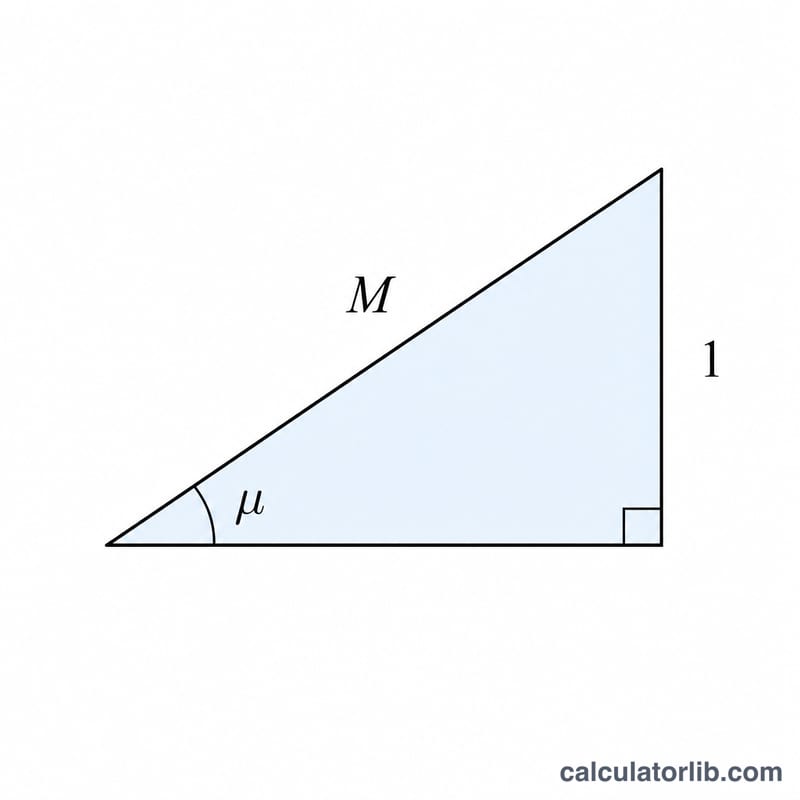
$$\nu = 1.50762 - 1.04720 = 0.46042\ \text{rad} = 26.380^\circ$$The Mach angle
$$\mu = \arcsin(0.5) = 30^\circ$$FAQ
Why must M be at least 1? The expansion fan and the \(\sqrt{M^{2}-1}\) terms only exist in supersonic flow. Below \(M=1\) the function is undefined.
What is the maximum turning angle? For air (\(\gamma=1.4\)) the limit as \(M\to\infty\) is \(\nu_{\max} = (\sqrt{6} - 1)\cdot 90^\circ \approx 130.45^\circ\), the largest angle a flow could theoretically turn while expanding to vacuum.
How do I find downstream Mach number for a given turn? Add the turn angle to the upstream \(\nu\), then invert the function numerically to get the new \(M\).