
What is the Reynolds Number?
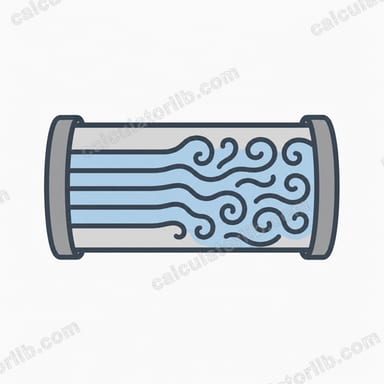
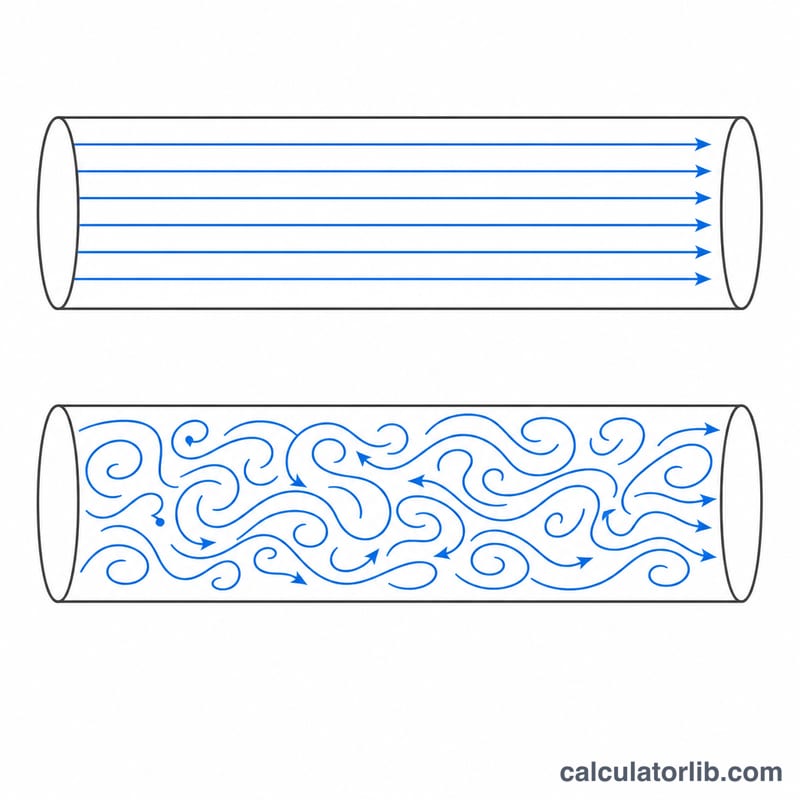
The Reynolds number (Re) is a dimensionless quantity in fluid mechanics that predicts whether a flow will be laminar (smooth) or turbulent (chaotic). It expresses the ratio of inertial forces to viscous forces in a moving fluid. Engineers use it to design pipes, aircraft, pumps, heat exchangers and countless other systems where fluid behavior matters.
How to use this calculator
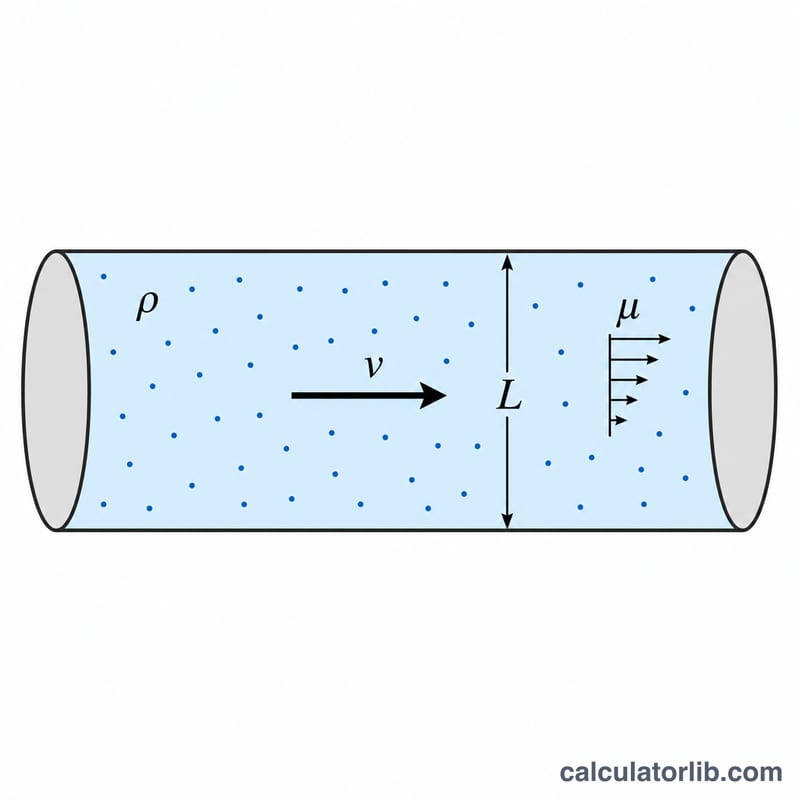
Enter four values: the fluid density \(\rho\) (kg/m³), the flow velocity \(v\) (m/s), a characteristic length \(L\) (m) — typically the pipe diameter for internal flow — and the dynamic viscosity \(\mu\) (Pa·s). The calculator returns the Reynolds number and classifies the flow regime.
The formula explained
The Reynolds number is calculated as $$Re = \frac{\text{Density } \rho \cdot \text{Velocity } v \cdot \text{Length } L}{\text{Viscosity } \mu}$$ A large \(Re\) means inertial forces dominate (turbulent flow), while a small \(Re\) means viscous forces dominate (laminar flow). For flow in a circular pipe the common thresholds are: \(Re < 2300\) is laminar, 2300–4000 is transitional, and \(Re > 4000\) is turbulent.
Worked example
Water (\(\rho = 1000\) kg/m³, \(\mu = 0.001\) Pa·s) flows at \(v = 2\) m/s through a pipe of diameter \(L = 0.05\) m. Then $$Re = \frac{1000 \times 2 \times 0.05}{0.001} = \frac{100}{0.001} = 100{,}000.$$ Since this far exceeds 4000, the flow is turbulent.
FAQ
Is the Reynolds number unitless? Yes. When SI units are used consistently, all units cancel, leaving a pure dimensionless number.
What length should I use? Use the characteristic length relevant to your geometry: pipe diameter for internal pipe flow, chord length for an airfoil, or plate length for flow over a flat plate.
Can I use kinematic viscosity instead? Yes — divide \(v \cdot L\) by the kinematic viscosity \(\nu\) (m²/s) since \(\nu = \mu/\rho\).