
What is the Ratio Unit Conversion Calculator?
This is a universal mathematical tool that converts a dimensionless ratio expressed in one unit into all the other common ratio units at once: none (unitless), percent (%), permille (parts per thousand), permyriad (basis points / parts per ten-thousand), ppm, ppb, ppt and ppq (parts per million, billion, trillion and quadrillion). Because every one of these is simply a power-of-ten scale of the same pure fraction, the conversions are exact and apply everywhere - there are no country-specific rules.
How to use it
Type the number you have into Ratio value, then pick its unit from the Input unit dropdown. The calculator instantly shows the equivalent value in every other unit. For example, enter 1 and select Percent (%) to see that 1% equals 10 permille, 100 basis points, 10,000 ppm, and so on.
The formula explained
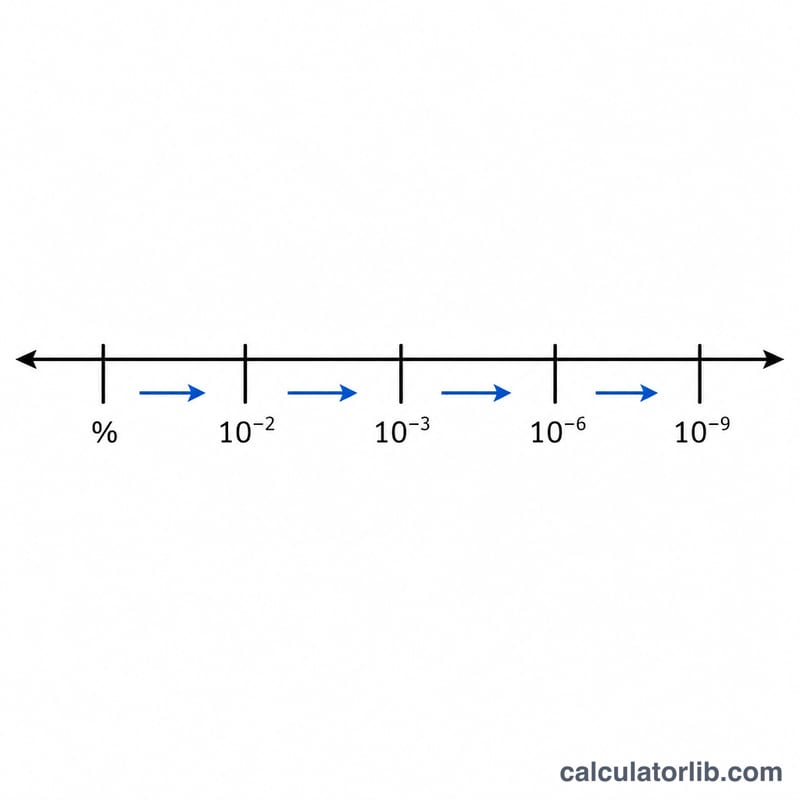
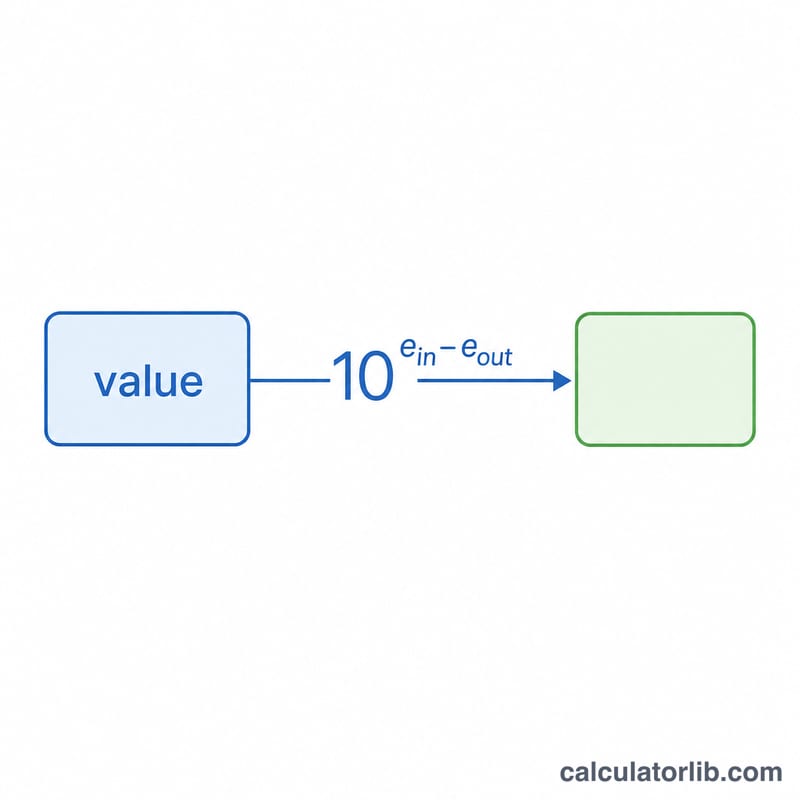
Each unit corresponds to an exponent of ten. None = \(10^{0}\), percent = \(10^{-2}\), permille = \(10^{-3}\), permyriad = \(10^{-4}\), ppm = \(10^{-6}\), ppb = \(10^{-9}\), ppt = \(10^{-12}\) and ppq = \(10^{-15}\). First the input is reduced to a canonical fraction $$f = \text{value} \times 10^{e_{\text{in}}}$$ Then any output unit U is found with $$\text{out}_U = \text{value} \times 10^{\,e_{\text{in}} - e_U}$$ Working with the difference of exponents avoids floating-point drift.
Worked example
Enter value = 500 with Input unit = ppm (e = -6). The fraction is $$f = 500 \times 10^{-6} = 0.0005$$ As percent that is \(0.0005 / 0.01 = 0.05\%\), as permille 0.5, and as a plain fraction 0.0005. Switch the same 0.05% back to ppm and you again get 500.
FAQ
Is a basis point the same as permyriad? Yes. One basis point is one part per ten-thousand (\(10^{-4}\)), so 100 basis points = 1%.
What does "none / unitless" mean? It is the raw fraction itself, where 1.0 represents 100% (a whole).
Can I enter negative values? Yes. Ratios are usually non-negative, but the math scales linearly, so negatives convert correctly too.