
What Is the Water Viscosity Calculator?
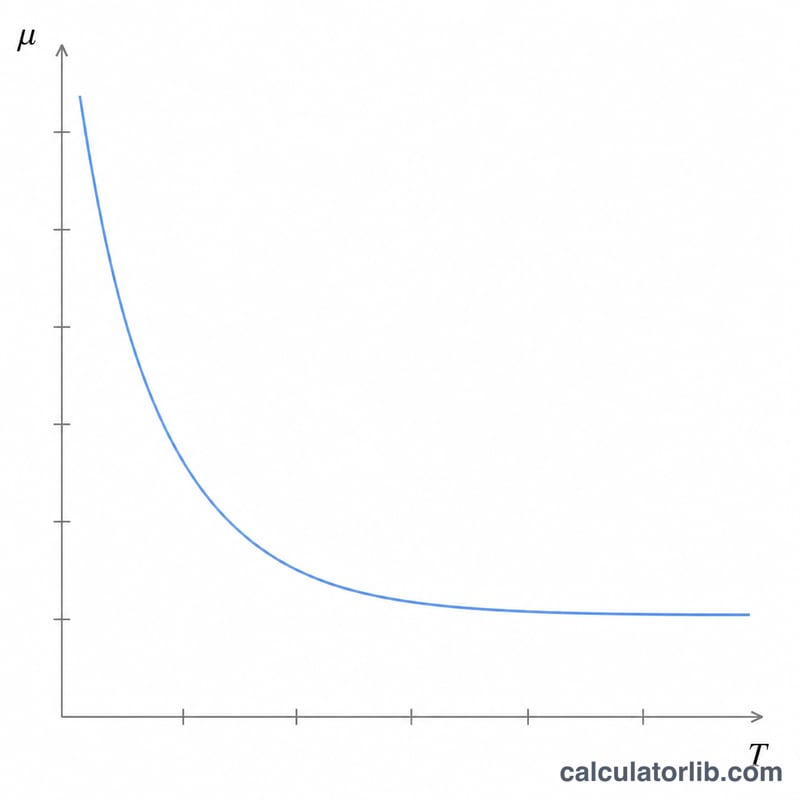
Viscosity measures a fluid's resistance to flow. For water, viscosity drops sharply as temperature rises — hot water flows much more easily than cold water. This calculator estimates the dynamic (absolute) viscosity of pure water at any temperature using the well-known Vogel empirical relation, returning results in pascal-seconds (Pa·s), millipascal-seconds (mPa·s), and centipoise (cP). The relation is a universal physics tool and applies anywhere.
How to Use It
Enter the water temperature in degrees Celsius and read off the viscosity. The calculator converts your input to kelvin (T = °C + 273.15), applies the Vogel formula, and reports the answer in three common units. Note that 1 mPa·s equals exactly 1 centipoise, so those two figures are numerically identical.
The Formula Explained
The Vogel (Vogel–Fulcher–Tammann style) relation used here is:
$$\mu(T) = 2.414\times10^{-5} \cdot 10^{\frac{247.8}{T - 140}} \ \text{Pa}\cdot\text{s}$$where \(T\) is the absolute temperature in kelvin. The constant \(2.414\times10^{-5}\) sets the high-temperature limit, while the exponent term grows rapidly as \(T\) falls toward \(140\ \text{K}\), capturing the steep increase in viscosity at low temperatures.
Worked Example
At 20 °C, \(T = 293.15\ \text{K}\), so \(T - 140 = 153.15\). The exponent is \(247.8 / 153.15 \approx 1.6180\), giving \(10^{1.6180} \approx 41.50\). Multiplying by \(2.414\times10^{-5}\) gives \(\mu \approx 1.002\times10^{-3}\ \text{Pa}\cdot\text{s}\), or about 1.00 mPa·s (1.00 cP) — matching the textbook value for water at room temperature.
FAQ
What units does this use? Dynamic viscosity in Pa·s, mPa·s, and centipoise (cP). \(1\ \text{Pa}\cdot\text{s} = 1000\ \text{cP}\).
How accurate is the Vogel relation? It is accurate to within roughly 1% over the common 0–100 °C range for pure water at atmospheric conditions; it is an empirical fit, not an exact theory.
Is this kinematic or dynamic viscosity? This gives dynamic (absolute) viscosity \(\mu\). To get kinematic viscosity \(\nu\), divide by the water density at that temperature.