
What Is the Wind Correction Angle?
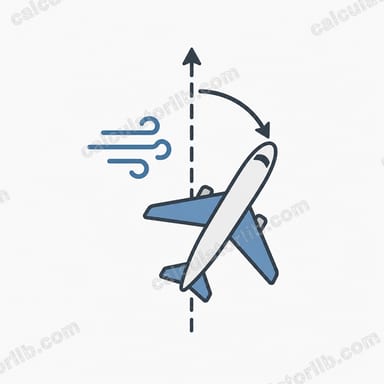
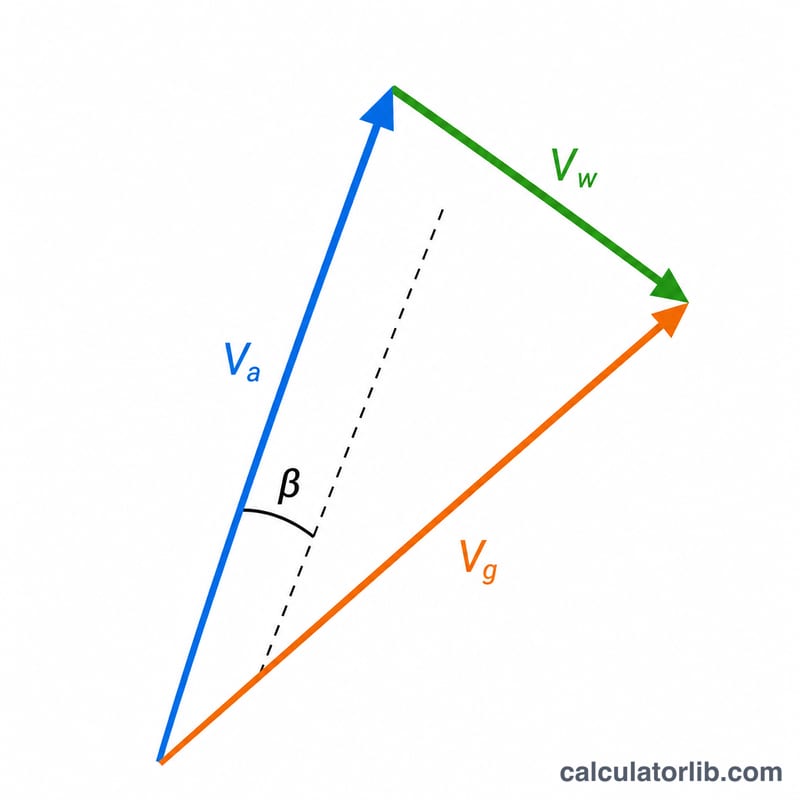
The wind correction angle (WCA), also called the crab angle, is the number of degrees a pilot must turn the aircraft's nose into the wind so that the actual track over the ground matches the desired course. Because wind pushes an aircraft sideways, flying with the nose pointed straight at the destination causes drift. The WCA cancels that drift so the airplane "crabs" along the intended line. This calculator is universal and applies to any aircraft, glider, drone, or even watercraft navigation problem.
How to Use This Calculator
Enter your true airspeed (TAS) in knots, the wind speed in knots, your desired course in degrees, and the direction the wind is coming from in degrees. The calculator returns the wind correction angle, the magnetic/true heading you should fly, and your resulting ground speed. A positive WCA means you crab to the right; a negative value means crab left.
The Formula Explained
The core relationship is $$\text{WCA} = \arcsin\!\left( \frac{\text{Wind Speed} \cdot \sin\!\left( \text{Wind Dir} - \text{Course} \right)}{\text{TAS}} \right)$$ where \(\theta\) is the angle between the wind direction and the course. The sine of the wind angle isolates the crosswind component, and dividing by airspeed converts it to an angle. Ground speed is then $$\text{GS} = \text{TAS}\cos(\text{WCA}) - \text{Wind Speed}\cos\!\left( \text{Wind Dir} - \text{Course} \right)$$ accounting for the head/tailwind component along the track.
Worked Example
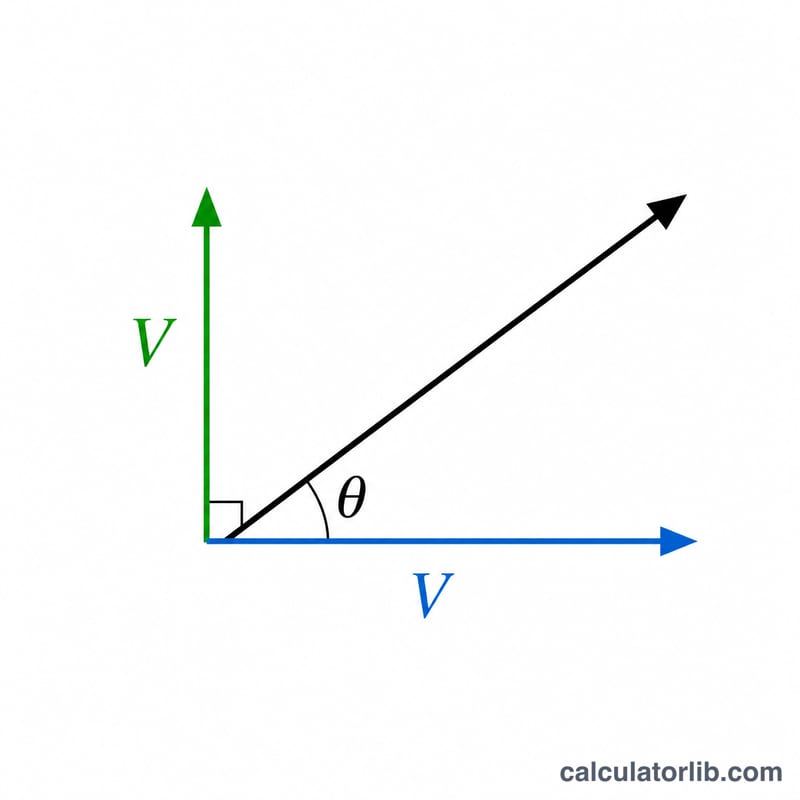
Suppose TAS = 120 kt, wind = 30 kt from 180°, and your course is 090°. The wind angle is \(180 - 90 = 90^\circ\), so \(\sin\theta = 1\). $$\text{WCA} = \arcsin(30 \times 1 / 120) = \arcsin(0.25) \approx 14.48^\circ$$ Your heading is \(090 + 14.48 = 104.48^\circ\), and ground speed is $$120 \times \cos(14.48^\circ) - 30 \times \cos(90^\circ) \approx 116.19 \text{ kt}$$
FAQ
Why is the wind direction entered as "from"? Aviation convention reports wind by the direction it blows from (e.g., a "180" wind comes out of the south).
What if the wind is directly ahead or behind? Then \(\sin\theta\) is 0 and the WCA is 0—the wind only changes ground speed, not heading.
Is the WCA the same as drift angle? They are equal in magnitude but opposite in sign; drift is what the wind does, WCA is the correction you apply to cancel it.