
What is the Air Pressure at Altitude Calculator?
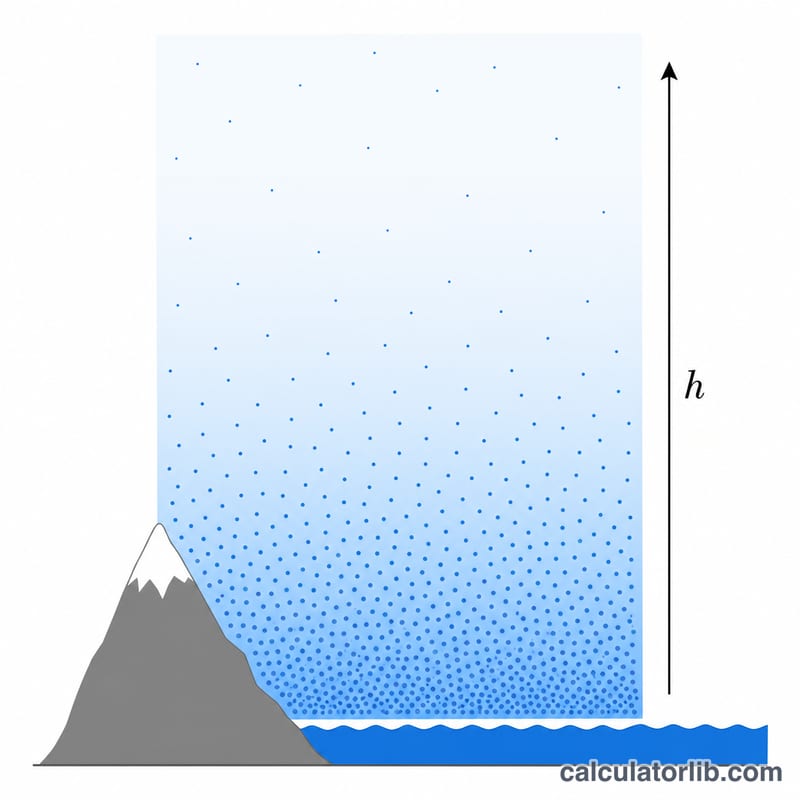
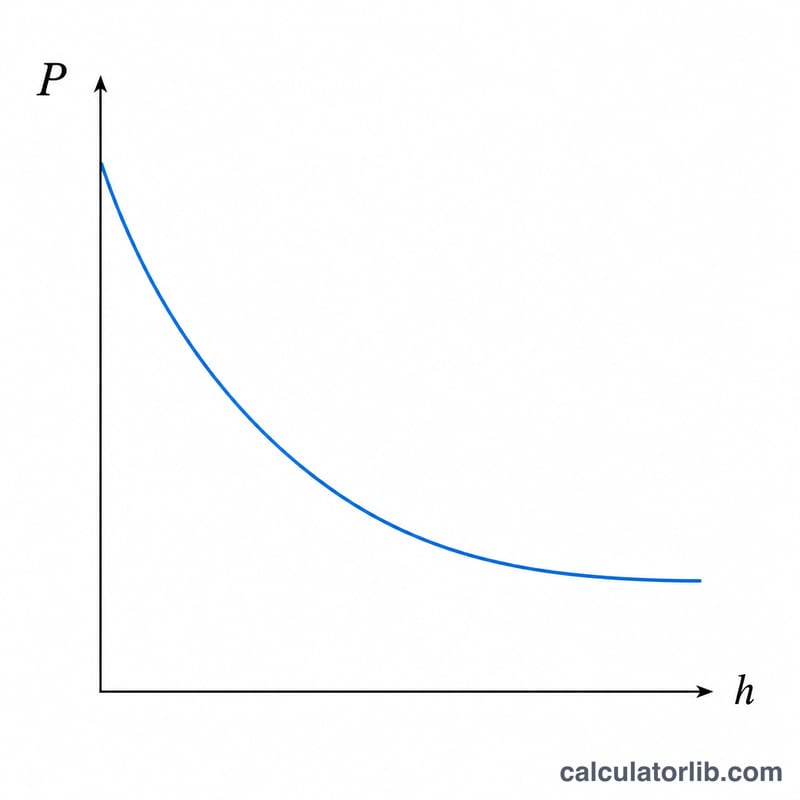
This tool estimates atmospheric (barometric) pressure at a given altitude using the standard atmosphere model for the troposphere. As you climb higher, there is less air above you, so pressure falls. The calculator returns the result in hectopascals (hPa, equivalent to millibars), kilopascals (kPa), and standard atmospheres (atm).
How to use it
Enter the altitude above sea level in metres and the sea-level pressure P0 in hPa. The standard sea-level pressure is 1013.25 hPa, but you can substitute the actual reported sea-level pressure for your location to get a more accurate value. Press calculate to see the pressure at that height.
The formula explained
The model uses $$P = P_0 \left(1 - \frac{0.0065\,h}{288.15}\right)^{5.255}$$. Here 0.0065 K/m is the standard temperature lapse rate, 288.15 K is the standard sea-level temperature, and the exponent 5.255 comes from gravity, the molar mass of air, and the gas constant. The formula is valid up to roughly 11,000 m (the troposphere).
Worked example
At an altitude of 1000 m with P0 = 1013.25 hPa: the base is \(1 - (0.0065 \times 1000 / 288.15) = 1 - 0.022557 = 0.977443\). Raising to the power 5.255 gives about 0.88699, and \(1013.25 \times 0.88699 \approx 898.76\) hPa, or about 89.88 kPa.
Constants Used in the Barometric Formula
The barometric formula used by this calculator models the lower atmosphere (the troposphere) as having a constant temperature lapse rate. The pressure at altitude \(h\) (in metres) is:
$$P = P_0\left(1 - \frac{L\,h}{T_0}\right)^{5.255}$$The fixed constants below come from the International Standard Atmosphere (ISA) and are baked into the formula.
| Symbol | Meaning | Value |
|---|---|---|
| \(P_0\) | Standard sea-level pressure (default; you may enter your own) | 1013.25 hPa |
| \(L\) | Temperature lapse rate | 0.0065 K/m |
| \(T_0\) | Standard sea-level temperature | 288.15 K (15 °C) |
| \(g\) | Standard gravitational acceleration | 9.80665 m/s² |
| \(M\) | Molar mass of dry air | 0.0289644 kg/mol |
| \(R\) | Universal gas constant | 8.31447 J/(mol·K) |
Where the exponent 5.255 comes from
The exponent is not arbitrary — it is the dimensionless group \(\frac{gM}{RL}\):
$$\frac{gM}{RL} = \frac{9.80665 \times 0.0289644}{8.31447 \times 0.0065} = 5.2558$$which rounds to the 5.255 used in the working formula.
Validity: This single-layer form assumes a constant lapse rate of 0.0065 K/m and is valid only within the troposphere, up to approximately 11,000 m (the base of the tropopause). Above that altitude the temperature profile changes and a different layer model must be used.
FAQ
Why does pressure drop with altitude? Because the column of air above you gets shorter and lighter, exerting less weight.
What is hPa? The hectopascal is the SI unit used in meteorology; 1 hPa equals 1 millibar.
Is this accurate everywhere? It assumes a standard atmosphere. Real conditions (temperature, weather systems) shift the actual value, so use local sea-level pressure for best accuracy.