
What Is the Mixing Ratio of Air?
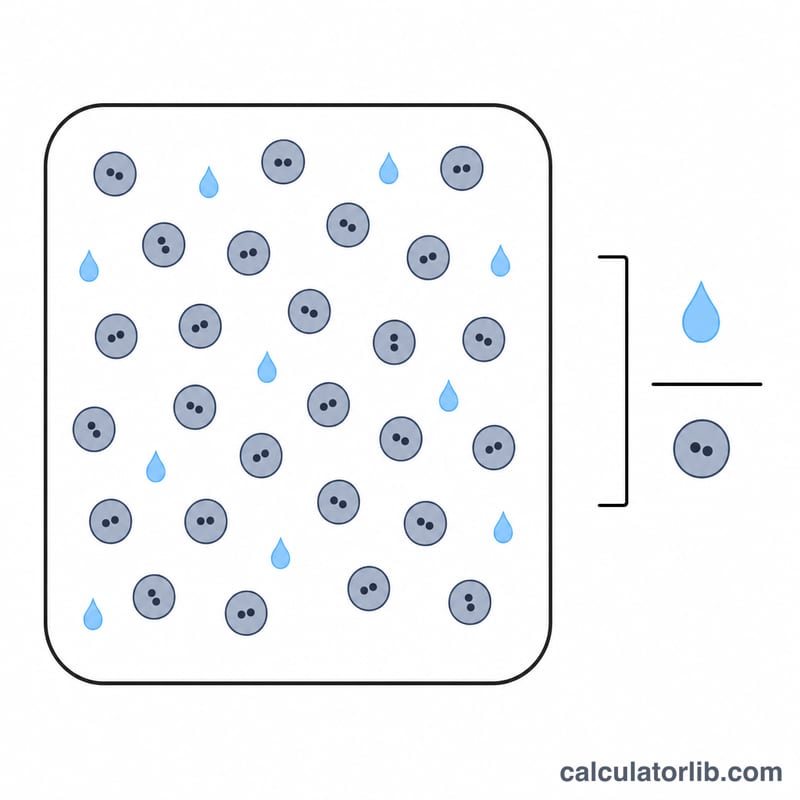
The mixing ratio is the mass of water vapor present in a parcel of air divided by the mass of the dry air it is mixed with. Unlike relative humidity, it does not change when air is heated or cooled (as long as no condensation occurs), which makes it a stable, conserved measure of moisture content in meteorology, HVAC engineering, and atmospheric science. This calculator works in any location — it depends only on physical pressures, not on jurisdiction.
How to Use This Calculator
Enter the partial pressure of water vapor (e) and the total air pressure (P), both in hectopascals (hPa, equivalent to millibars). The tool returns the mixing ratio as a dimensionless value (kg of vapor per kg of dry air) and the more commonly quoted value in grams per kilogram (g/kg). Standard sea-level pressure is about 1013.25 hPa.
The Formula Explained
The mixing ratio is given by:
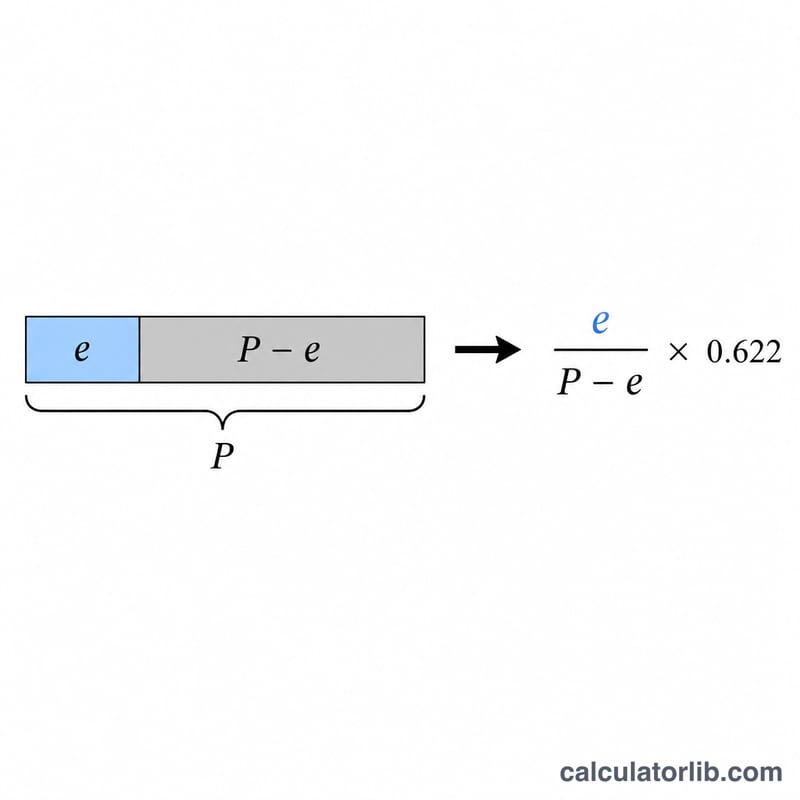
$$w = 0.622 \times \frac{\text{Vapor Pressure (hPa)}}{\text{Total Pressure (hPa)} - \text{Vapor Pressure (hPa)}}$$
The constant 0.622 is the ratio of the molar mass of water vapor (≈18.02 g/mol) to that of dry air (≈28.96 g/mol). The denominator \(P - e\) is the partial pressure of the dry air alone, since by Dalton's law the total pressure is the sum of the dry-air pressure and the vapor pressure.
Worked Example
Suppose the vapor pressure \(e = 12\) hPa and total pressure \(P = 1013.25\) hPa. Then $$w = 0.622 \times \frac{12}{1013.25 - 12} = \frac{7.464}{1001.25} \approx 0.007455 \text{ kg/kg},$$ or about 7.455 g/kg.
FAQ
What units should I use? Both e and P must use the same pressure unit (hPa/mb work well). Because the formula is a ratio, the units cancel and the result is dimensionless.
How is this different from specific humidity? Specific humidity is the mass of vapor per mass of total (moist) air, while mixing ratio uses dry air in the denominator. For typical atmospheric values the two are very close.
Where do I get the vapor pressure? You can compute e from the dew point or from relative humidity and saturation vapor pressure, then plug it in here.