
What is the Acceleration due to Gravity Calculator?
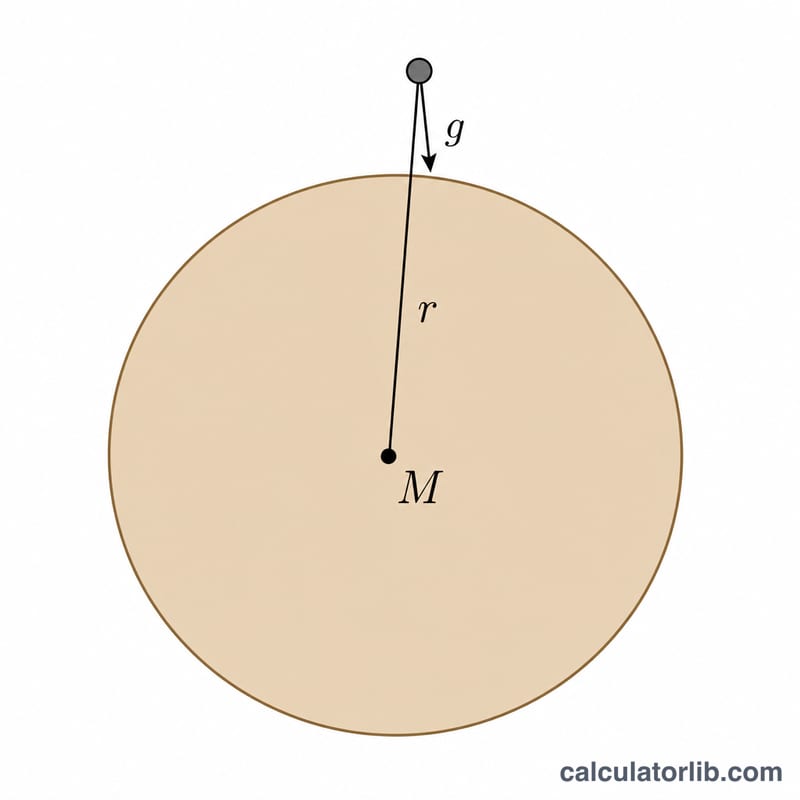
This calculator finds the acceleration due to gravity g produced by any massive body at a given distance from its center. It uses Newton's law of universal gravitation, which states that the gravitational acceleration depends only on the mass of the attracting body and the distance from its center — not on the mass of the object being attracted. This makes it a universal physics tool useful for planets, moons, stars, or any spherical mass.
How to Use It
Enter the mass M of the attracting body in kilograms and the distance r from its center in meters, then read the resulting acceleration in m/s². For surface gravity, use the body's radius as r. Scientific notation such as 5.972e24 is accepted for very large masses.
The Formula Explained
The equation is:
$$g = \dfrac{G \cdot M}{r^2}$$
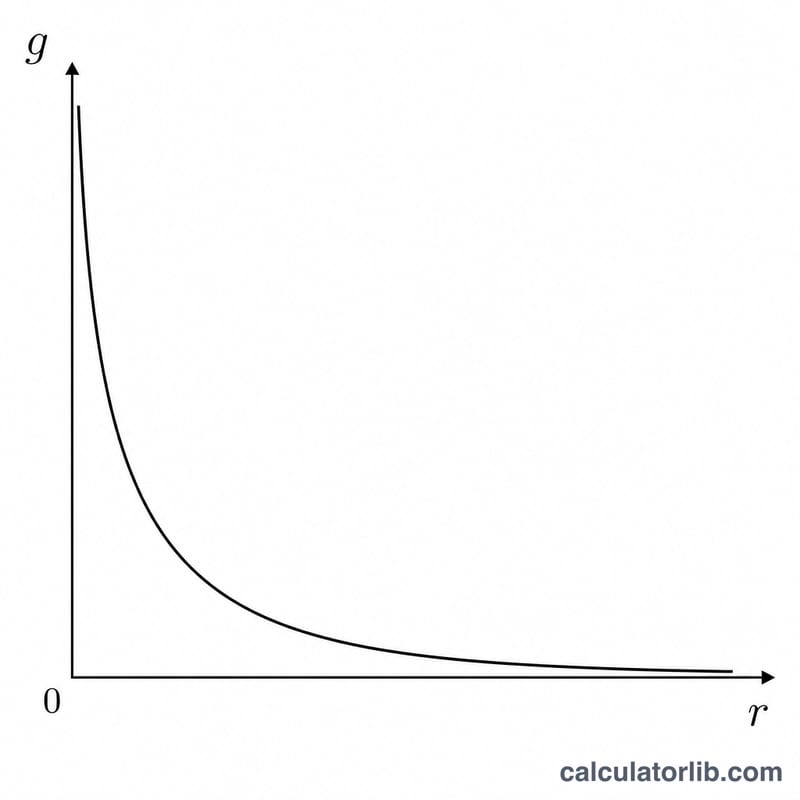
where \(G = 6.67430 \times 10^{-11}\ \text{N}\cdot\text{m}^2/\text{kg}^2\) is the universal gravitational constant, \(M\) is the mass of the body in kilograms, and \(r\) is the distance from the center of the body in meters. Because r is squared, doubling your distance from the center reduces gravity to one quarter of its original value.
Worked Example
For Earth, \(M = 5.972 \times 10^{24}\ \text{kg}\) and \(r = 6{,}371{,}000\ \text{m}\) (mean radius). Then:
$$g = \frac{6.67430 \times 10^{-11} \times 5.972 \times 10^{24}}{(6{,}371{,}000)^2} \approx 9.82\ \text{m/s}^2$$ matching Earth's well-known surface gravity of roughly 9.8 m/s².
Constants & Reference Values
The following values are used in the \(g = GM/r^2\) calculation. The gravitational constant is taken from the CODATA recommended values; planetary masses and radii are standard astronomical reference figures.
| Quantity | Symbol | Value | Units | Source |
|---|---|---|---|---|
| Gravitational constant | G | 6.67430×10⁻¹¹ | N·m²/kg² | CODATA 2018 |
| Earth mass | M⊕ | 5.972×10²⁴ | kg | IAU / NASA |
| Earth mean radius | r⊕ | 6,371,000 | m | IUGG mean radius |
| Standard gravity (defined) | g₀ | 9.80665 | m/s² | CGPM (1901) |
The relative standard uncertainty of \(G\) is about \(2.2\times10^{-5}\), making it one of the least precisely known fundamental constants. Because measured \(g\) on Earth's surface ranges from roughly \(9.78\ \text{m/s}^2\) at the equator to \(9.83\ \text{m/s}^2\) at the poles, the conventional standard value \(g_0 = 9.80665\ \text{m/s}^2\) is adopted for engineering and metrology.
FAQ
Why doesn't the falling object's mass appear? Gravitational acceleration is independent of the falling object's mass — that's why a feather and a hammer fall at the same rate in a vacuum.
Can I compute gravity above the surface? Yes. Set r equal to the body's radius plus your altitude (both in meters) to find g at that height.
What units should I use? Mass in kilograms and distance in meters, giving acceleration in meters per second squared (m/s²).