
What Is the Angle of Incidence?
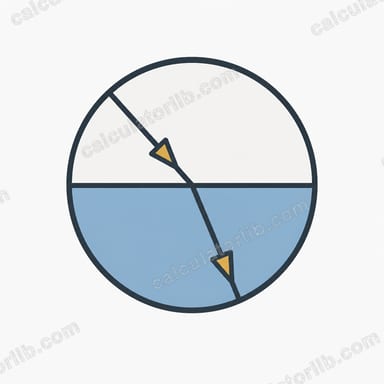
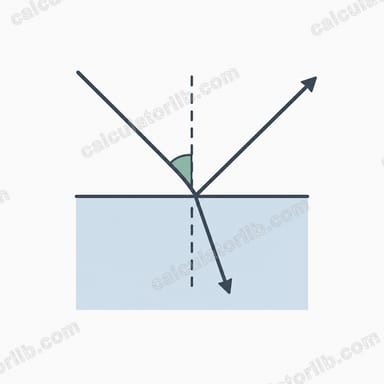
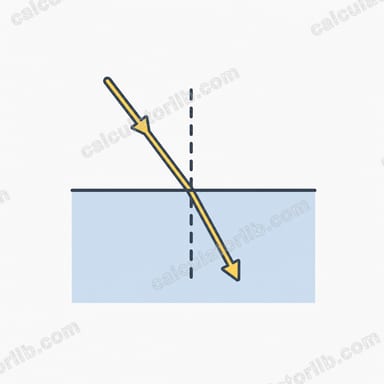
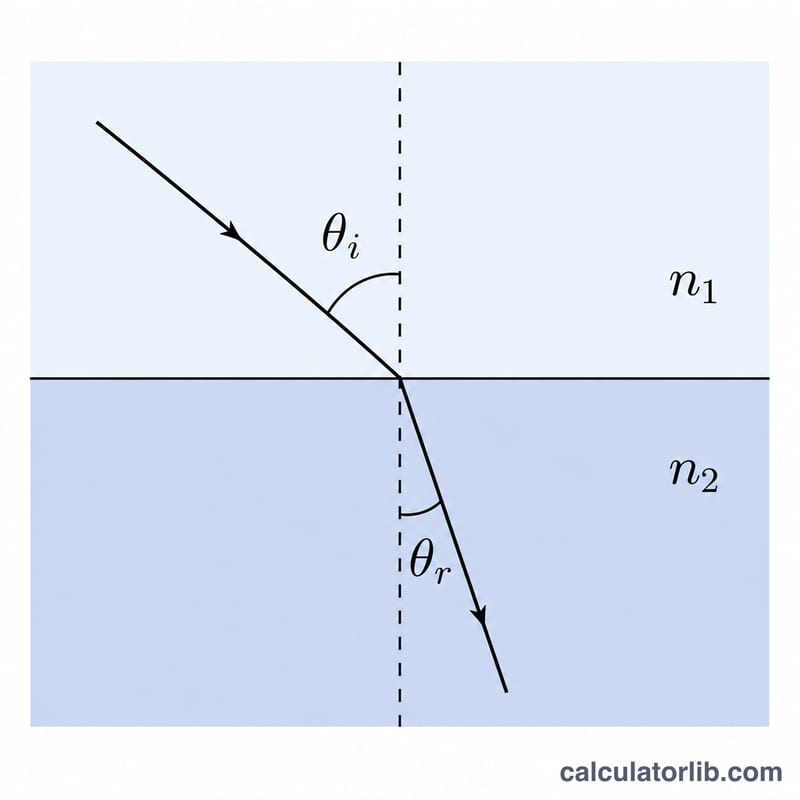
The angle of incidence is the angle between an incoming light ray and the normal (the line perpendicular to a surface) at the point where the ray strikes a boundary between two transparent media. When light passes from one medium to another, it bends — a phenomenon called refraction. This calculator works backwards from the refraction angle to recover the original incidence angle using Snell's law, a universal optics relationship that needs no country or unit context.
How to Use This Calculator
Enter the refractive index of the first medium (\(\text{n}_1\), where the ray originates), the refractive index of the second medium (\(\text{n}_2\), where it travels after bending), and the measured angle of refraction \(\theta_r\) in degrees. The tool returns the angle of incidence \(\theta_i\) in degrees. Common indices: air ≈ 1.00, water ≈ 1.33, crown glass ≈ 1.50, diamond ≈ 2.42.
The Formula Explained
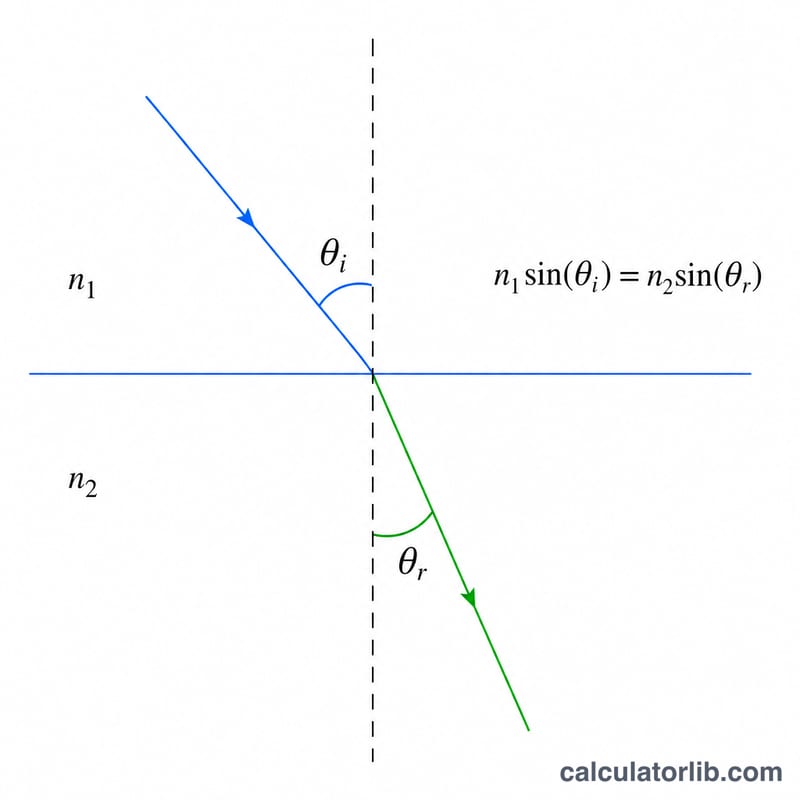
Snell's law states that \(\text{n}_1 \cdot \sin\theta_i = \text{n}_2 \cdot \sin\theta_r\). Rearranging for the incidence angle gives
$$\theta_i = \arcsin\!\left(\frac{\text{n}_2 \cdot \sin\!\left(\theta_r\right)}{\text{n}_1}\right)$$The arcsine is only defined when its argument stays between −1 and 1; if \(\frac{\text{n}_2 \cdot \sin\theta_r}{\text{n}_1}\) exceeds 1, no real incidence angle exists, which physically signals total internal reflection or impossible geometry.
Worked Example
Light leaves air (\(\text{n}_1 = 1.0\)) and enters glass (\(\text{n}_2 = 1.5\)), refracting to \(\theta_r = 19.47°\). Then \(\sin\theta_r \approx 0.3334\), so
$$\frac{\text{n}_2 \cdot \sin\theta_r}{\text{n}_1} = 1.5 \times 0.3334 = 0.5001$$Taking \(\arcsin(0.5001) \approx 30.0°\). The light originally struck the surface at about 30 degrees from the normal.
Refractive Indices of Common Materials
Snell's law relies on the refractive index \(n\) of each medium. The angle of incidence is recovered from a measured refraction angle using:
$$\theta_i = \arcsin\!\left(\frac{n_2 \sin\theta_r}{n_1}\right)$$The table below lists representative refractive indices for common transparent media. All values are quoted for the sodium D-line (\(\lambda \approx 589\,\text{nm}\), yellow light) at room temperature; the index varies slightly with wavelength (dispersion) and temperature.
| Material | Refractive index \(n\) |
|---|---|
| Vacuum | 1.0000 |
| Air (0 °C, 1 atm) | 1.0003 |
| Ice | 1.31 |
| Water (20 °C) | 1.333 |
| Ethanol | 1.361 |
| Fused quartz | 1.46 |
| Crown glass | 1.52 |
| Flint glass | 1.62 |
| Sapphire | 1.77 |
| Zircon | 1.92 |
| Diamond | 2.42 |
Because the index of air is so close to 1, it is common in introductory problems to treat \(n_{\text{air}} \approx 1.0000\). Use the more precise 1.0003 only when high accuracy is required.
FAQ
What if I get an error or 90°? If \(\frac{\text{n}_2 \cdot \sin\theta_r}{\text{n}_1}\) is greater than 1, the geometry is invalid for refraction (total internal reflection), and no real incidence angle exists.
Can I swap the media? Yes — just make sure \(\text{n}_1\) is the medium the incident ray comes from and \(\theta_r\) is measured in the second medium.
Is the answer in degrees or radians? All angles here are in degrees for both input and output.