
What It Is
The Slope to Angle Calculator converts a slope — expressed as rise over run — into an inclination angle in degrees. Slopes appear everywhere: roof pitches, ramps, road grades, hiking trails, and drainage pipes. While slope is often given as a ratio or percentage, many designs and standards specify an angle, so a quick conversion is invaluable.
How to Use It
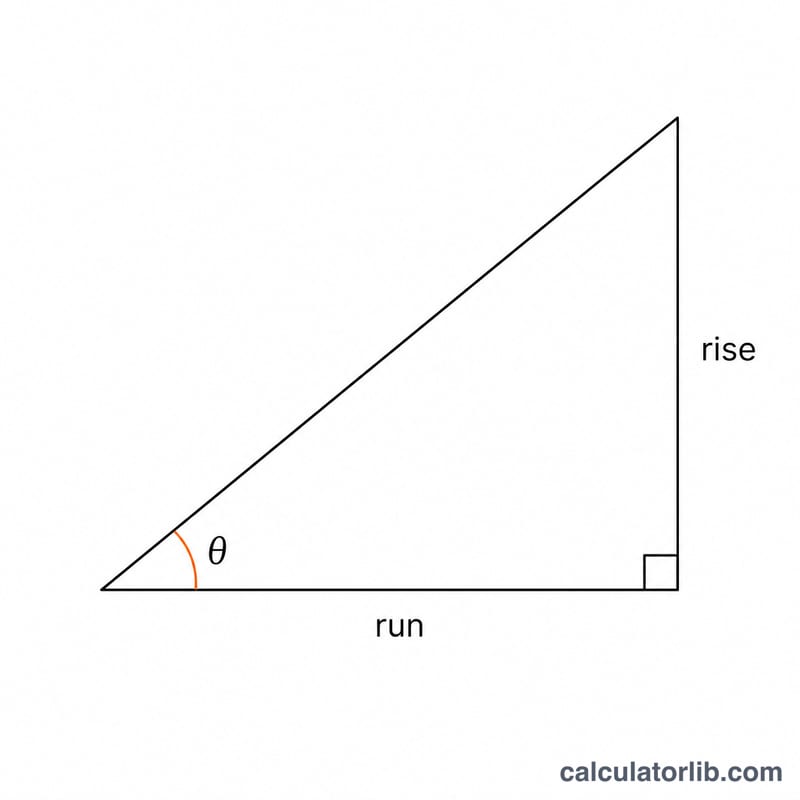
Enter the rise (the vertical change) and the run (the horizontal distance). The units cancel out, so as long as both use the same unit (meters, feet, inches), the result is correct. The calculator returns the angle in degrees, the raw slope ratio, and the grade as a percentage.
The Formula Explained
The slope m equals rise divided by run. Because the tangent of an angle is the ratio of the opposite side to the adjacent side of a right triangle, the angle is recovered with the inverse tangent: \(\theta = \arctan(m)\). The result from atan is in radians, which we convert to degrees by multiplying by \(180/\pi\).
Worked Example
Suppose a ramp rises 3 units over a run of 4 units. The slope is \(3 \div 4 = 0.75\). The angle is \(\arctan(0.75) \approx 36.87°\), and the grade is 75%. A 1:1 slope (rise = run) gives exactly 45°.

FAQ
What is the difference between grade and angle? Grade is the slope as a percentage (rise/run × 100); angle is the same slope expressed in degrees. They are not equal — a 100% grade is 45°, not 100°.
What happens if run is zero? A vertical line has an undefined slope and a 90° angle. This tool treats a zero run as a slope of 0 to avoid division errors, so supply a nonzero run for meaningful results.
Can I use negative values? Yes. A negative rise yields a negative (downhill) angle, which is useful for descents and downward grades.