
What Is a Coterminal Angle?
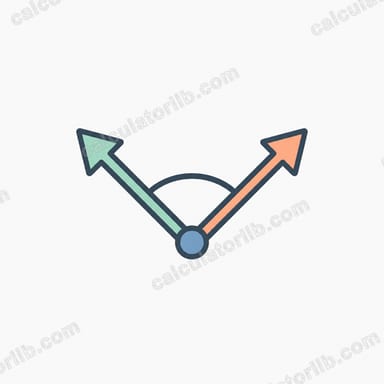
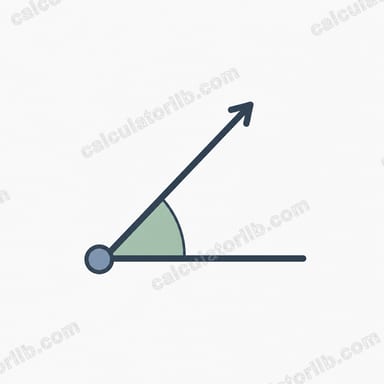
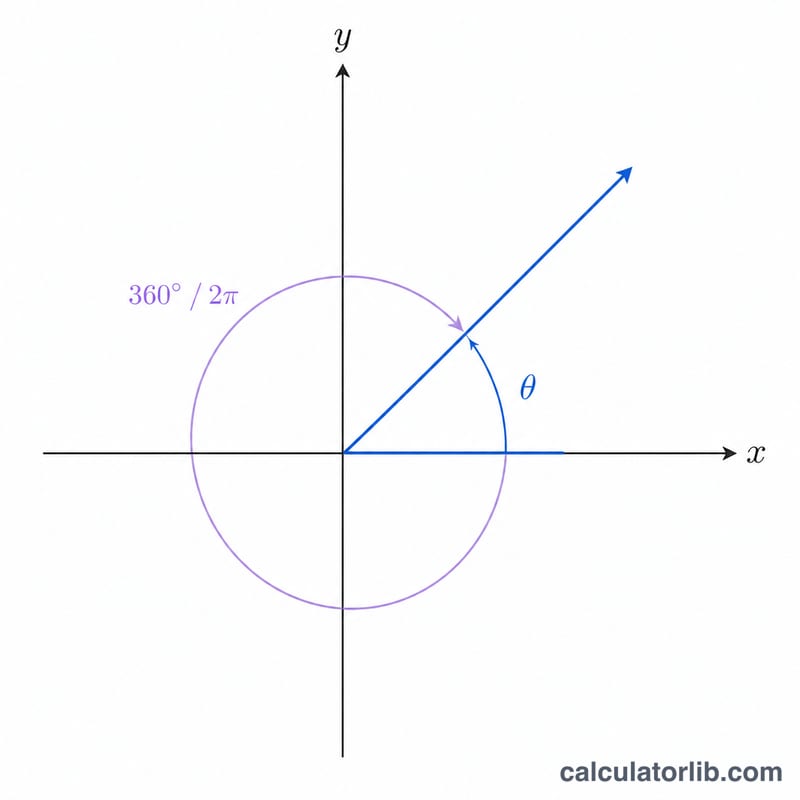
Two angles are coterminal when they share the same initial and terminal sides in standard position — their terminal rays point in exactly the same direction. Because a full rotation is 360° (or 2π radians), you can add or subtract any whole number of full turns to an angle and land on a coterminal angle. This calculator works in either degrees or radians and returns the smallest positive coterminal angle, a negative coterminal angle, and the next positive one.
How to Use It
Enter your angle, choose degrees or radians, and calculate. The tool normalizes the angle into one full rotation to find the smallest positive equivalent, then offsets by a full turn in each direction.
The Formula Explained
Coterminal angles are given by \(\theta \pm 360^{\circ} \cdot n\) in degrees or \(\theta \pm 2\pi \cdot n\) in radians, where \(n\) is any integer. To find the principal positive coterminal angle, take the remainder of θ divided by a full rotation; if the result is negative, add one full rotation.
$$\theta_{c} = \text{Angle} \pm 360^{\circ} \cdot k$$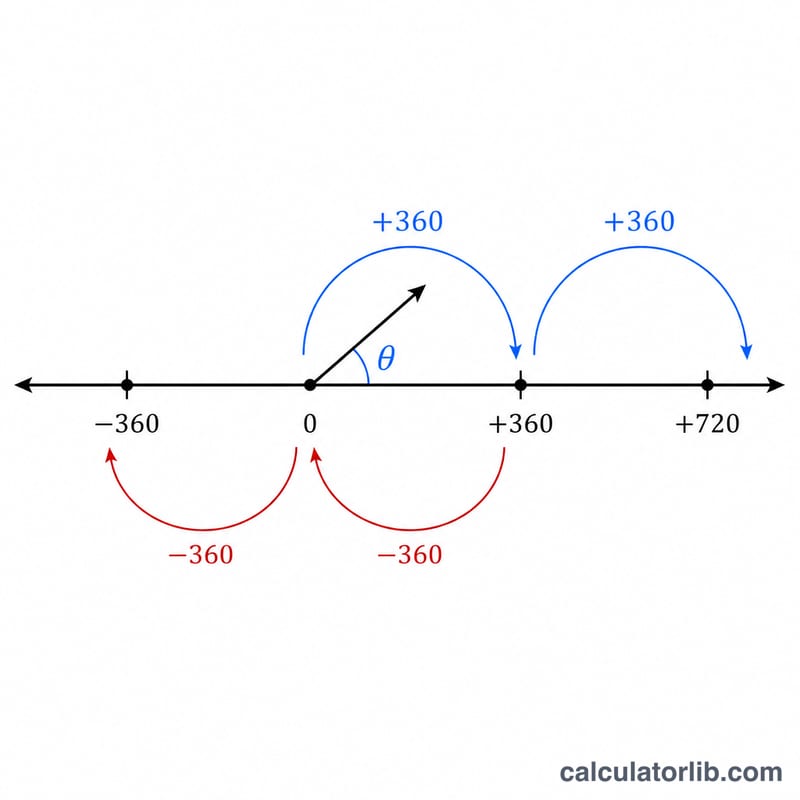
Worked Example
Start with 420°. Subtracting one full rotation:
$$420^{\circ} - 360^{\circ} = 60^{\circ}$$the smallest positive coterminal angle. A negative coterminal angle is
$$60^{\circ} - 360^{\circ} = -300^{\circ}$$and the next positive one is
$$60^{\circ} + 360^{\circ} = 420^{\circ}$$FAQ
Can angles be coterminal in radians? Yes — add or subtract 2π instead of 360°. For example, \(\frac{\pi}{6}\) and \(\frac{13\pi}{6}\) are coterminal.
How many coterminal angles exist? Infinitely many, one for each integer \(n\).
Are 0° and 360° coterminal? Yes, they share the same terminal side; this tool reports 0° as the principal value.