
What Is the Clock Angle Calculator?
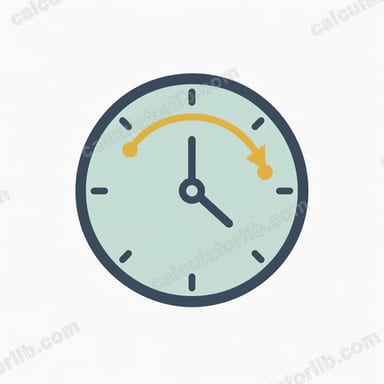
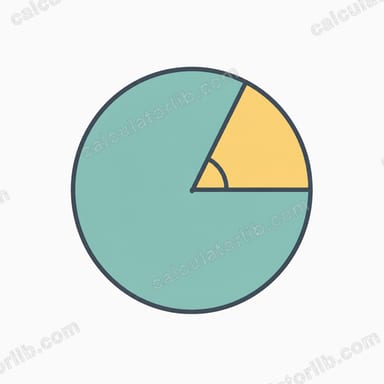
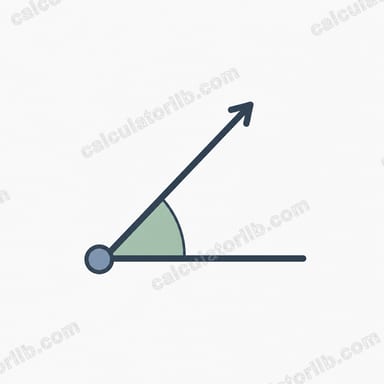
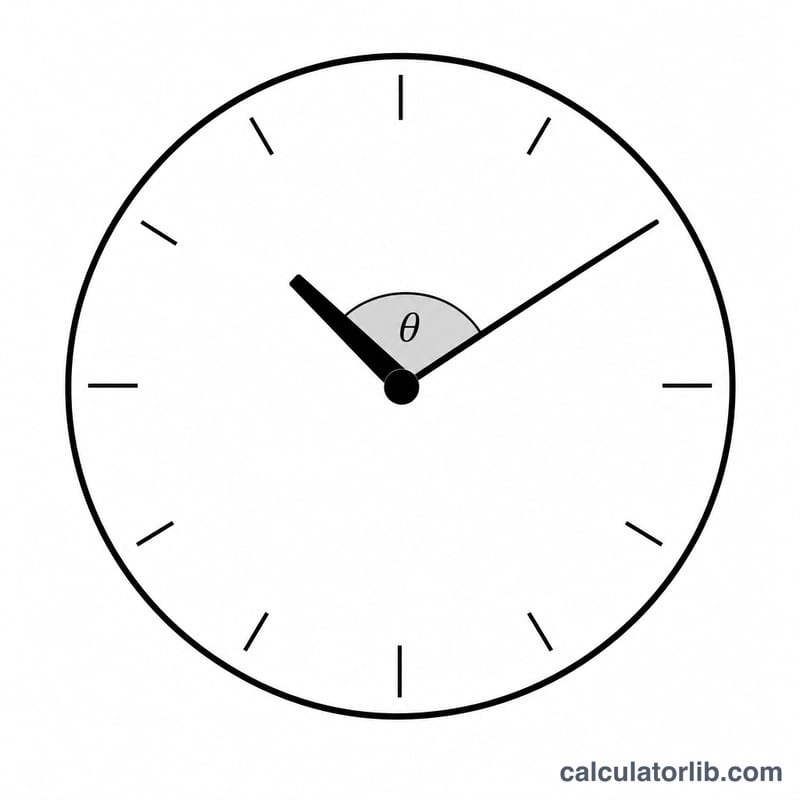
The Clock Angle Calculator finds the angle formed between the hour hand and the minute hand of a standard 12-hour analog clock at any given time. It is a classic geometry and aptitude-test problem, and this tool gives you both the smaller (non-reflex) angle and the larger reflex angle instantly.
How to Use It
Enter the hour (0–12) and the minute (0–59), then read the result. For example, to find the angle at 3:15, type 3 and 15. The calculator automatically reduces the hour modulo 12, so entering 12 or 0 both represent the top of the clock.
The Formula Explained
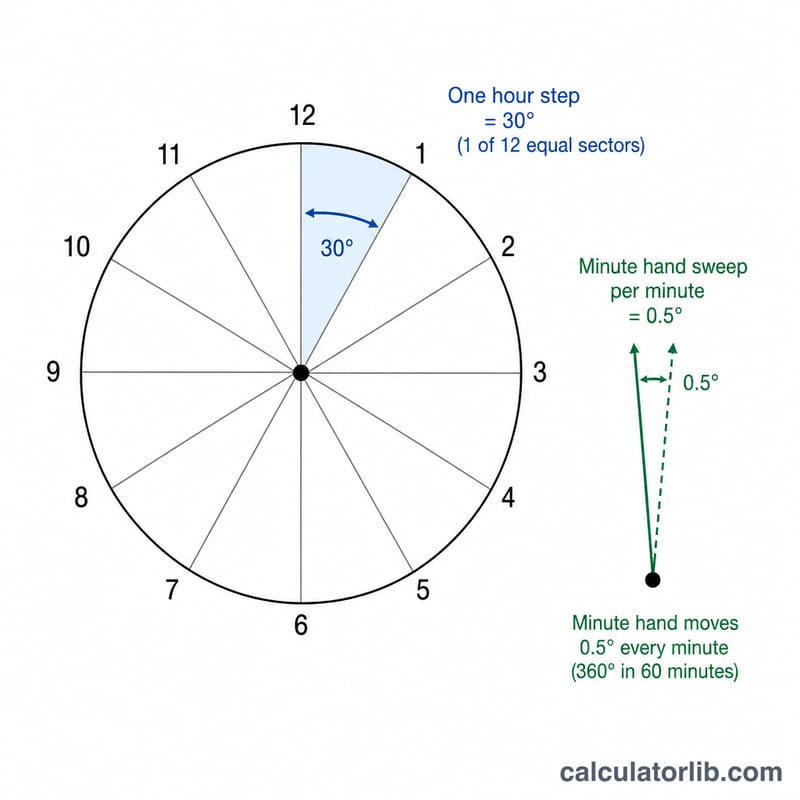
The minute hand moves 360° in 60 minutes, or 6° per minute. The hour hand moves 360° in 12 hours, or 30° per hour, and also 0.5° per minute. The hour hand's position is therefore \(30H + 0.5M\) degrees, and the minute hand's position is \(6M\) degrees. The difference is:
$$\theta = \left| (30H + 0.5M) - 6M \right| = \left| 30H - 5.5M \right|$$
If this value is greater than 180°, the actual smaller angle is \(360° - \theta\).
Worked Example
At 3:30, \(H = 3\) and \(M = 30\).
$$\theta = \left| 30 \times 3 - 5.5 \times 30 \right| = \left| 90 - 165 \right| = 75°$$
Since \(75 \le 180\), the smaller angle is 75° and the reflex angle is \(360 - 75 = 285°\).
FAQ
Why 5.5 and not 6? Because the hour hand also drifts forward as the minutes pass (0.5° per minute). Subtracting that drift from the minute hand's 6° gives the net 5.5° per minute term.
What about 12:00? Both hands overlap, so the angle is 0°.
Does it work for any time? Yes — for any whole minute. The hour is taken modulo 12, so 13:00 (1 PM) gives the same answer as 1:00.