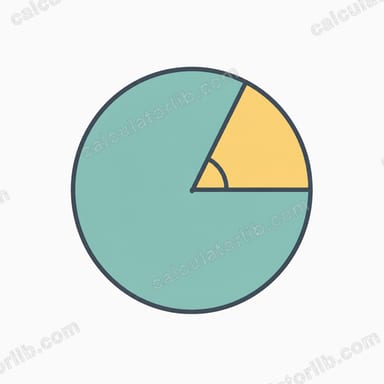

What Is a Central Angle?
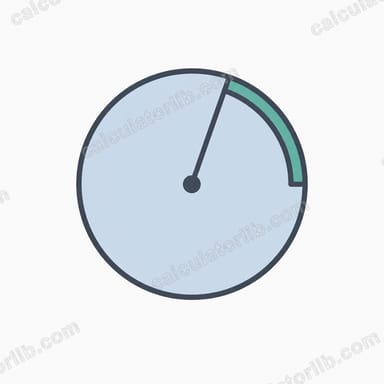
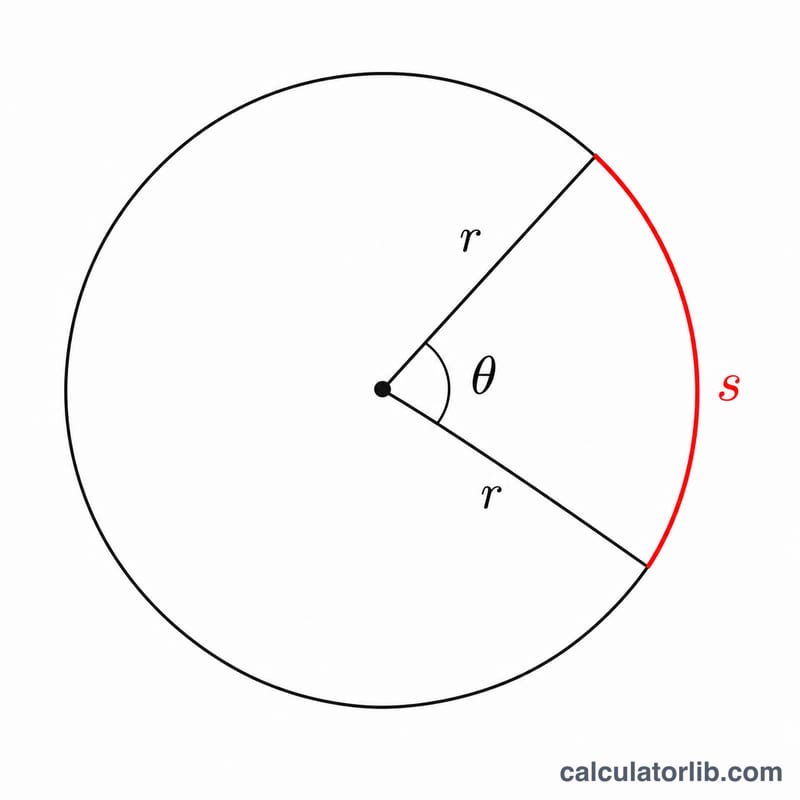
A central angle is the angle formed at the center of a circle by two radii that meet the endpoints of an arc. It directly relates the length of that arc to the circle's radius. This calculator computes the central angle from a known arc length and radius, returning the result in both radians and degrees.
How to Use This Calculator
Enter the arc length (the curved distance along the circle's edge) and the radius (the distance from the center to the edge) in the same unit. Press calculate to instantly see the central angle. The radians value is the pure ratio \(s/r\), while the degrees value is the more familiar angular measure.
The Formula Explained
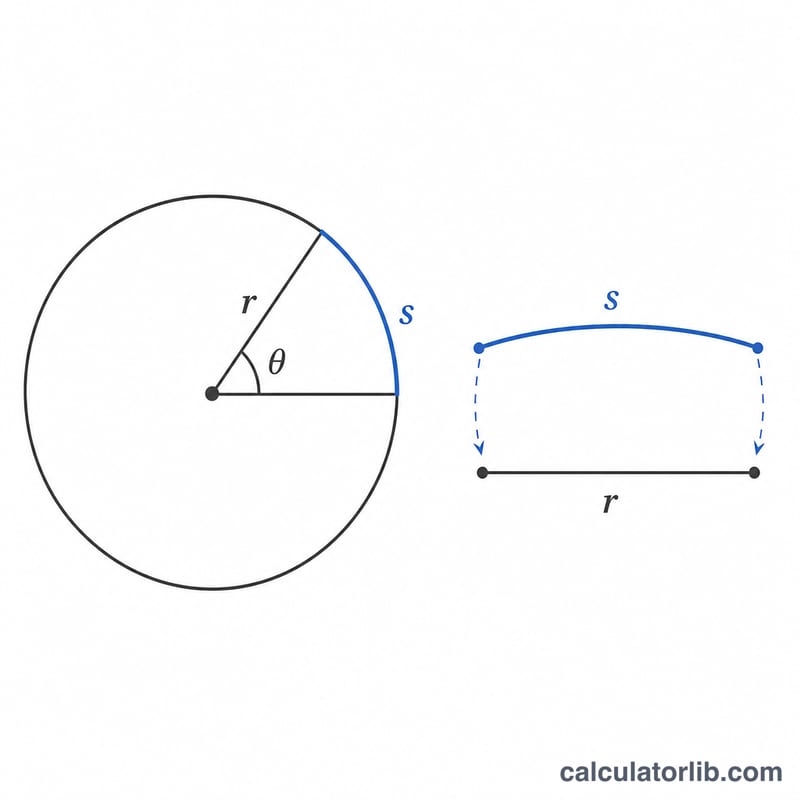
The fundamental relationship is \(\theta = s / r\), where \(\theta\) is in radians, \(s\) is arc length, and \(r\) is radius. Because one full circle is \(2\pi\) radians (360°), you convert radians to degrees by multiplying by \(180/\pi\). So $$\theta^\circ = \frac{s}{r} \times \frac{180}{\pi}$$ This works for any circle as long as arc length and radius share the same unit.
Worked Example
Suppose an arc is 10 cm long on a circle with a radius of 5 cm. The angle in radians is \(10 / 5 = 2\) radians. Converting to degrees: $$2 \times \frac{180}{\pi} \approx 114.59^\circ$$ So the two radii bounding that arc form a central angle of about 114.59 degrees.
FAQ
Do arc length and radius need the same units? Yes. The ratio must be unitless, so measure both in the same unit (cm, m, inches, etc.).
Why is the radian value the same as \(s/r\)? By definition, one radian is the angle for which the arc length equals the radius, making the ratio itself the radian measure.
What if my arc length exceeds the circumference? Then the resulting angle exceeds 360° (\(2\pi\) rad), meaning the arc wraps around the circle more than once.