
What Are Supplementary Angles?
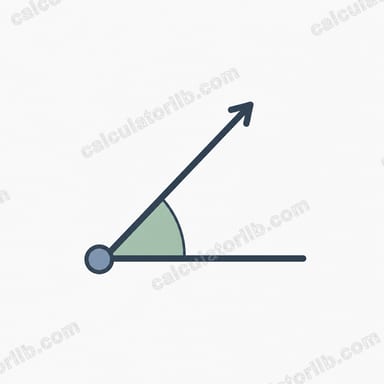
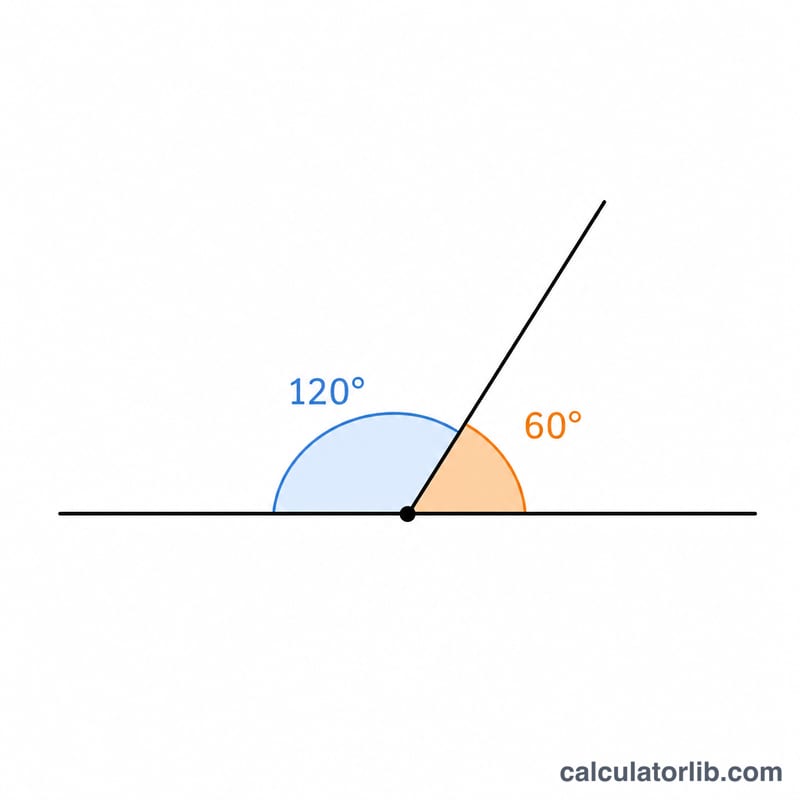
Two angles are called supplementary when their measures add up to exactly 180 degrees. This calculator finds the supplement of any angle you enter, using the simple relationship supplement = 180° − angle. Supplementary angles often appear as a pair forming a straight line, where the two angles together make a 180° straight angle.
How to Use the Calculator
Enter the known angle in degrees (a value between 0 and 180) and the calculator instantly returns its supplement. For example, the supplement of a 60° angle is 120°, because \(60 + 120 = 180\). The tool also shows the original angle and confirms that the two values sum to 180°.
The Formula Explained
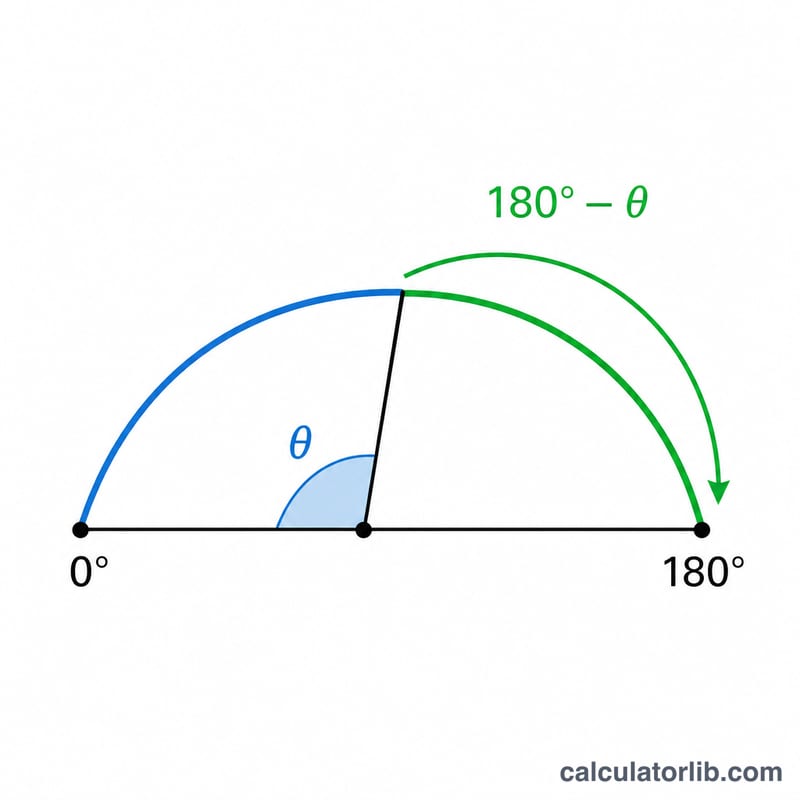
The formula is straightforward: subtract your angle from 180. If your angle is \(\theta\), then its supplement is:
$$\text{Supplement} = 180^{\circ} - \theta$$Note that only angles less than 180° have a meaningful positive supplement; an angle of exactly 180° has a supplement of 0°, and an angle of 0° has a supplement of 180°.
Worked Example
Suppose one angle in a linear pair measures 35°. To find its supplement, subtract:
$$180 - 35 = 145^{\circ}$$So a 35° angle and a 145° angle are supplementary, since \(35 + 145 = 180\).
FAQ
What is the difference between complementary and supplementary angles? Complementary angles add up to 90°, while supplementary angles add up to 180°.
Can two acute angles be supplementary? No. Two acute angles (each less than 90°) sum to less than 180°, so they cannot be supplementary. One of a supplementary pair must be 90° or larger unless both are exactly 90°.
Are supplementary angles always adjacent? Not necessarily. Angles can be supplementary based on their measures alone, even if they are not next to each other.