
What this calculator does
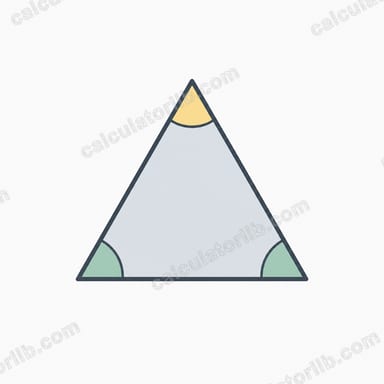
Enter the three side lengths of a triangle and instantly get its three interior angles — both in decimal degrees and in degrees-minutes-seconds (D° M′ S″) — together with the area and the height drawn onto the longest side. This is pure geometry, so it works with any consistent length unit (cm, m, inches, or unitless values); the angles are dimensionless and the area comes out in your input unit squared.
How to use it
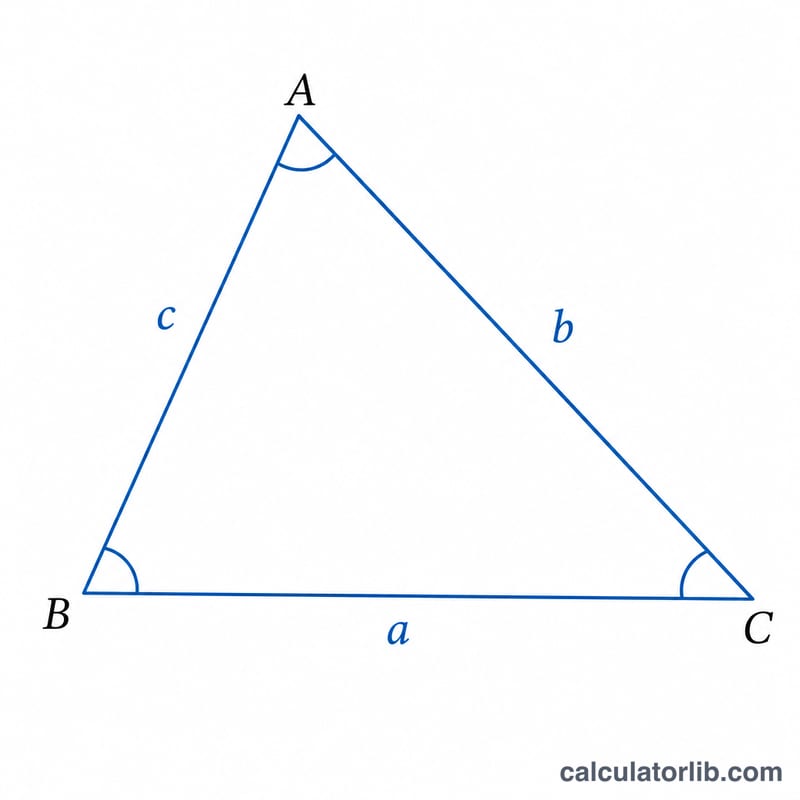
Type a value for side a, side b, and side c. The three sides must satisfy the triangle inequality: each side must be positive and strictly less than the sum of the other two. If they do not, no triangle exists and the calculator tells you so. Angle A is always the angle opposite side a, angle B opposite side b, and angle C opposite side c.
The formula explained
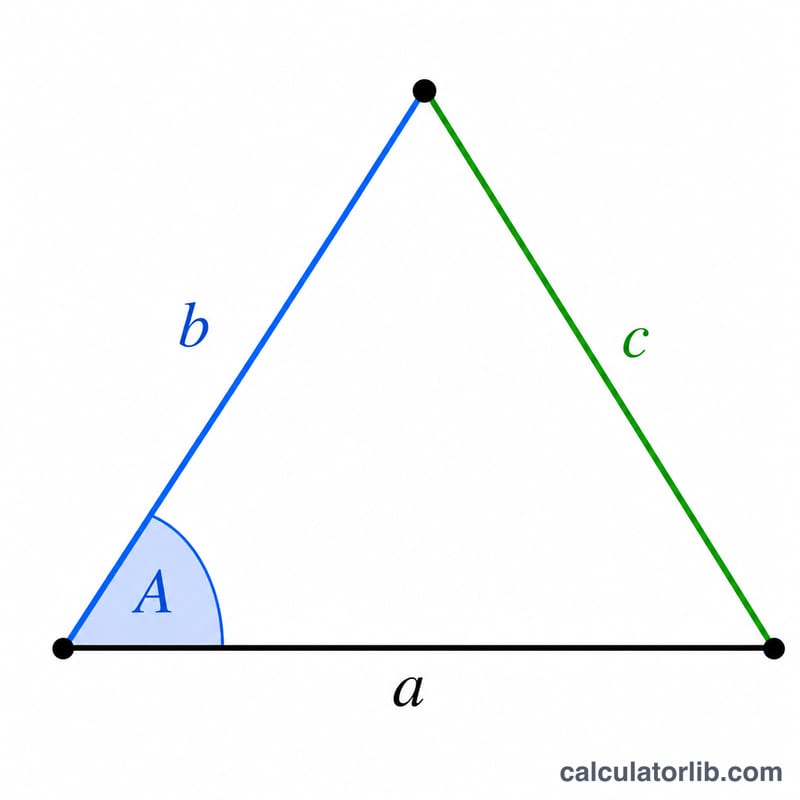
The angles come from the Law of Cosines. For angle A opposite side a: \(\cos A = \frac{b^{2} + c^{2} - a^{2}}{2bc}\), then \(A = \cos^{-1}(\dots)\). The same pattern gives B and C.
$$A = \cos^{-1}\!\left( \frac{b^{2} + c^{2} - a^{2}}{2\,b\,c} \right), \quad B = \cos^{-1}\!\left( \frac{a^{2} + c^{2} - b^{2}}{2\,a\,c} \right), \quad C = 180^{\circ} - A - B$$Because rounding can push the cosine argument slightly past \(\pm 1\), it is clamped to the valid range first, which keeps obtuse angles correct. The area uses Heron's formula with semi-perimeter \(s = \frac{a+b+c}{2}\), giving \(S = \sqrt{s(s-a)(s-b)(s-c)}\). The reported height is the altitude onto the longest side, \(h = \frac{2S}{\text{longest side}}\). Each decimal angle is split into \(D = \lfloor \deg \rfloor\), \(M = \lfloor (\deg - D)\times 60 \rfloor\), and \(S\) = the remaining seconds shown to two decimals.
Worked example
For \(a = 4\), \(b = 2\), \(c = 3\): \(s = 4.5\) and
$$S = \sqrt{4.5\times 0.5\times 2.5\times 1.5} \approx 2.90474.$$The longest side is \(a = 4\), so \(h = \frac{2S}{4} \approx 1.45237\).
$$\cos A = \frac{4+9-16}{12} = -0.25,$$giving \(A \approx 104.4775^{\circ}\) (104° 28′ 39.05″). Similarly \(B \approx 28.9550^{\circ}\) and \(C \approx 46.5675^{\circ}\), which sum to exactly \(180^{\circ}\).
FAQ
Can it handle obtuse triangles? Yes. The Law of Cosines naturally returns angles greater than 90° whenever a side squared exceeds the sum of the other two squared.
Why do my angles add to 180°? Every Euclidean triangle's interior angles sum to 180°; the calculator derives angle C as \(180 - A - B\) to guarantee this exactly.
What units are the results in? Angles are in degrees, the height is in the same unit as your sides, and the area is in that unit squared.