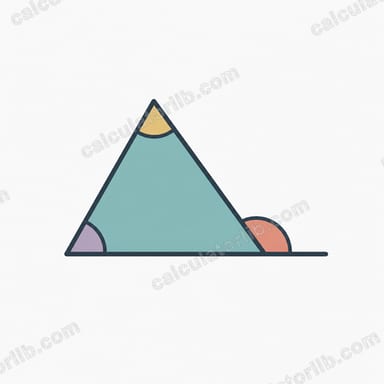

What this calculator does
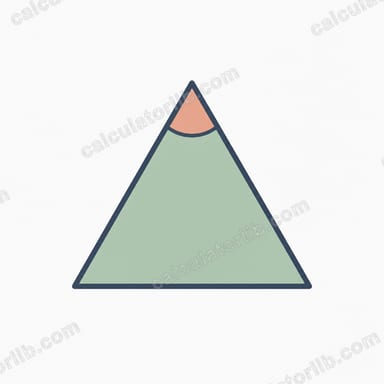
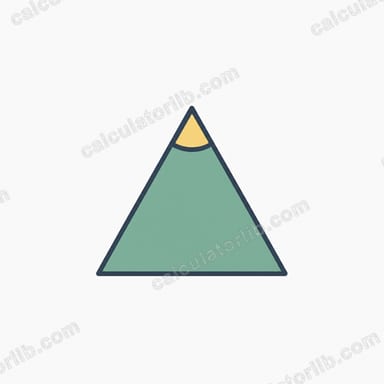
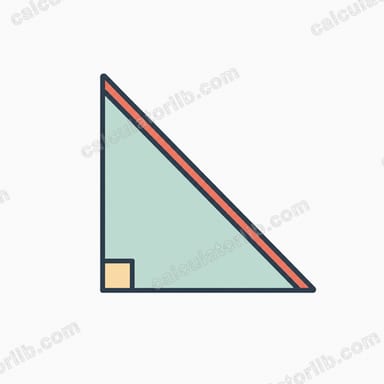
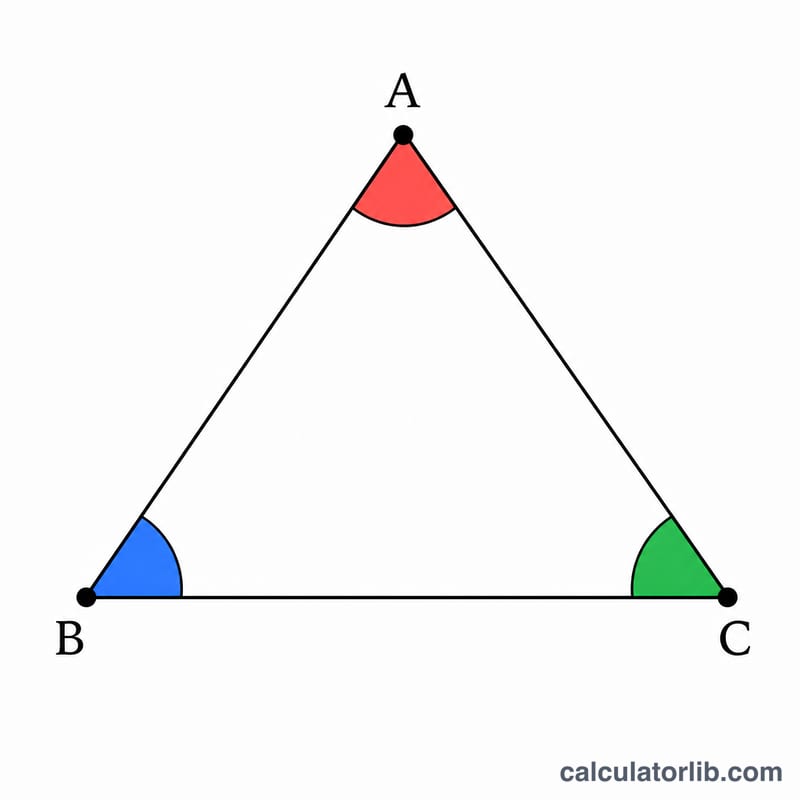
This tool finds the missing pieces of a triangle's angle geometry. Given any two interior angles, it computes the third interior angle and all three exterior angles. It works for every type of triangle — acute, right, obtuse, scalene, isosceles, or equilateral.
How to use it
Enter two interior angles (in degrees) of your triangle into fields A and B. The calculator instantly returns interior angle C plus the exterior angles at all three vertices. Make sure your two entered angles sum to less than 180° so a valid triangle exists.
The formula explained
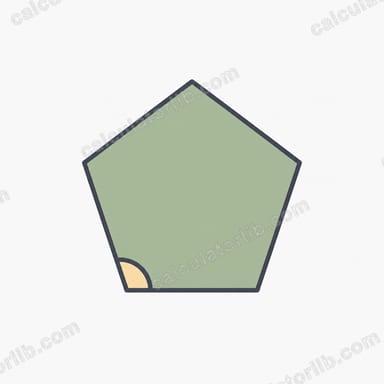
The interior angles of any triangle always sum to 180°, so the third angle is \(C = 180^{\circ} - A - B\). An exterior angle at a vertex is the angle formed between one side and the extension of the adjacent side; it is the supplement of the interior angle: \(\text{Ext} = 180^{\circ} - \text{Interior}\). By the Exterior Angle Theorem, each exterior angle also equals the sum of the two non-adjacent (remote) interior angles.
$$\begin{gathered} C = 180^{\circ} - \text{Angle A} - \text{Angle B} \\[1.5em] \text{where}\quad \left\{ \begin{aligned} \text{Ext}_A &= 180^{\circ} - \text{Angle A} \\ \text{Ext}_B &= 180^{\circ} - \text{Angle B} \\ \text{Ext}_C &= 180^{\circ} - C \end{aligned} \right. \end{gathered}$$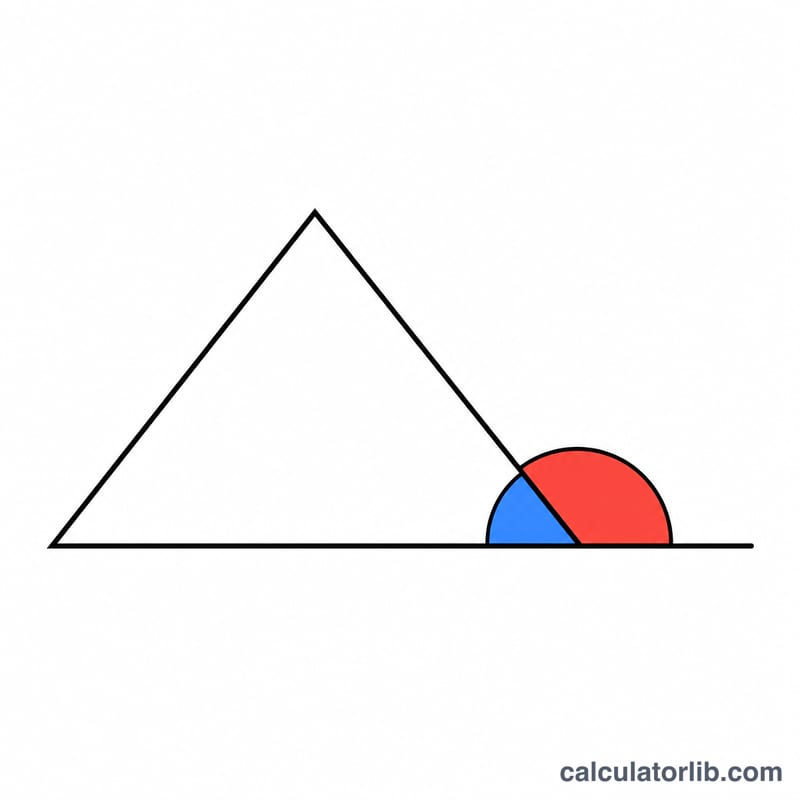
Worked example
Suppose A = 50° and B = 60°. Then \(C = 180 - 50 - 60 = 70^{\circ}\). The exterior angles are:
$$\text{Ext A} = 180 - 50 = 130^{\circ}, \quad \text{Ext B} = 180 - 60 = 120^{\circ}, \quad \text{Ext C} = 180 - 70 = 110^{\circ}$$As a check, the three exterior angles sum to \(130 + 120 + 110 = 360^{\circ}\), which is always true.
FAQ
Do the exterior angles always add to 360°? Yes. For any convex polygon the exterior angles sum to 360°, and a triangle is no exception.
What if my two angles add up to 180° or more? Then no valid triangle exists; the third angle would be zero or negative. Re-check your inputs.
Is the exterior angle the same as the reflex angle? No. The exterior angle here is the supplement (180° − interior), the standard convention used in geometry.