
What Is a Triangle Calculator?
A triangle calculator is a geometry tool that works out the missing measurements of a triangle when you supply enough known values. Depending on the information you provide — side lengths, angles, or a combination — it can find the remaining sides, angles, area, perimeter, and even the height. It saves you from manually applying the Pythagorean theorem, the law of sines, or the law of cosines every time you need an answer.
How to Use It
Enter the values you already know and leave the rest blank. The calculator needs at least three pieces of information, and at least one of them must be a side length. Common valid combinations include:
- SSS — all three sides
- SAS — two sides and the angle between them
- ASA — two angles and the side between them
- AAS — two angles and a non-included side
- SSA — two sides and a non-included angle (may give two solutions)
Once you click calculate, the tool returns the full set of sides, angles, perimeter, and area.
The Formulas Explained
The calculator relies on a few core rules:
- Angle sum: the three interior angles always add to 180°.
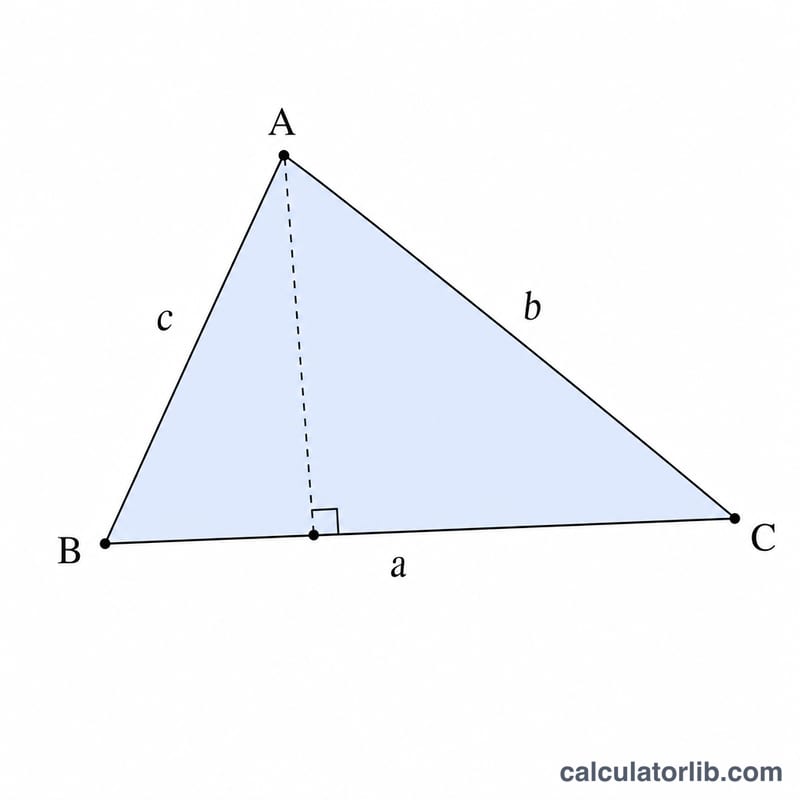
- Law of cosines: \(c^2 = a^2 + b^2 - 2ab\cdot\cos(C)\), used for SSS and SAS.
- Law of sines: \(\dfrac{a}{\sin(A)} = \dfrac{b}{\sin(B)} = \dfrac{c}{\sin(C)}\), used for ASA, AAS, and SSA.
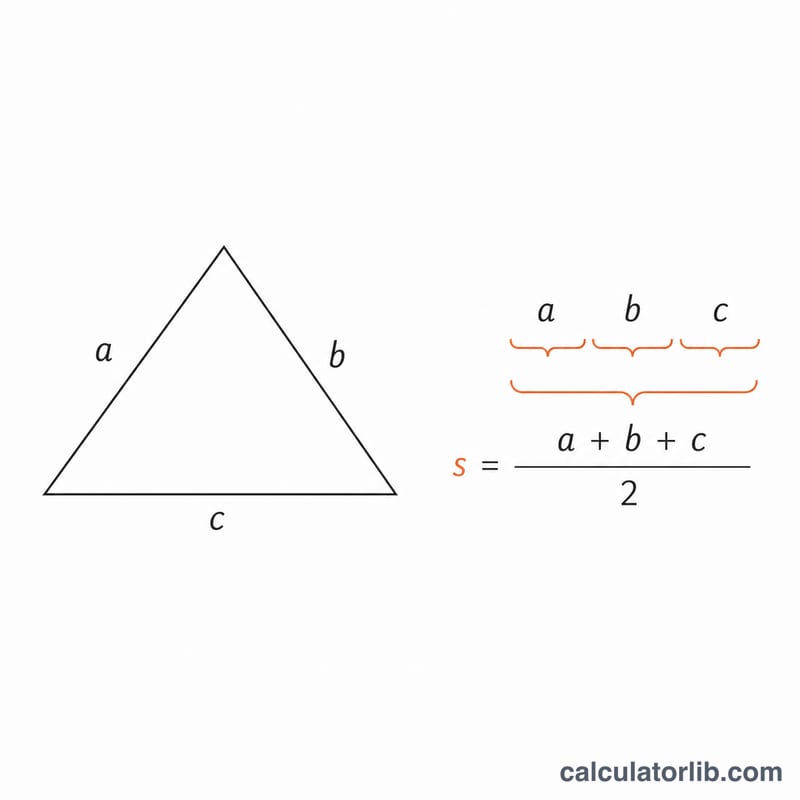
- Area (Heron's formula): $$\text{Area} = \sqrt{s\,(s-a)\,(s-b)\,(s-c)}$$ where \(s = \dfrac{a+b+c}{2}\).
Worked Example
Suppose you know two sides, \(a = 6\) and \(b = 8\), with the included angle \(C = 60°\). Using the law of cosines: $$c^2 = 6^2 + 8^2 - 2(6)(8)\cdot\cos(60°) = 36 + 64 - 96(0.5) = 52$$ so \(c \approx 7.21\). The area is $$\tfrac{1}{2}\cdot a\cdot b\cdot\sin(C) = 0.5 \times 6 \times 8 \times \sin(60°) \approx 20.78$$ square units, and the perimeter is about 21.21 units.
FAQ
Why do I sometimes get two possible triangles? The SSA case is ambiguous — the same data can describe two valid triangles, so the calculator may show both.
Can it tell me what type of triangle I have? Yes. Based on the sides and angles, it identifies whether the triangle is equilateral, isosceles, scalene, right, acute, or obtuse.
Do angles need to be in degrees? Most triangle calculators default to degrees, but many let you switch to radians if needed.