
What is the incircle of a triangle?
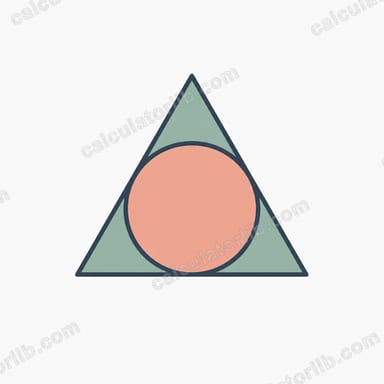
The incircle is the largest circle that fits inside a triangle, touching all three sides. Its center is the incenter (where the angle bisectors meet) and its radius is called the inradius, denoted \(r\). This calculator finds the inradius and related incircle measurements directly from the three side lengths \(a\), \(b\) and \(c\).
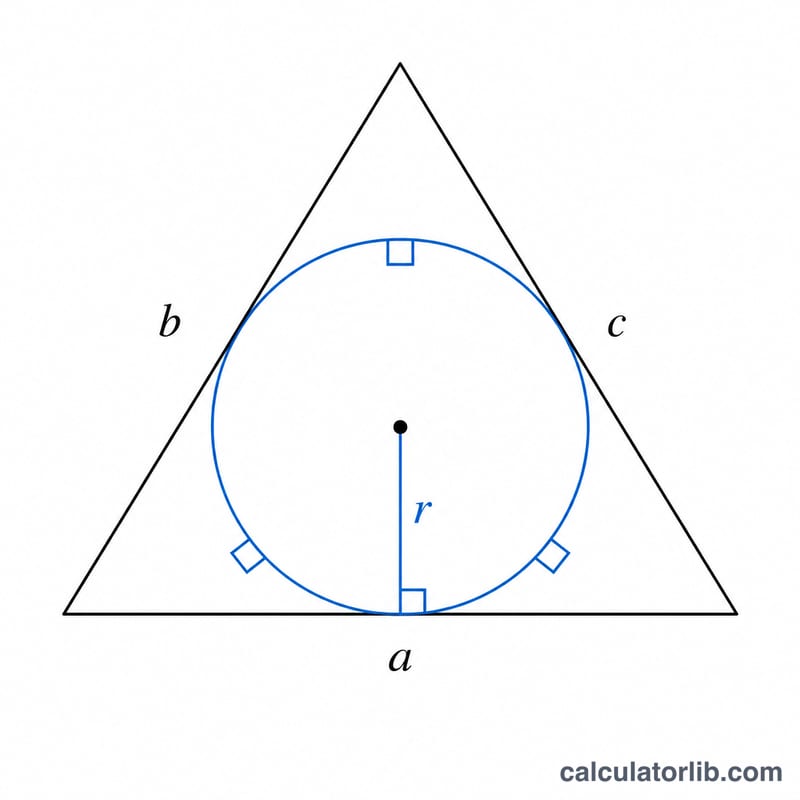
How to use it
Enter the three side lengths of your triangle in any consistent unit. The calculator first checks the triangle is valid, then returns the inradius \(r\) along with the triangle's area, semi-perimeter, and the area and circumference of the incircle. Make sure your three sides actually form a triangle: each side must be shorter than the sum of the other two.
The formula explained
The inradius comes from a neat identity: the area of a triangle equals its inradius times its semi-perimeter, so \(r = \text{Area} / s\). The semi-perimeter is \(s = (a + b + c) / 2\). The area is found with Heron's formula, $$\text{Area} = \sqrt{s(s - a)(s - b)(s - c)},$$ which needs only the side lengths — no angles or height required.
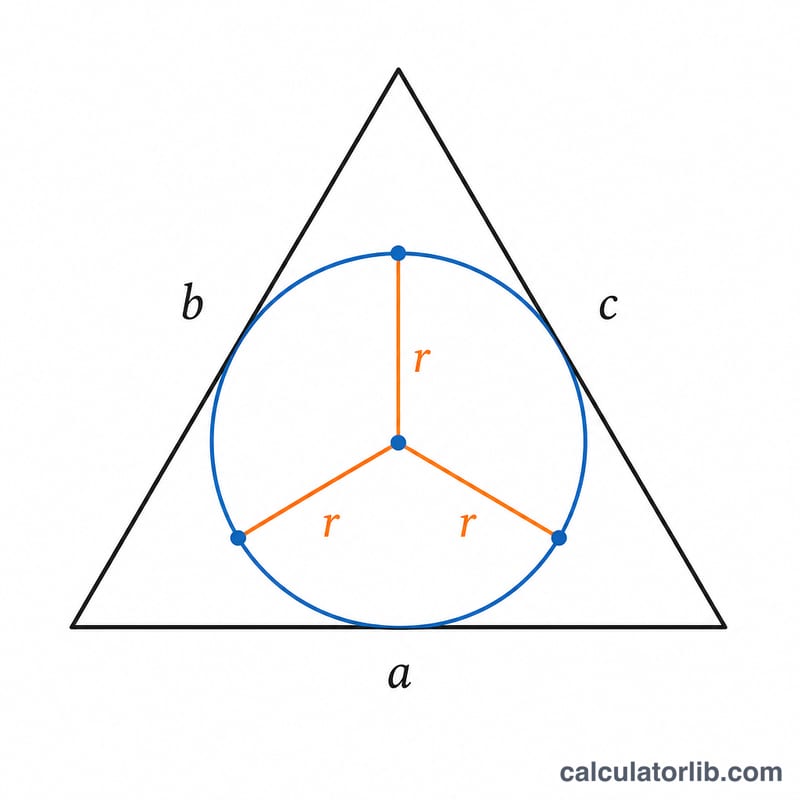
Worked example
Take a 3-4-5 right triangle. The semi-perimeter is $$s = (3 + 4 + 5) / 2 = 6.$$ Heron's formula gives $$\text{Area} = \sqrt{6 \cdot 3 \cdot 2 \cdot 1} = \sqrt{36} = 6.$$ Therefore the inradius is $$r = 6 / 6 = 1.$$ The incircle area is \(\pi \cdot 1^2 \approx 3.1416\) and its circumference is \(2\pi \cdot 1 \approx 6.2832\).
FAQ
What units does the result use? Whatever units you enter the sides in: the inradius shares the same length unit, area uses square units.
Why do I get zero or no result? The sides do not satisfy the triangle inequality, so no valid triangle (and no incircle) exists.
How is this different from the circumcircle? The incircle sits inside the triangle touching the sides; the circumcircle passes through all three vertices and uses \(R = abc / (4 \cdot \text{Area})\).