
What is a 30-60-90 triangle?
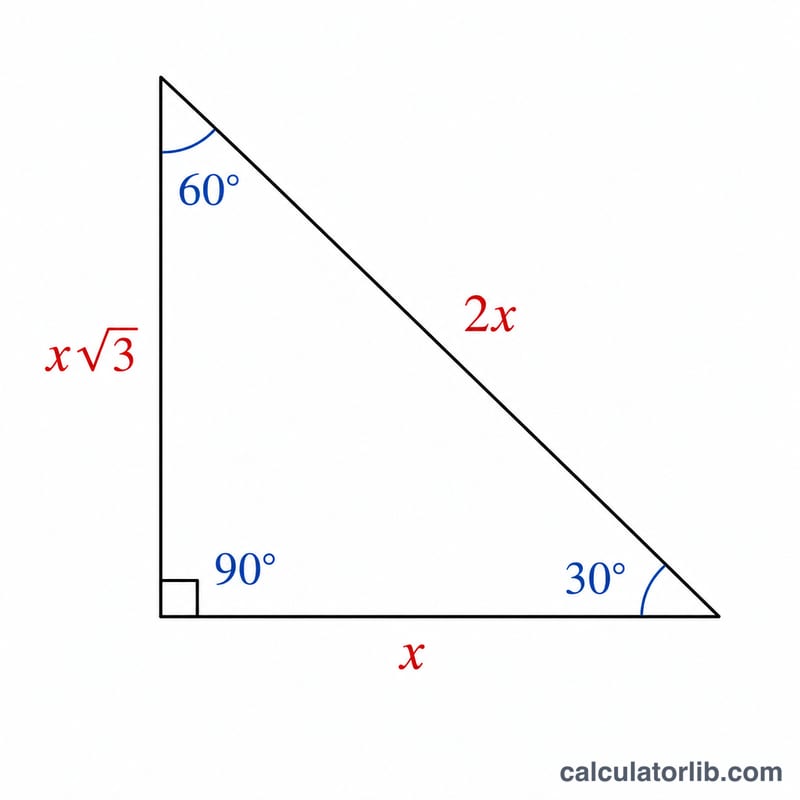
A 30-60-90 triangle is a special right triangle whose interior angles measure exactly 30°, 60°, and 90°. Because the angles are fixed, the three sides always keep the same proportions. If the short leg (the side opposite the 30° angle) has length x, then the long leg (opposite 60°) is x√3 and the hypotenuse (opposite 90°) is 2x. This \(1 : \sqrt{3} : 2\) ratio lets you solve the entire triangle from a single known side.
How to use this calculator
Pick which side you already know — the short leg, the long leg, or the hypotenuse — and type its length. The calculator first works out the short leg x, then derives every other measurement: the remaining sides, the area, and the perimeter. It works with any positive number and any unit (cm, m, inches, feet) as long as you stay consistent.
The formula explained
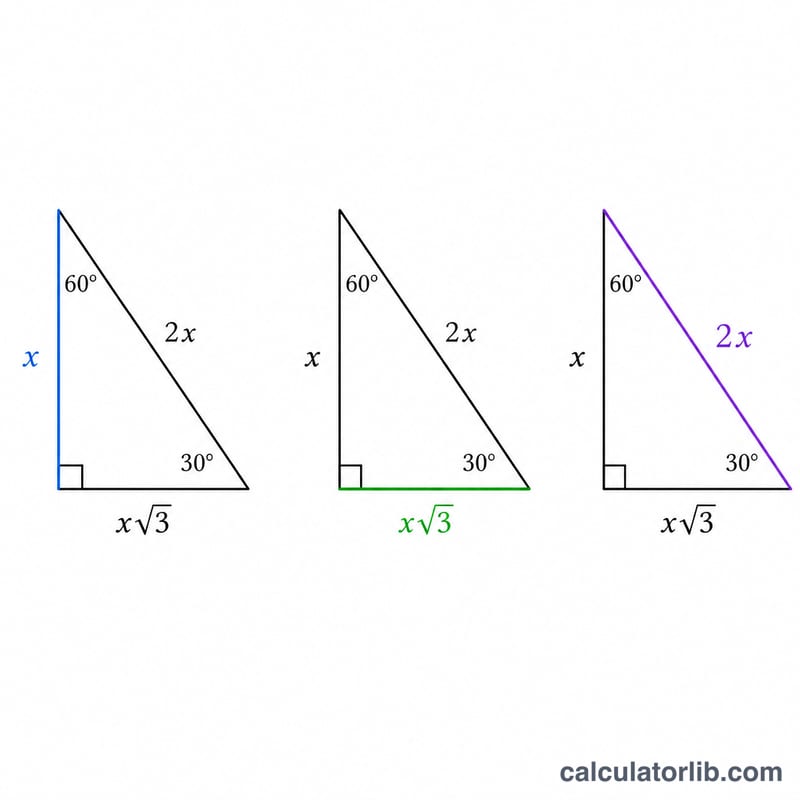
Everything is anchored to the short leg x. From a known long leg, \(x = \text{long} \div \sqrt{3}\); from a known hypotenuse, \(x = \text{hyp} \div 2\). Then $$\text{short} : \text{long} : \text{hyp} = x : x\sqrt{3} : 2x$$ long = x√3, hypotenuse = 2x, area = (√3 ⁄ 2)·x², and perimeter = x + x√3 + 2x = x(3 + √3). $$A = \frac{\sqrt{3}}{2}\,x^2$$ $$P = x + x\sqrt{3} + 2x = x(3 + \sqrt{3})$$
Worked example
Suppose the short leg is 5. Then the long leg = 5 × √3 ≈ 8.66, the hypotenuse = 2 × 5 = 10, the area = (√3⁄2) × 5² ≈ 21.65, and the perimeter ≈ 5 + 8.66 + 10 = 23.66. $$\text{long} = 5 \times \sqrt{3} \approx 8.66$$ $$\text{hyp} = 2 \times 5 = 10$$ $$A = \frac{\sqrt{3}}{2} \times 5^2 \approx 21.65$$ $$P \approx 5 + 8.66 + 10 = 23.66$$
30-60-90 Side Ratios Reference Table
In every 30-60-90 right triangle the three sides hold the fixed ratio \(1 : \sqrt{3} : 2\). If the short leg (opposite the 30° angle) is \(a\), then the long leg (opposite 60°) is \(a\sqrt{3}\) and the hypotenuse (opposite the 90° angle) is \(2a\). The area is \(\tfrac{\sqrt{3}}{2}a^{2}\) and the perimeter is \(a(3+\sqrt{3})\). The table below lists exact and approximate values (using \(\sqrt{3}\approx1.732\)) for several common short-leg lengths.
| Short leg \(a\) | Long leg \(a\sqrt{3}\) | Hypotenuse \(2a\) | Area \(\tfrac{\sqrt{3}}{2}a^{2}\) | Perimeter \(a(3+\sqrt{3})\) |
|---|---|---|---|---|
| 1 | \(\sqrt{3}\approx1.732\) | 2 | \(\tfrac{\sqrt{3}}{2}\approx0.866\) | \(3+\sqrt{3}\approx4.732\) |
| 2 | \(2\sqrt{3}\approx3.464\) | 4 | \(2\sqrt{3}\approx3.464\) | \(\approx9.464\) |
| 5 | \(5\sqrt{3}\approx\) 8.660 | 10 | \(\tfrac{25\sqrt{3}}{2}\approx21.651\) | \(\approx23.660\) |
| 10 | \(10\sqrt{3}\approx17.321\) | 20 | \(50\sqrt{3}\approx86.603\) | \(\approx47.321\) |
Each row scales linearly: doubling the short leg doubles every side and the perimeter, but quadruples the area (since area depends on \(a^{2}\)).
FAQ
Which side is the short leg? The short leg is always the side opposite the smallest angle, 30°. It is the shortest of the three sides.
Can I enter the hypotenuse? Yes. Choose "Hypotenuse" from the menu; the calculator divides it by 2 to find the short leg and rebuilds the triangle.
Is the long leg twice the short leg? No — that is a common mistake. The hypotenuse is twice the short leg; the long leg is \(\sqrt{3}\) (≈1.732) times the short leg.