
What is Pascal's Triangle?
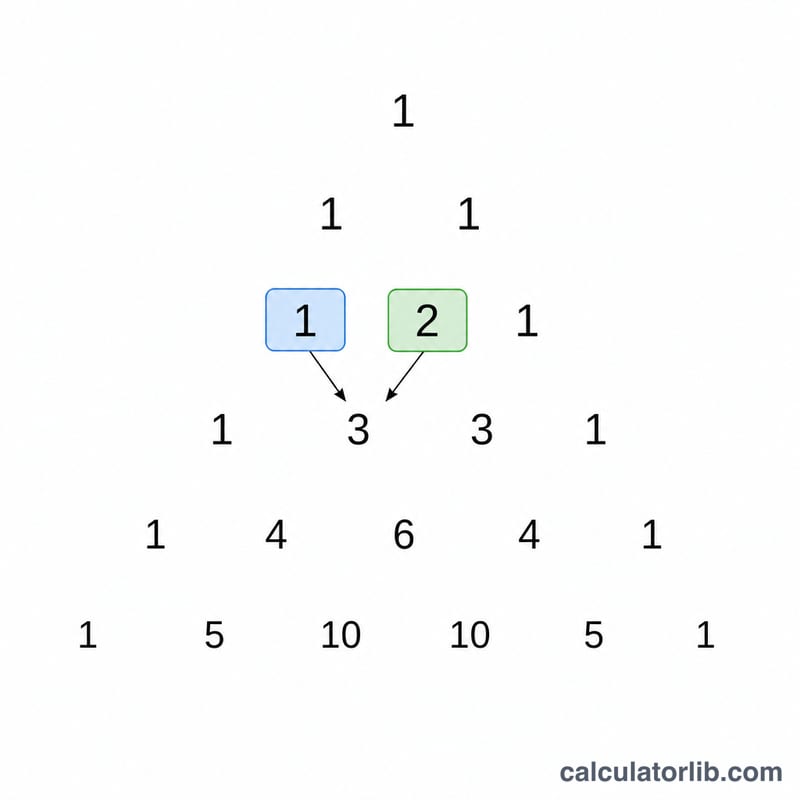
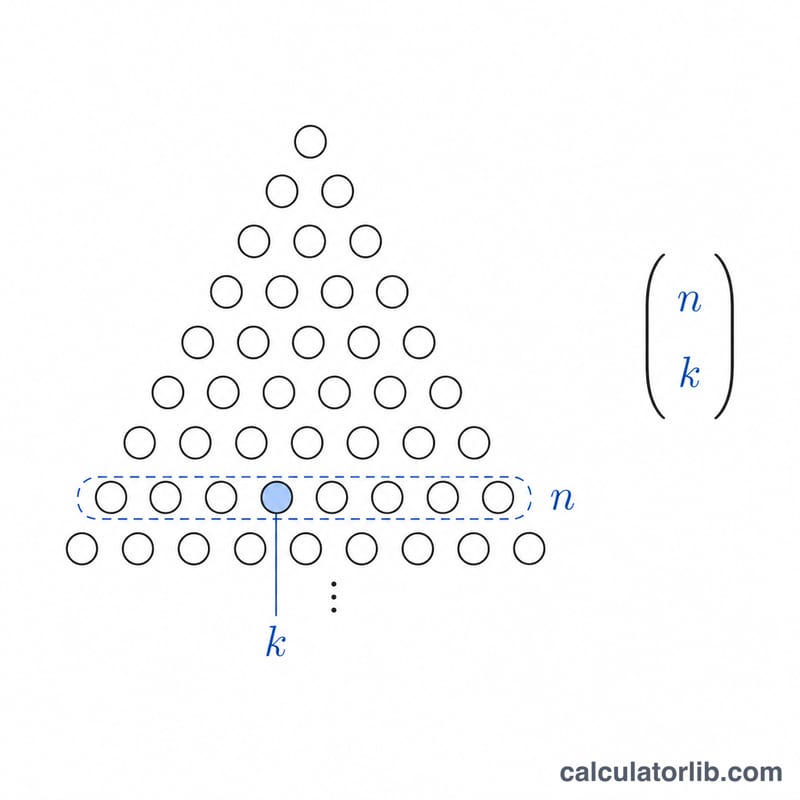
Pascal's Triangle is a triangular array of numbers where each entry is the sum of the two numbers directly above it. The edges are all 1, and the interior numbers grow from there. Every entry equals a binomial coefficient, written \(C(n, k)\) or "n choose k", which counts the number of ways to choose k items from a set of n. The triangle is 0-indexed: the very top is row 0 = {1}, row 1 = {1, 1}, row 2 = {1, 2, 1}, and so on.
How to use this calculator
Pick a mode under Show. Choose One Number to compute a single entry: enter the row index n and column index k (both starting at 0, with k between 0 and n). Choose Row(s) to generate the full triangle and enter the Number of rows — the tool prints every row from 0 up to that value, along with each row's sum.
The formula explained
The closed form is $$C(n,k) = \frac{n!}{k!\,(n-k)!}.$$ To avoid huge factorials, the calculator uses the multiplicative form \(C(n,k) = \prod_{i=1}^{k} \frac{n-k+i}{i}\) for \(i = 1..k\), looping over the smaller of \(k\) and \(n-k\) thanks to the symmetry \(C(n,k) = C(n,n-k)\). The triangle itself is built with the recurrence $$a(n,k) = a(n-1,k-1) + a(n-1,k),$$ which needs only additions.
Worked example
For \(n = 4\), \(k = 2\): $$C(4,2) = \frac{4!}{2!\cdot 2!} = \frac{24}{4} = 6.$$ That matches the third number in row 4 of the triangle {1, 4, 6, 4, 1}. The sum of row 4 is \(2^4 = 16\).
Applications
Binomial expansion: the coefficients of \((x + y)^n\) are exactly row n. For example, $$(x + y)^4 = x^4 + 4x^3y + 6x^2y^2 + 4xy^3 + y^4.$$ Combinations: \(C(n,k)\) is the number of ways to choose k objects from n. Probability: with equally likely binary outcomes, row n sums to \(2^n\) total outcomes, and \(C(n,k)/2^n\) is the chance of exactly k successes — e.g. \(P(\text{exactly 1 head in 3 tosses}) = C(3,1)/2^3 = 3/8 = 37.5\%\).
FAQ
Is the triangle 0-indexed? Yes. Both the row n and column k start at 0, so the top single 1 is row 0, column 0.
What if k is greater than n? That point lies outside the triangle, so the value is 0 and the calculator flags a note.
Why does each row sum to a power of 2? Because the sum of all \(C(n,k)\) for \(k = 0..n\) equals \(2^n\), which is also the total number of subsets of an n-element set.