
What is CAGR?
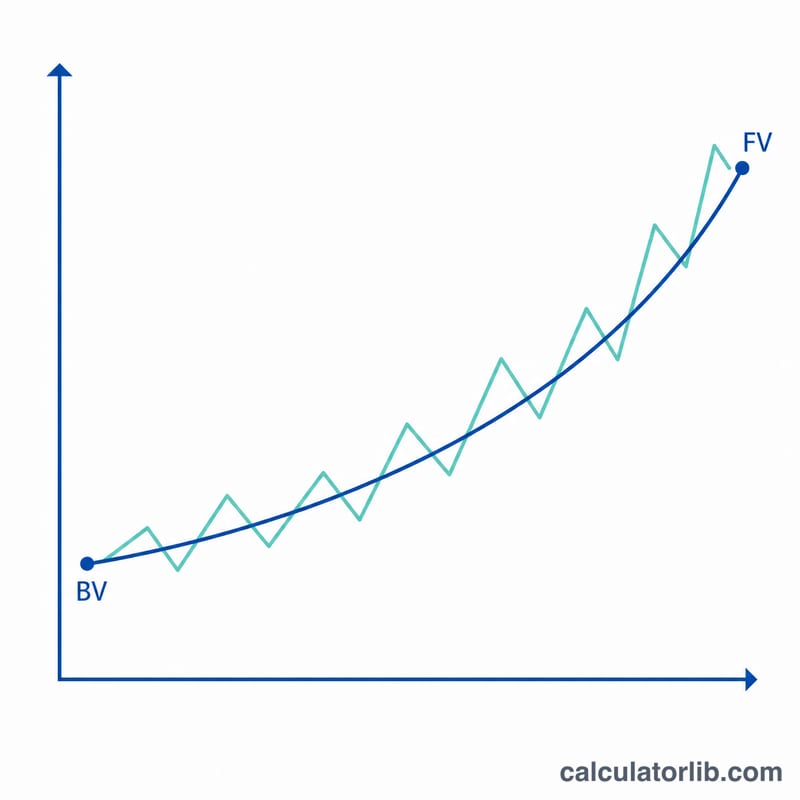
The Compound Annual Growth Rate (CAGR) is the constant year-over-year rate that would take an investment or business metric from its beginning value to its final value over a given time span. Unlike a simple average, CAGR smooths out the ups and downs of individual periods, giving a single annualized figure that makes different investments comparable. This tool is currency-agnostic, so it works for stock portfolios, revenue, users, or any quantity that grows by compounding.
How to use this calculator
Pick what you want to solve for: the CAGR percentage, the number of periods, the beginning value, or the final value. Then enter the three known quantities. If you measure time in something other than years, set the Period unit dropdown to Days, Weeks, Months, Quarters or Years. The calculator converts your period count to fractional years (t = periods / periods-per-year) because CAGR is always an annual rate. For example, 60 months and 5 years both normalize to t = 5.
The formula explained
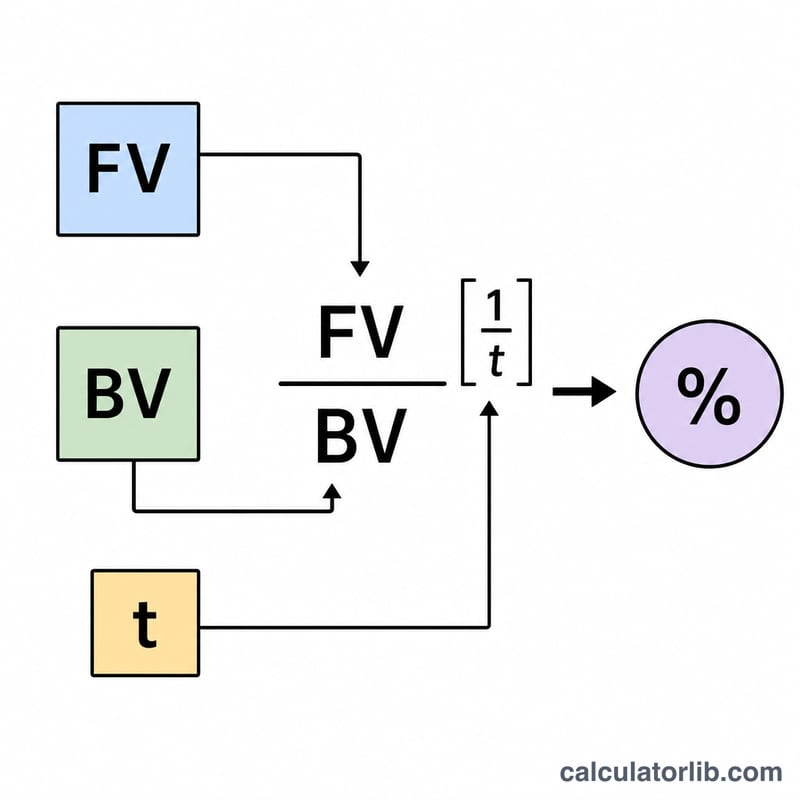
The core equation is CAGR = ((FV / BV)^(1/t) - 1) x 100, where FV is the final value, BV is the beginning value, and t is the number of years. Rearranged, the same relationship lets you solve for any variable: FV = BV x (1 + r)^t, BV = FV / (1 + r)^t, and t = ln(FV / BV) / ln(1 + r), where r = CAGR / 100. A negative CAGR simply means the value declined over the period.
Worked example
Suppose an investment grows from BV = 1,000 to FV = 2,000 over 5 years. CAGR = ((2000 / 1000)^(1/5) - 1) x 100 = (2^0.2 - 1) x 100 = (1.148698 - 1) x 100 = 14.87%. If instead you entered 60 Months, t = 60 / 12 = 5 years and the answer is identical.
Interpreting Your CAGR Result
CAGR is a smoothed annualized growth rate. It describes the single constant rate that would have carried the beginning value to the final value over the period, as if growth compounded evenly each year. Real investments rarely behave this smoothly.
- It is not your actual year-by-year return. An investment that gains 40% one year and loses 10% the next can have the same CAGR as one that grew at a steady pace. CAGR reports the end-to-end average effect, not the individual annual figures.
- It ignores volatility and intermediate fluctuations. CAGR uses only the first and last values. Any peaks, dips, or path the value took in between are invisible to the calculation, so two very different journeys can share an identical CAGR.
- Positive CAGR means the final value exceeds the beginning value — the investment grew on average over the period.
- Negative CAGR means the final value is below the beginning value — an average decline per period.
- Zero CAGR means the final value equals the beginning value — no net change over the full horizon, regardless of any rises and falls along the way.
- It does not account for contributions or withdrawals. CAGR assumes a single lump sum left untouched. If money was added or removed during the period, the simple BV-to-FV calculation will misstate the true investment performance, and a money-weighted measure is more appropriate.
This is general educational information about how the metric works, not financial advice.
Key Terms & Variables
- Beginning Value (BV)
- The starting amount at the first point in time — the initial investment, balance, or measured quantity.
- Final Value (FV)
- The ending amount at the last point in time, after all growth or decline over the period.
- Periods (t)
- The length of the time horizon. In the CAGR formula this is expressed in years; this calculator lets you enter days, weeks, months, quarters, or years and converts accordingly. CAGR is conventionally an annual rate.
- CAGR / rate (r)
- The compound annual growth rate — the constant per-year rate that links BV to FV: \(\text{CAGR} = \left( (FV/BV)^{1/t} - 1 \right) \times 100\).
- Compounding
- The effect of growth building on previous growth, so each year's gain is calculated on the accumulated total rather than only the original amount. CAGR inherently assumes compounding once per period.
- CAGR vs. arithmetic average return
- The arithmetic average simply adds the yearly returns and divides by the number of years. Because it ignores compounding and the order of returns, it is always greater than or equal to the CAGR (the geometric average) whenever returns vary; CAGR better reflects actual end wealth.
- CAGR vs. total return
- Total return is the overall percentage change from BV to FV across the whole period (e.g. 100% for a doubling). CAGR spreads that same total change evenly across each year, so a 100% total return over 5 years equals roughly a 14.87% CAGR.
FAQ
Why does CAGR differ from the average annual return? The arithmetic average ignores compounding and can overstate growth; CAGR reflects the actual compounded path.
Can CAGR be negative? Yes. If the final value is below the beginning value, the formula returns a negative percentage representing an annualized decline.
What if my beginning value is zero? CAGR is undefined when BV is 0 because FV/BV divides by zero. Both values must be greater than zero.