
What Is the GDP Growth Rate?
Gross Domestic Product (GDP) measures the total value of all goods and services produced by an economy over a period of time. The GDP growth rate expresses how much that output has changed from one period to the next, shown as a percentage. It is one of the most widely watched indicators of economic health: positive growth signals expansion, while negative growth can indicate a contraction or recession.
How to Use This Calculator
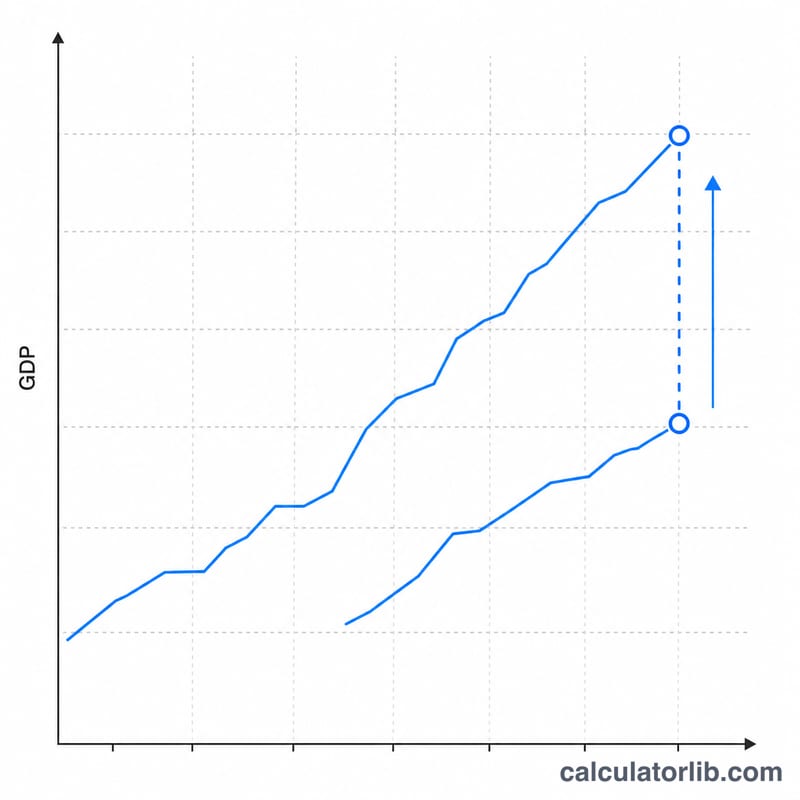
Enter the previous GDP (for example, last year's value) and the current GDP (the most recent value). The calculator returns the growth rate as a percentage along with the absolute change. The two GDP figures should be measured in the same units and ideally adjusted for inflation (real GDP) if you want to isolate true economic growth from price changes.
The Formula Explained
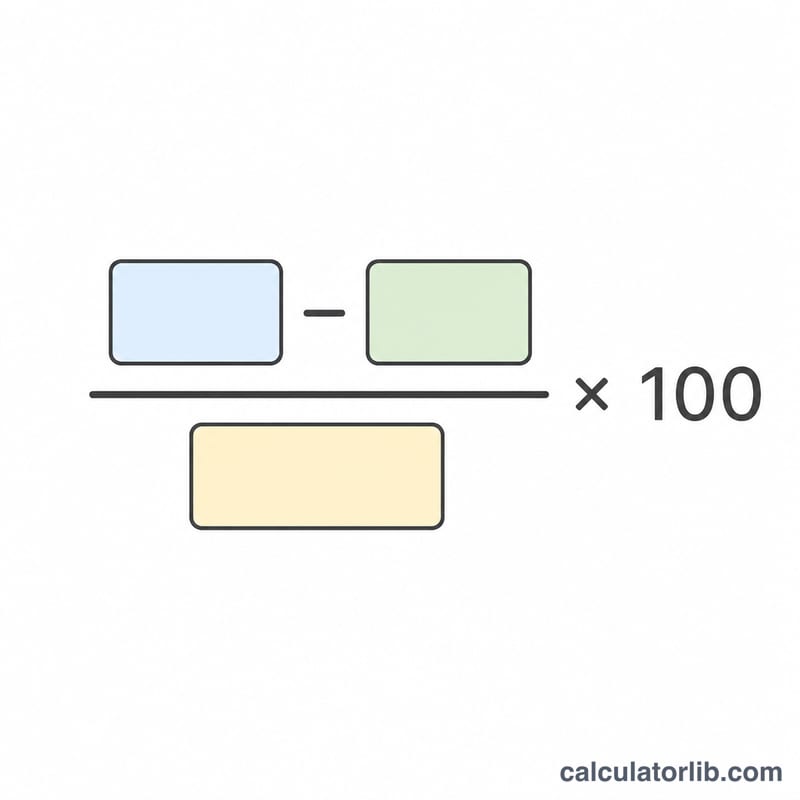
The growth rate is calculated as:
$$\text{GDP Growth Rate} = \frac{\text{Current GDP} - \text{Previous GDP}}{\text{Previous GDP}} \times 100\%$$You subtract the older value from the newer value to find the change, divide by the older value to express it as a proportion, then multiply by 100 to convert to a percentage.
Worked Example
Suppose a country's GDP was 20,000 (billion) last year and rose to 21,000 this year. The change is \(21{,}000 - 20{,}000 = 1{,}000\). Dividing by the previous GDP gives \(1{,}000 \div 20{,}000 = 0.05\), and multiplying by 100 yields a 5% growth rate.
FAQ
Should I use real or nominal GDP? Use real (inflation-adjusted) GDP to measure true economic growth; nominal GDP includes price increases.
What does a negative growth rate mean? It means the economy shrank over the period. Two consecutive quarters of negative growth are a common informal definition of recession.
Can I use this for quarterly data? Yes. Just enter two quarterly figures; the result is the growth between those two quarters (not annualized).